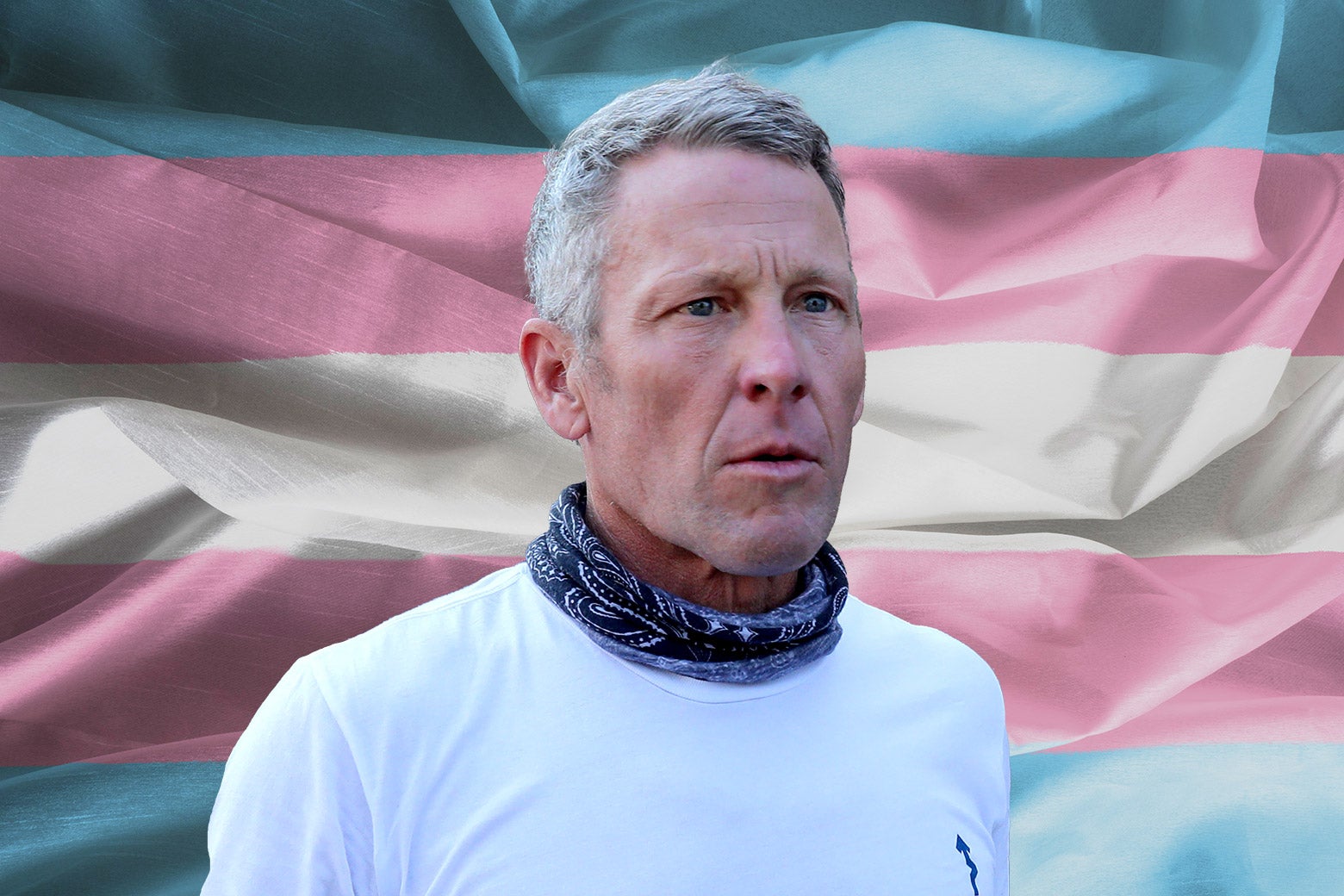
Lance Armstrong, one of the most famous cheaters in the history of sport, wants to have a talk about fairness in athletics. Armstrong says he is “uniquely positioned to have these conversations,” and that’s true, if not in the way he probably means it. The hypocrisy is the low-hanging fruit, though, and nobody should be so preoccupied with picking it that they forget to address a different, more insidious element of Armstrong’s self-indulgent new video series.
Armstrong has a handful of questions about transgender athletes, which he posed to the world on Sunday. The first one, which also has the shakiest premise, is worth chewing on: “Is there not a world in which one can be supportive of the transgender community and curious about the fairness of Trans athletes in sport yet not be labeled a transphobe or a bigot as we ask questions?”
The answer is yes. That world exists now. Scores of sports governing bodies are inquisitive about whether trans athletes, especially women, have any advantage over their cisgender competitors in women’s sports. They’ve spent considerable time investigating the subject, and in general, they have decided against all-out bans of trans competitors. The competitions tend to follow the guidance of scientists and geneticists, who are much less certain of trans athletes’ advantages than are various podcast hosts, conservative media icons, and disappointed parents of high school girls who finished a spot lower than they’d have preferred in a track meet. The woke mob, or whatever, has not burned these leagues down.
Armstrong is asking the wrong question, though. He’d like to know if a world exists—and it does—where someone could ask a question about fairness in competition and not be labeled transphobic. He has less apparent curiosity about why anyone who takes issue with trans participation might, in fact, get a label of bigotry. If he’d asked that question, the answer would be just as simple: Because a lot of the loudest questioners and protesters of trans women in sports are also preoccupied with shoving trans people out of every other conceivable corner of polite society, and they’re concocting arguments on the fly in order to relocate trans people to those margins. It’s a spectacular coincidence, or none of this is on the level.
Efforts to keep trans athletes off teams that align with their identity never happen in a vacuum. The Republican-controlled House of Representatives just passed a bill to force schools that receive federal money to place athletes on the team that matches their birth gender. The House was following the lead of many Republican-controlled states, which started pushing through similar laws a few years ago. The lawmakers’ passion for protecting women’s sports has frequently come with other priorities that have made it into their own (often successful) legislative pushes: making trans people pee where conservative lawmakers want, banning gender-affirming care for kids altogether while giving the state a window to take trans kids away from their parents, or, as part of a broader anti–LGBTQ+ buffet, trying to make drag shows illegal.
With trans people on their minds so much, these lawmakers could do a lot. They could do something about one of the most vile, embarrassing statistic sets in America, the one that shows that LGBTQ+ kids are several times more likely than their peers to consider suicide, and that trans kids are several times more likely to do so than gay cisgender kids within that group. The politicians spending their time on this issue have instead chosen to spend energy keeping trans athletes out of swimming pools.
The conservative political and media campaigns supporting these efforts have paid dividends. The vast majority of Americans, and even a slim majority of Democrats, now see trans participation in sports as Republican politicians do. Gallup said in May that 69 percent of the public thought trans athletes should play on teams that match their birth gender. That number rose 7 percentage points from a poll two years ago. Conservatives, for the moment, have a winning argument. They’ve convinced people that the issue is as simple as they say it is—that trans girls and women have an unfair advantage in competition—and in trans participation in sports, they’ve found an entry point to tout all manner of anti-trans policies.
The entire enterprise is bullshit, though. The people on the front lines of the media and political cause against trans athletes don’t care an ounce about the sports they claim to be saving. And it’s bullshit because the stalking horse that conservatives have used to mount their attack on trans athletes is a hollow concept of “fairness” that gets sparsely applied to anyone else. The motivation is disingenuous, the argument is bad, and the politicians and media members who target trans athletes are wasting your time.
For one example, take Clay Travis, a longtime sports media personality who now plays the role of a firebrand conservative talk-radio host with a huge show. Few people in the conservative media world, or anywhere else, have sounded louder alarms than Travis about the dangers of trans athletes. In 2022, he said that trans women would bring about nothing less than the extinction of women’s competition. “We are headed toward an era of male biological domination of women’s sports,” he said. “Women’s sports are under existential attack.” Insanity, Travis said, was sweeping the nation.
Travis sounds different when women’s sports are just sports, rather than ground zero of a culture war. If women’s sports did die out completely, Travis would see that as the loss of a second-rate product. “Men’s sports are better than women’s sports because men are the objectively better athletes,” he said. And if anyone wants to talk about women’s sports on their own terms, instead of as a setting to exclude trans people from, Travis again sounds different. He responded to a startlingly normal ESPN tweet about three great WNBA players by telling the network to stop its “descent into woke sports engineering.”
Travis is a fitting avatar for the conservative movement’s two-faced approach to the subject. The politicians who actually pass the laws aimed at trans athletes act, en masse, similarly. Many of them or their relatives and friends might have played women’s sports, but their actual political support for women’s sports has been rare. The NCAA, a body with at least theoretical athletic oversight of all of these lawmakers’ favorite college sports teams, has systematically shorted women’s sports for decades. Republican lawmakers have barely lifted a finger to help them since Title IX went into effect in 1972. (To be clear, Democratic politicians haven’t either, and have not been outright profiles in courage on trans inclusion.)
College and high school sports have hosted innumerable scandals centering around sexual violence and misconduct toward female athletes. Professional women’s sports have, too. Most do not even prompt glancing legislative efforts, and when they do, it’s an incredibly long slog to get anything done. If any women’s sports issue other than transgender athletes participating in them has kicked the entire Republican Party into overdrive for multiple years, then I’ve missed it. These are the people now bringing you the U.S. House’s so-called Protection of Women and Girls in Sports Act of 2023.
Even if the people leading this charge were not lying through their teeth about why they’re doing it, they would be making a shallow case. Proponents of keeping trans women out of women’s sports have portrayed the issue as one of fairness. Firebrands like Travis warn of sports anarchy if trans women can play. Steve Scalise, the Republican majority leader, called the House bill “an important, commonsense measure to protect the integrity and fairness of competition in women’s sports.”* No matter how inflamed the language, it always comes back to the point that seems to have found majority support: Trans women in sports aren’t fair.
The people making that argument with the most confidence are selling themselves, and the rest of us, a bill of goods. The issue isn’t settled, in large part because there aren’t that many trans women playing women’s sports, so scientists have not accrued mountains of data about them over many years. Some studies find an advantage. Some do not. And so, so many actual experts have cautioned that we just don’t know. Armstrong also asked: “Do we yet know the answers? And do we even want to know the answers?” And again, the answers to Armstrong are obvious: No, we don’t know. And yes, of course we want to know. But for the time being, maybe it’s best not to bar trans women based on a hunch that, at most, is backed only by disputed data. Such restraint might be especially prudent when the hunch is held by people who have a hobby of advocating for laws that make trans lives harder. And while we sort all of this out, maybe it’s also best for men in the stands at track meets not to interrogate the gender of 9-year-olds who are competing against their grandkids.
Fairness, though, is a funny idea. For most athletes, it means not breaking the rules. Don’t electronically steal signs and bang on a trash can to tell hitters what’s coming. Don’t deflate footballs too much. Don’t take a shortcut during a marathon. Don’t put this specific performance-enhancing drug in your body.
What fairness doesn’t mean, at least for most athletes, is that they have to regulate who they are to make their competitors more comfortable. While I’m not aware of any trans athletes clobbering their peers in a way that becomes YouTube fodder for generations, it’s worth considering cisgender cases of exactly that. After all, plenty of cis athletes do have enormous, easily visible physical advantages over their peers—gaps that are so big that no amount of protein shakes or dead lifts could possibly close them. Nobody asked if Derrick Henry, the future all-pro NFL running back, was OK to be there when he was built like a midsize sedan and running over future accountants on Florida high school fields. Nobody asked that of Zion Williamson, the No. 1 NBA draft pick, when regular-sized middle schoolers in South Carolina scampered around, trying to “guard” him. Nobody asked that of Michael Phelps, whose parents might as well have designed him at the Gold Medalist Genetics Build-a-Baby Store.
It wasn’t “fair” when these outlier athletes came up in their sports competing against regular civilians, or even against tremendous amateur athletes. Henry was so strong and so fast that he was an unequivocal safety hazard, even more than the typical running back, for anyone who tried to tackle him. Nobody told him to get off the field, no matter how immense the differences between him and the unlucky kids in his way.
Armstrong should think about why a more typically matched trans girl at a swim meet, or on a soccer field, should be any different. He should consider if her presence is really unfair, or if a well-organized coalition has just said it enough times that more people have started to believe it. He should consider whether the people who don’t want her there see her as anything more than another battle in a multifront fight against trans inclusion. And if that trans girl who just wants to play sports and feel like herself has become a battering ram to be wielded against other trans people, then it’s not just disgraced former cycling champions who need to stand in the doorway.
Correction, June 28, 2023: This article originally misidentified Steve Scalise as the House Republican whip.