This year’s Olympic Games saw no greater tragedy than Imane Khelif’s. The Algerian boxer should have been globally feted for her gold medal win, one of just three medals her country took home from Paris. Instead, she became the target of a right-wing smear campaign that falsely claimed she was a man or transgender.
Khelif was assigned female at birth, was raised as a girl, and has competed as a woman, against other women, for the entirety of her athletic career. But anti-trans opportunists seized on a statement from a discredited, corrupt sports organization that accused Khelif of having abnormal biological markers for her gender. The bullying went on for weeks, driven by social media posts from Donald Trump, Elon Musk, J.K. Rowling, right-wing leaders from across Europe, and dozens of conservative commentators.
It was a shameful display of cruelty that tarnished an otherwise triumphant competition for Khelif. Mid-Olympics, when she should have been reveling in each win, talking to reporters about her training regimen and history-making ascent, she was defending her gender to a press scrum while holding back tears.
That Khelif was robbed of unsullied victory this summer has made it all the more thrilling to watch her embark on a celebratory victory tour this fall. Since the Paris Games, Khelif has been featured on the cover of Vogue Arabia, posed for a moody photo shoot with Le Monde, and appeared as a guest at the Bottega Veneta show during Milan Fashion Week. In photos and interviews, she exudes grace and defiance, claiming for herself a space in the public narrative that has been overcrowded with her detractors.
Khelif is creating an image exclusive to her—one that finds the tough core at the center of classic glamour. The photo spreads feature her wearing bold, oversize silhouettes in colorful leather and snakeskin, striking commanding poses in garments traditionally considered menswear. Broad-shouldered suit jackets, sturdy belts, slicked-back hair, stiff upright collars—it’s a look of self-possession and control, and of certainty of one’s place in the world.
It doesn’t read as a rebuke to Khelif’s harassers so much as a denial of their significance. The sense of power she projects makes them seem powerless by comparison: They’re preoccupied with imaginary tales about a 25-year-old Algerian they’ve never met. She’s winning gold and looking like a superstar.
Still, it’s impossible to absorb these images without thinking about the way anti-trans advocates seized on Khelif’s appearance to propel their campaign against her. They shared photos of Khelif’s body and face, arguing that she was too masculine to be eligible for a women’s sporting event. In one of Trump’s final ads before the presidential election, a narrator lamented the Biden era, a time when “men could beat up women and win medals,” over a slow-motion close-up of Khelif in the Olympic boxing ring.
While that ad was airing in the U.S., people across the world were paging through photo shoots that celebrate Khelif for all the things right-wing influencers mock. The strong facial features held up as evidence that Khelif is secretly a man? Turns out they compose the striking bone structure of a high-fashion model. The purportedly suspicious machismo in her body language? It’s swagger. It’s magnetic. It’s a photographer’s dream—and it would kill on the runway.
There is a bit of a feminist social stigma around applauding someone for something they cannot choose or control, like their jawline or body type. But when a person’s looks are specifically targeted for global humiliation, it can feel like a necessary corrective to find reason to praise them. So it is deeply satisfying, for those of us disturbed by Khelif’s persecution, to see her face, physique, and gender presentation exalted for their uncommon beauty, especially in clothing that does not attempt to contradict the anti-trans right by making belabored overtures to femininity.
Khelif does not care much for interviews; her entourage told Le Monde that she “speaks the language of boxing.” But she spoke to the reporter anyway—she was “intimidating,” he wrote—and discussed this year’s harassment with passion and clarity. “These people like Donald Trump or Elon Musk, they don’t know me, any more than I know them,” she said. “Based on unverified information, they attacked a young girl who was just there to realize her dream.” Reliving those painful weeks may seem to Khelif the price she must pay for media exposure that could boost her career. There is an irony at the center of her story: Though she has made history—she is the first Arab woman and African woman to win gold in boxing—she might not have risen to international recognition if not for the people who chose to make her an avatar of their transgender bogeyman.
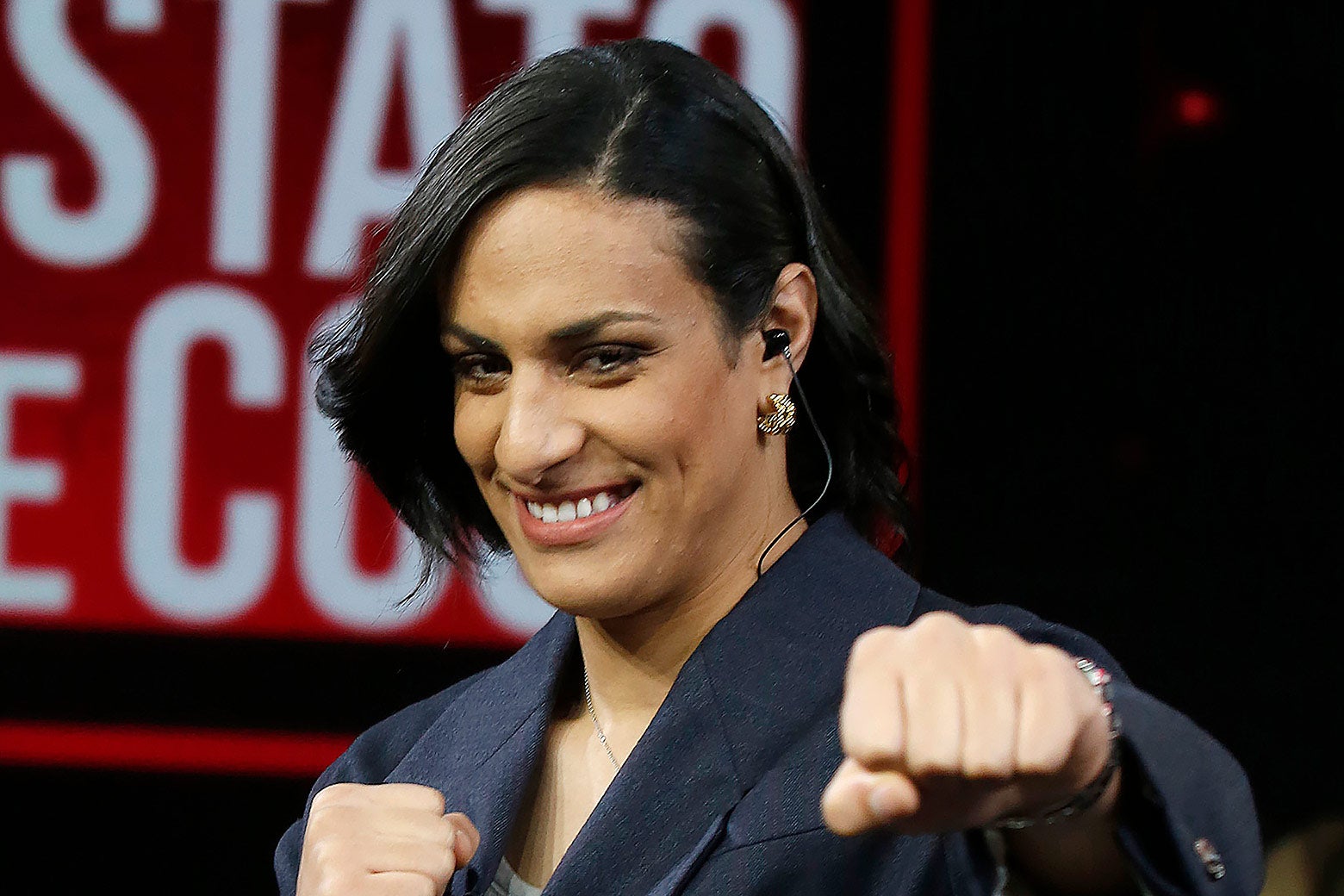
Despite her discomfort with some elements of the press tour, Khelif seems to be enjoying parts of it. A series of images from her Vogue Arabia shoot depict her sparring with the camera, throwing playful punches with a grin on her face. In a video the magazine made of Khelif’s time at Milan Fashion Week, she seems affable and game, amused by the spectacle, and above all, comfortable in her skin—or, at least, comfortable in the sumptuous suede of her mustard-yellow Bottega Veneta shacket.
As she should be. Khelif has never been discouraged by those who’ve told her she didn’t belong. Before she became one of the best boxers in the world, she grew up in a conservative, rural town where boys made fun of her for excelling at soccer. She had to sell scrap metal to pay for buses to boxing classes, and neighbors admonished her father because her athletic ambitions subverted cultural norms. Her road to Olympic gold—and now luxury fashion spreads—has been littered with obstacles that many of her competitors have never had to confront.
The image of Khelif now emerging is that of a full, multifaceted person, not the caricature of conservatives or a one-note champion of Olympic glory. In one arresting photo from the Le Monde shoot, she stares down the camera from behind a lustrous leather collar, at once provoking and inviting. In the look on her face, there is the tenacity of a woman who has risen above her bullies since childhood—and, also, the fragility of a young person still finding her footing in the public eye. As leaders of the global right continue to use Khelif’s likeness to advance their repressive agendas, she will need to draw on that strength. I hope she can keep that softness too.