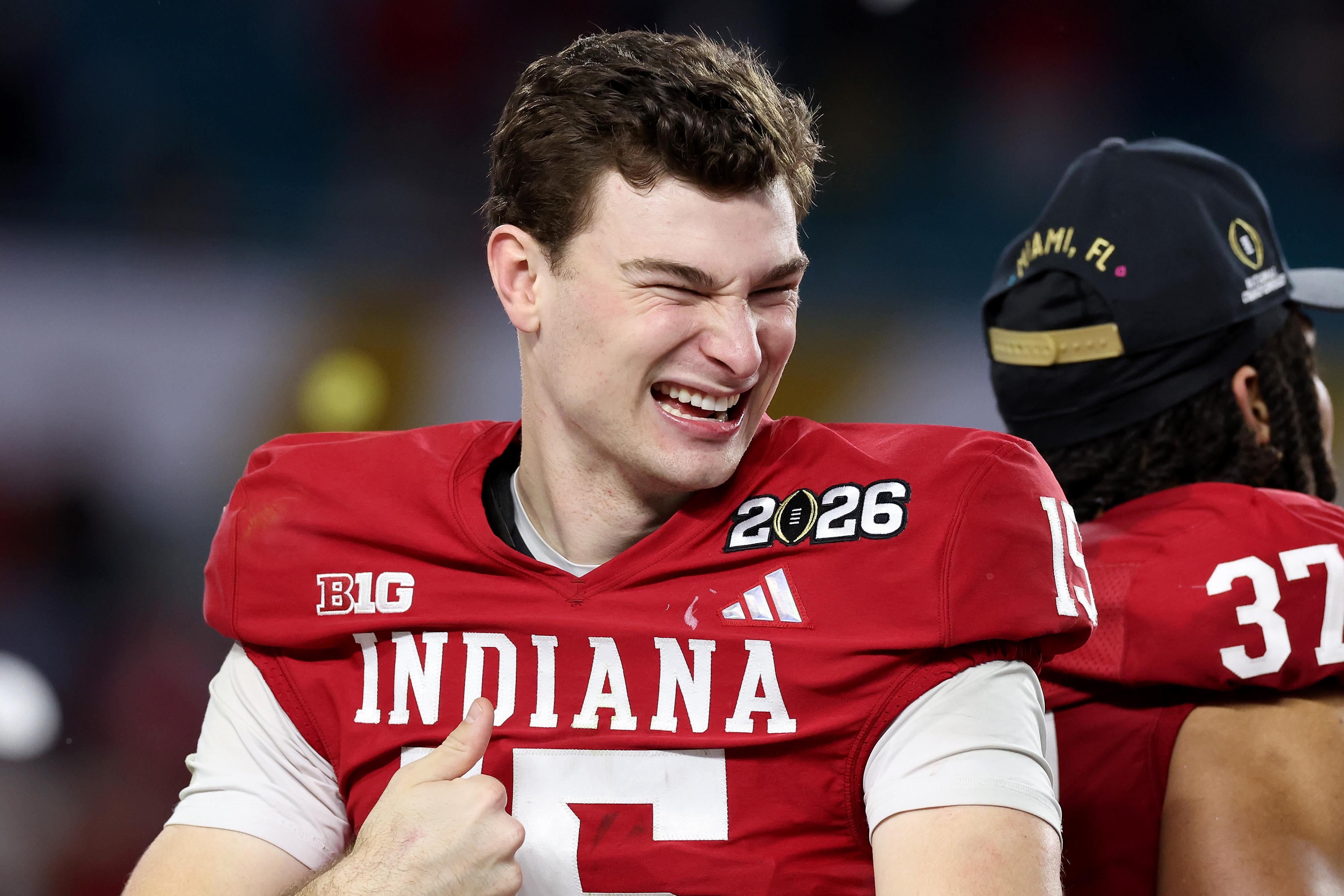
Indiana is the national champion. That’s a sentence that once made a lot of sense when the topic at hand was basketball and has recently made sense a few times when it was soccer. But even if you were locked in on the Hoosiers’ rise the past two seasons in football, you may find yourself reading that sentence back to yourself a few times to make sure it’s not a chatbot hallucination. Indeed, this is the world now. The Hoosiers just became the first 16–0 major college football team since Yale in 1894.
At least this time it wasn’t easy. Indiana’s 27–21 win over Miami on Monday came down to the last minute, when Hurricanes quarterback Carson Beck underthrew a pass and Indiana’s Jamari Sharpe intercepted it. The Hurricanes were playing in their own stadium, trying to bury a quarter century of mediocrity since the days when the U ruled the sport. In the end, they were a bit player in someone else’s drama, but they did play the part well. That the Hoosiers would have to scratch and claw for victory was narratively appropriate as a capper to the greatest two-year turnaround in the history of college football and quite possibly all of sports. Indiana’s College Football Playoff quarterfinal win over Alabama and semifinal romp over Oregon were by a combined score of 94–25. If a team was going to kick a century of being terrible and win the whole damned thing, it didn’t feel right that it would do it with three blowouts in a row.
The Indiana football story is a great one. It’s also one that a lot of people have gotten wrong, or at least fudged by overindexing on the easiest things to spot. The 2025 Hoosiers were a creation of the new college sports economy, in which players get paid and can freely bounce from one school to another. But they were just as much the result of some of the most old-school tricks in the college football book. Indiana just fielded one of the small handful of greatest teams ever, and it did it by blending modernity and tradition in an unprecedented—and probably unreplicable—fashion.
This would not be happening if not for this new college sports economy. Before you could just pay players, Indiana was a basketball school that did not care to pay much of anyone when it came to football. Until 2011, the program’s head coach was making well under a million bucks a year. But in 2024, Indiana hired a new head coach, Curt Cignetti, who had won a metric ton of games at James Madison and, before that, at Elon and Division II Indiana University of Pennsylvania. Cignetti, 64, explained to people in his first few weeks in Bloomington that his pitch to get players to join the program was “It’s simple. I win. Google me.” Indiana was under the (correct) impression that if it did not start to take football seriously, it could be left behind whenever college sports next realigned in a further consolidation of rich-school power. Indiana’s once great men’s basketball program wouldn’t solve that even if it stopped underachieving.
So Indiana invested in football, first making the playoff as first-round fodder in 2024, then building a war machine in 2025. This was the first season of schools being allowed to directly pay players, by way of a settlement that rearranged college athletics’ financial structure. Indiana spent up to the roughly $20.5 million department-wide spending cap and piled on some additional dollars via third-party supporters who passed the hat. I’ve been told that Indiana’s roster this season cost in the vicinity of $25 million.
That is a lot of money, but it’s not college football warlord money. As Indiana ascended this year, other teams’ fan bases could comprehend only the flattest possible understanding of the Indiana story. “All it took was Mark Cuban buying the entire roster,” noted one person on social media on Monday. The IU-alum billionaire did indeed start cutting checks to Indiana this season, but that didn’t get the Hoosiers close to the top of the sport. A few teams, including the Ohio State squad that IU beat to win the Big Ten Championship, are widely thought to have spent north of $30 million on their teams. Cuban’s relationship with Indiana is not anything like what Nike founder Phil Knight has with his alma mater, Oregon. Indiana hadn’t won a bowl game since 1991 and had made a fair case as the worst major program in the country over a 125-year history by the time Cignetti arrived. A school with a huge alumni base merely decided it was tired of that and got the right people in the door to execute a new vision.
Indiana’s roster budget was the price of contention. But to put together a team that one could reasonably argue is the greatest in college football history, Indiana had to outplay its own finances. The Hoosiers were able to do that because Cignetti, their head coach, is a prodigious evaluator and program-builder who can stretch a dollar like few others. A big handful of Indiana’s best players were with Cignetti at James Madison, where he coached a Football Championship Subdivision power, then led the Dukes on their transition to FBS, the top half of Division I. Edge rusher Mikail Kamara, linebacker Aiden Fisher, and cornerback D’Angelo Ponds were arguably the three best players on Indiana’s defense. Cignetti found all of them while at the lower level (and even found Elijah Sarratt out of a Division II school that has since dropped to Division III). Kamara blocked a punt on Monday that led to a recovery for a touchdown, the decisive play in what was otherwise an even, back-and-forth contest.
Cignetti’s ability to identify talent and allocate a roster budget stems from his time as a Division II head coach at IUP. He left a job as Nick Saban’s recruiting coordinator at Alabama to take that job in 2011, desperate to become a head coach somewhere after not getting looks elsewhere. He has turned out to be a master of that craft, even when his recruiting targets are more high-profile than those JMU players he brought with him. Indiana’s Heisman Trophy–winning quarterback Fernando Mendoza came over from Cal last offseason. Mendoza was a sought-after and proven player, but there isn’t a serious person in the universe who thought he would be the most outstanding player in the country this year. Cignetti thought he could be, and the Indiana staff helped Mendoza transform into a potential No. 1 NFL draft pick.
A significant advantage for Cignetti and Indiana has been their continuity. While other programs that enjoy this sort of meteoric rise would be liable to lose their assistant coaches to head-coaching opportunities, Indiana so far has not. Both of the team’s coordinators have been with Cignetti for about a decade, going back several rungs on the small-school ladder. Cignetti’s father was a college football coach who, while head coach at West Virginia, was once treated for cancer, an affliction that Cignetti has said he believes came from stress. Cignetti talks often about Indiana’s light practice loads and about how his assistant coaches get time to see their spouses. That environment has helped Indiana avoid the kind of brain drain that has hobbled many great programs, like Dabo Swinney’s Clemson and even Saban’s Alabama. (Offensive coordinator Mike Shanahan made a few brilliant calls in crunch time on Monday.)
Athletic directors who aspire to greatness are, of course, looking at Cignetti and wondering how they might unearth their own version of him. For a good start, they should be open-minded toward hiring coaches who have piled up wins at lower levels. Football is football, after all. All the better if that coach appears to set a good culture and talented people seem to enjoy working for him. But the Cignetti–Indiana story is so blessed by timing that most imitators won’t just disappoint—they’ll fall flat.
Cignetti’s Division II experience from a decade ago gave him the ideal apprenticeship in spreading around dollars efficiently, as DII teams need to allocate partial scholarships around the roster. He arrived at Indiana right as that kind of management was fresh and new for every major program in the country. He arrived at the outset of the 12-team playoff format, enabling 2024’s Indiana team to build major momentum when it made a token playoff appearance as the No. 10 seed and quickly lost to Notre Dame. (In another year, Indiana would’ve made a prestigious but lower-profile bowl game, denying the program lots of publicity and fundraising momentum.) Cignetti even had the benefit of showing up at a moment when the NCAA’s eligibility rules were falling apart, allowing teams to load up on fifth- and sixth-year players who would otherwise need to sign up for Linkedin. By age, the Hoosiers are not far from being an NFL team. You’d be hard-pressed to find a more favorable set of circumstances for a turnaround.
All of which makes this a singular moment in the sport. The Indiana football program still has the third most losses of any team in FBS history, and I’m not sensing that Northwestern or Wake Forest is all that close to hanging a championship banner. Maybe, though. College football was a static sport for a long time. The last year a team won its program’s first national title was 1996, when the Florida Gators did it. A new economic structure will create new first-time champs on a quicker timeline than that going forward. It will just never, ever yield a two-year flip job like the one Indiana just put on.