Sign up for the Slatest to get the most insightful analysis, criticism, and advice out there, delivered to your inbox daily.
In her early 20s, Sherrinford Holmes began to discover that she can’t stand the feeling of being confined to any point on the gender spectrum, whether it’s woman—which she said is how most people perceive her—man, or genderfluid. She likened the sensation to feeling weighed down by hotel bed sheets or blankets when she would prefer to kick them loose.
“It feels restricting,” said Holmes, now 33. “It feels suffocating.”
Holmes presents as mostly femme, but that’s not a reflection of how she sees herself; practically speaking, it’s about which clothes are made for her body and what feels most comfortable.
“Most of the time, gender’s not even on my radar,” Holmes said. “There’s so much else to do in my life. I have dishes that are piled up to the roof. I have to finish 16 other projects. My work just went crazy. You want me to think about gender today?”
About five years ago, Canton Winer, a Northern Illinois University professor who researches gender and sexuality, was beginning to interview dozens of people for a study about asexuality (defined as experiencing little or no sexual attraction), a main research interest of his. He asked each participant to describe their gender identity. Almost everyone gave him a definite answer, but when Winer probed deeper by asking about how accurate whichever label they provided felt to them, about a third of people seemed to distance themselves from the initial answers they had given him. So in a paper published earlier this year in the journal Socius, he coined a new term to describe the phenomenon he noticed: gender detachment.
“We kind of operate with this common sense that, well, everyone has a gender identity,” Winer said. “But I think this finding shows us that that’s not necessarily true.”
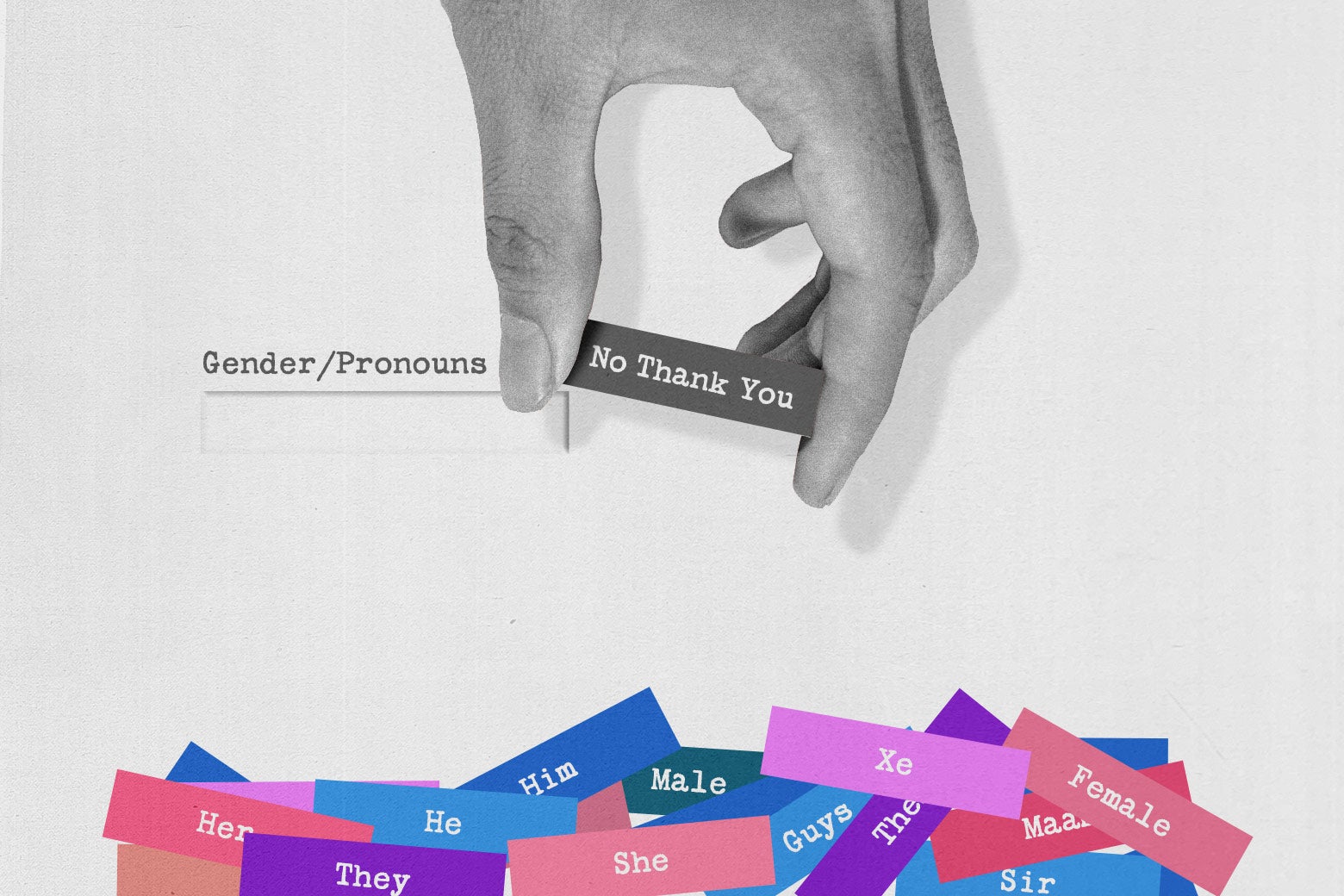
The gender-detached people Winer spoke to, one of whom supplied her gender as “meh,” identified as asexual. In the same way asexuality for some can feel like a lack of a sexual orientation, rather than an orientation of its own representing no sexual attraction, Winer’s interviewees were essentially articulating to him a lack of gender identity. He summarized some of his respondents’ answers to him thus: “The concept of having a gender that I identify with feels inaccurate, uncomfortable, unnecessary, irrelevant to me,” he said. “I think actually that a lot of people who say that they’re agender probably feel that way about gender, but we don’t really live in a world that gives us the option to say, ‘Well, my gender is no thank you.’ ”
When Winer first floated the term gender detachment by Holmes and other participants in his research, it resonated with many of them, but, like many gender-and-sexuality-related labels, there’s some squishiness in its application. For Holmes, gender detachment is synonymous with the more established term agender, which to her expresses that fact that on any given day she does not think at all about gender as it relates to her own identity. Yet for another interviewee of Winer’s, Bob O’Boyle, gender detachment feels distinct and more accurate for his own identity than agender, which he describes as “gender-agnostic.” Usually O’Boyle, 43, tells people his gender is “ostensibly male” or “male-adjacent.”
Gender detachment instantly clicked for O’Boyle, who said he has never been able to wrap his head around the archetypical male experience. He said masculinity can even feel “very shallow” to him. Gender detachment, he said, “is an excellent way to describe how I have always felt about my relationship to gender.”
Winer himself described a similar feeling toward masculinity, though his personal relationship to gender wasn’t something he had thought to interrogate personally before undertaking this line of research.
“I found myself thinking maybe I’m not very attached to my gender identity either,” Winer said. “I don’t have a trans experience of the world because I don’t feel like, well, I have some other gender identity that’s different from my assigned gender at birth that feels accurate to me, but at the same time, there are elements of manhood that give me the ick.”
In his paper, Winer wrote about compulsory gender in much the same way asexual people and others have come to understand compulsory sexuality, or the idea that all people experience sexual attraction, and that to not do so is somehow “wrong” or dysfunctional.
“When you’re asexual, I think you already have to question some norms about society,” Winer said. “I think that can lead you to question various other things about the social world that we’re also told, ‘This is universal, this is true, everyone experiences this.’ It makes a lot of sense that gender would be one of those things that people might start to question, because gender and sexuality are so deeply intertwined with one another.”
Gender detachment and asexuality don’t go hand in hand for everyone; it’s not unusual to identify with one term and not the other. But there is something to the idea that people who opt out of one social construct—like gender or sexuality—are more likely to consider whether they might like to also opt out of others. Writers like Angela Chen, who authored the 2020 book Ace: What Asexuality Reveals About Desire, Society, and the Meaning of Sex, have in recent years been exploring how people on the ace spectrum use that identity as a means of reevaluating their relationships to other societal norms.
One person’s choice to detach themselves from a gender identity (or sexuality, for that matter) isn’t meant as a demand that the rest of us must follow suit, Holmes stressed. “Me choosing to opt out doesn’t mean you have to,” she said. “I’m not trying to force you to be something different.”
Already, Winer is hearing from fellow academics that gender detachment is a useful term, one they are incorporating into their own research. Meanwhile, he wants to keep exploring the concept, including how gender detachment may resonate with people who do not identify as asexual. He thinks there’s a lot society can learn from gender-detached people.
“Gender shouldn’t be some heavy obligation that we feel we have to carry with us,” Winer said. “Gender’s something that we can enjoy. Gender’s something that we can pleasure in. And if it’s not something that you’re finding pleasure in, you actually don’t have an obligation to continue engaging with it.”
In the face of the second Trump administration’s constant attacks on queer and trans rights, work like Winer’s is crucial to maintain and expand our vocabularies, and to articulate more ways of thinking about gender diversity. If we have the precise words to describe how we identify (or detach from identification altogether if we so choose), we can continue pushing back against the gender binary and the societal constructs that accompany it. And hopefully, we can find some measure of freedom in the space we’re able to open up.