Sign up for the Slatest to get the most insightful analysis, criticism, and advice out there, delivered to your inbox daily.
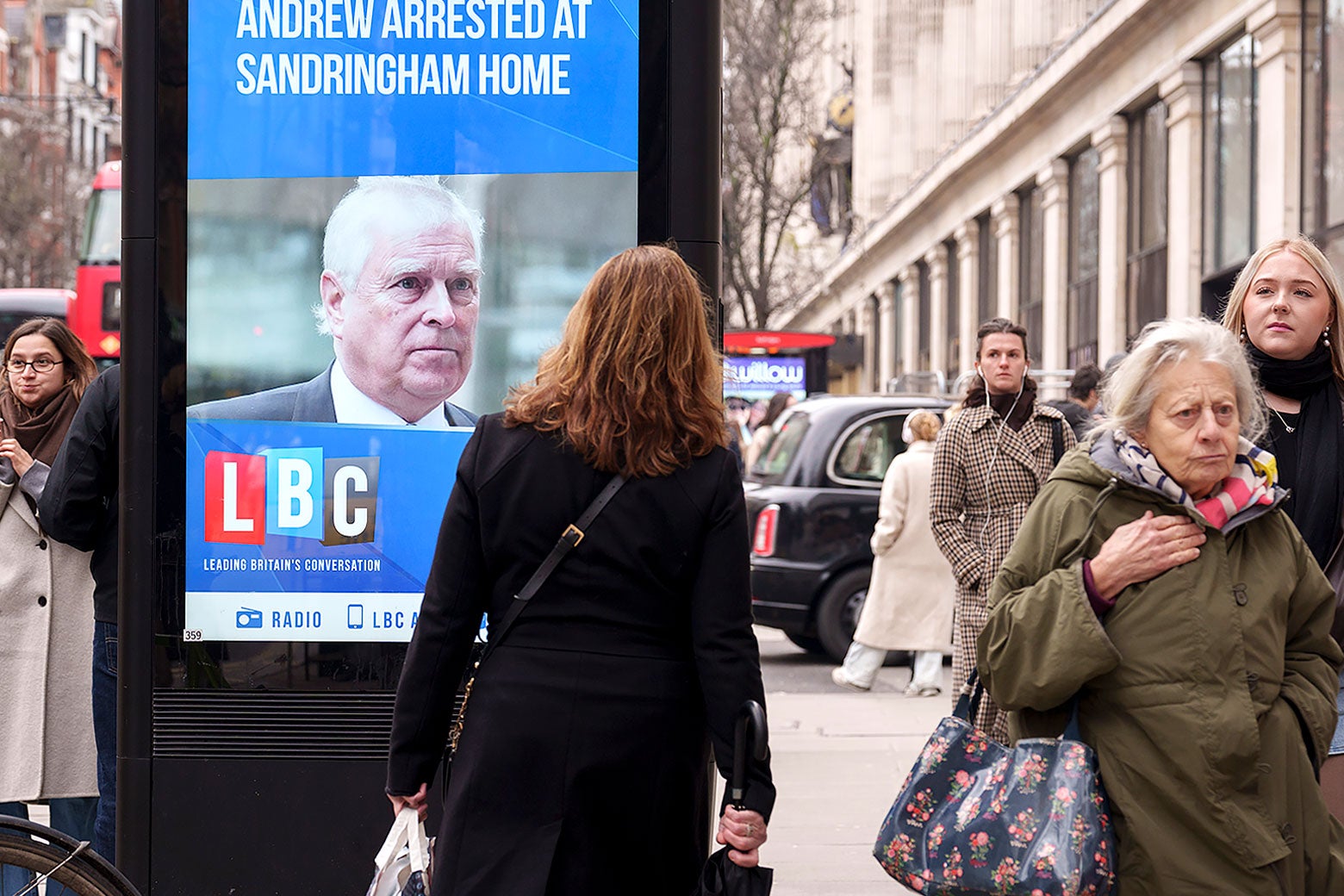
Andrew Mountbatten-Windsor has not been having a very happy birthday. At 8 a.m. local time today, police officers arrived at the Sandringham Estate in Norfolk, where he has been laying low after being ousted from Royal Lodge and stripped of his prince title late last year, to arrest him. This is—as so many things that have happened to the once-prince Andrew in recent years are—unprecedented. To find something equivalent, you have to go back to King Charles I’s arrest in 1647, which ultimately led to his execution, a repeat of which seems a little too much to hope for.
The arrest comes after a fortnight or so of increased noise across U.K. politics about what consequences Andrew ought to face in relation to the millions of new Epstein files released by the U.S. Department of Justice in late January. Former Prime Minister Gordon Brown, for instance, wrote an op-ed for the New Statesman magazine urging police to interview Andrew in relation to the alleged trafficking of girls by Jeffrey Epstein through London’s Stansted Airport.
And now, somewhat surprisingly, given how few people have been arrested in connection with the Epstein files, Andrew has in fact been taken into custody. Not for anything to do with sex trafficking, nor any of the many other sexual misconduct allegations that have been levied against Andrew, but on suspicion of misconduct in public office. The official definition of this crime is “serious wilful abuse or neglect of the power or responsibilities of the public office held,” according to the Crown Prosecution Service (Crown as in acting on behalf of his own brother, the king. Sorry but it is delicious.) The specific accusation is that Andrew sent confidential trade reports to Epstein in 2010 when he was Britain’s special envoy for international trade, which the new tranche of Epstein files allegedly show him doing. Some of those files appear to show that Andrew forwarded government reports about visits to China, Singapore, and Vietnam to Epstein, as well as information on gold and uranium investment opportunities linked to the reconstruction of Helmand province in Afghanistan. This would have been, to use the proper parlance, massively illegal. The maximum sentence this offense carries is life imprisonment.
So Andrew Mountbatten-Windsor is spending his 66th birthday being interviewed by police. It’s difficult not to feel a certain amount of schadenfreude about the idea of Andrew in a police holding cell, his mansion replaced by a cot and corner toilet. As much as nobody would like to find themselves in that position, it will certainly carry an extra sting for a man like Andrew, whose belief in his God-given superiority over other, lesser mortals has been a lifelong calling card. I’m sure it is also not much fun for him that King Charles, as well as William and Kate, have immediately issued statements in full support of the police investigation. “Let me state clearly: The law must take its course,” Charles said. And many happy returns.
From here three things could happen: Either the police will decide that they have enough to charge him with a criminal offense now, or they will drop the matter altogether, or they will release him within 24 hours and continue their inquiries while he stews at home. The latter is most likely. And although he is only currently arrested on suspicion of public office misconduct—and it is no doubt frustrating to many that it’s this alleged wrongdoing he’s seeing consequences for, rather than the accusations of sex crimes—there may well be more to come here. Thames Valley Police have previously said that they were reviewing allegations that a woman was trafficked to the U.K. by Epstein for the purposes of a sexual encounter with Andrew, and at present nine separate police forces are investigating Epstein’s U.K. links, including those that relate to Andrew.
It’s unlikely that these latest Andrew developments will result in major consequences for the status of the royal family in Britain. All told, Andrew’s arrest is probably good for the solidity of the monarchy. The king expressing his approval of a police investigation into his own brother is a means of demonstrating that, now, at least, they are “on our side,” rather than striving to protect one of their own. But the mood today in the U.K. is one of glee, frankly. I think most people here entertained little faith that Andrew would be subject to serious legal consequences for his alleged wrongdoing, and it has stuck in the nation’s craw that getting stripped of his royal titles might be the only punishment Andrew would face. Happily, it seems we may have been too pessimistic. One hopes that there are other high-profile figures in countries beginning with a U who appear in the Epstein files who are reading this news today and starting to realize that being above the law may have its limits.