Sign up for the Slatest to get the most insightful analysis, criticism, and advice out there, delivered to your inbox daily.
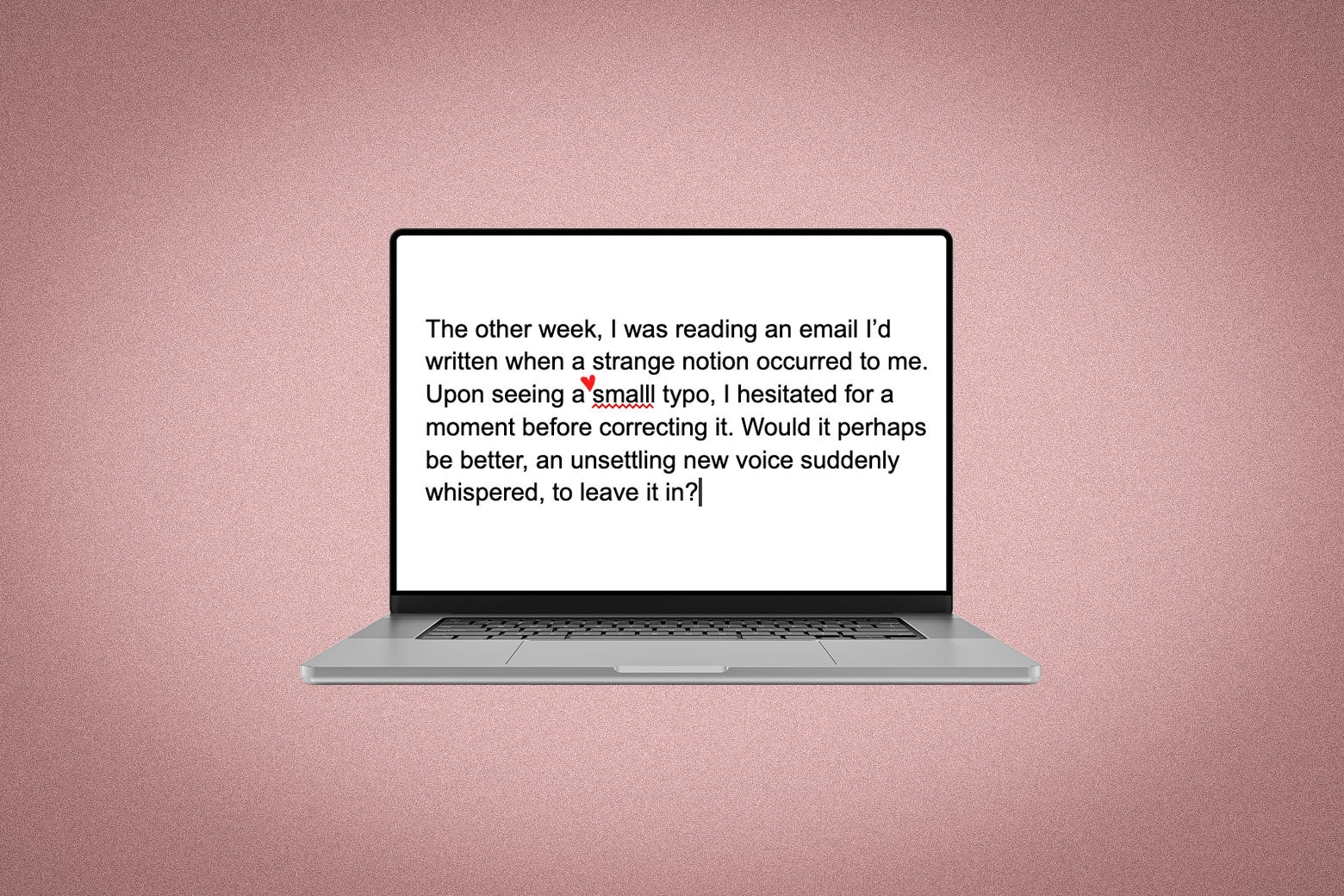
The other week, I was reading an email I’d written when a strange notion occurred to me. Upon seeing a small typo, I hesitated for a moment before correcting it. Would it perhaps be better, an unsettling new voice suddenly whispered, to leave it in?
This is a thought that would’ve appalled me a year ago. As a professional writer, I have long prided myself on impeccable grammar, judiciously wielded punctuation, and (at times indulgent) verbosity. But in the age of A.I. paranoia—when the comment sections of social media posts and online articles are littered with accusations decrying the dehumanizing warp of ChatGPT—suddenly, writing that appears too polished, too bedecked with literary devices, not to mention a dubious affinity for the word delve, now arouses suspicion.
In personal communications, I began to experience a newfound self-consciousness. Was that em dash really necessary? Was the voice perhaps a little impersonal? It went the other way too; any writing I encountered digitally was now subject to the same interrogation. Was there something about it that felt just a little bit uncanny? A little bit … ChatGPT?
And I’m not alone. A collective paranoia has people purging so-called A.I. tells from their prose, even if they penned it entirely with their human brains. Along with the now-infamous em dash, many are renouncing words for which ChatGPT is known to have a mysterious penchant, such as delve, nestled, boast, and meticulous. The structural device “It’s not just X, it’s Y”—now considered a flashing A.I. warning sign—is being surrendered en masse.
Describing his oversensitive “AI radar,” University of Illinois English professor John Gallagher said he had found himself convinced an academic article had been penned by A.I.—before realizing that it was published in 2019, predating the ChatGPT boom. Across different media, senses sharpened by TikToks detailing the latest “tells,” A.I. inquisitors are ready to pounce. “Writing online in 2025 feels like performing keyhole surgery while people scream ‘ROBOT! ROBOT! ROBOT!’ into your ear,” writer and coder Jack McNamara wrote recently of the phenomenon on Medium.
A growing number of people are forgoing formal writing conventions altogether for an unadulterated stream of consciousness—anything to preserve and insist upon their humanity. But as A.I. continues to improve, are we destined to lose this linguistic arms race? And are we at risk of sacrificing good writing along the way?
An unlikely consequence of all this has been the elevation of the once embarrassing typo. Until recently considered a sign of carelessness or even stupidity, the error is now seen by some to be the indelible fingerprint of a human wordsmith. Writer and entrepreneur Thomas Smith told me that although he refuses to sacrifice the em dash, these days he is inclined to leave typos in his Medium posts because he believes they’re a reassuring sign of human authorship. His audience seems to agree. Readers used to email Smith to point out minor typos. They’ve begun to add “But maybe you want to keep it in,” he says with a laugh.
Content strategist Larissa McCarty, whose role involves ghostwriting on LinkedIn, has undergone a similar shift in thinking. She told me she’s now heartened to encounter a light speckling of human error in copy and would go so far as to advise professionals to leave small mistakes in public posts to emphasize their authenticity.
Smith, who is also a part-time copywriter, says brands have requested he jettison all em dashes from his work, due to fears that anything that “looks like A.I.” could result in a downgrade from Google’s opaque SEO ranking system. Meanwhile, lists of “ChatGPT words to avoid” circulate in web publishing communities, and advice on how not to sound like a chatbot abounds on LinkedIn, TikTok, and Reddit.
Worryingly, this can have the effect of undermining otherwise strong writing. Some of the supposed tells are simply well-established writing conventions that ChatGPT was trained to ape: things like “lists of three examples” or the use of transition words like however.
“I know that there are techniques and methods to make your writing more engaging, but that’s also what ChatGPT uses,” said McCarty. “When I’m typing something up, I’m like, Oh, that’s a good idea for how to word that. But then, in the back of my mind, I’m like, It’s almost too good.” She now avoids writing her own metaphors, for example, because she thinks that this is something ChatGPT excels at.
An inherent suspicion of good writing is probably anathema to producing good writing. Although reflecting more deeply on how we write isn’t necessarily bad, this A.I.–fueled self-censorship has the potential to be corrosive. As with much of the ChatGPT fallout, students were among the first to encounter this A.I. paradox: where polished, proficient prose is demanded but can also raise suspicion, whether produced with the help of a chatbot or not.
A recent academic paper from a Hult International Business School researcher on this inherent tension noted that Montclair State University had instructed faculty to view good grammar as suspect. “A.I.-written essays tend to be atypically correct in grammar, usage, and editing,” the school had advised staff.
This all stems from a broader stigma around the use of A.I. For all the industry hype whirling around the technology, a growing number of academic papers highlight the phenomenon of “A.I. shaming.”
A 2025 Duke University study found that professionals believed that colleagues would consider them lazier and less competent if they used A.I., making them unlikely to disclose its use. This anticipated social penalty was real.
This is because, in contrast to older workplace productivity tools like Excel, generative A.I. isn’t seen as requiring specialized skills, Jessica Reif, the lead author of the study and a Ph.D. candidate at Duke’s Fuqua School of Business, told me. But even as we resist it, there are signs that our efforts to outrun ChatGPT’s incursion are doomed. While we might pluck “ChatGPT words” from our prose, there is evidence that A.I.’s empty lexicon is lodging itself somewhere more intimate: in our minds. A 2025 study from researchers at the Max Planck Institute for Human Development determined that podcasters and YouTubers have lately been parroting A.I.’s favorite words, including delve. This trend took off after the launch of ChatGPT and holds even for spontaneous, unscripted conversations.
What’s more, our tool bag of A.I. tells is likely to be only “transiently useful,” says Daphne Ippolito, an assistant computer science professor at Carnegie Mellon University. “Companies are constantly revising the recipes for their training data, so all of these trends are going to change,” she said.
Even as A.I. promises to improve, not everyone is fearful of the future. Smith has enjoyed seeing fellow writers embrace more personalized, stream-of-consciousness-style prose in recent months, with some even joking they can now get away without rigorous editing.
The imperatives of SEO are what helped popularize a slick and impersonal style in the first place, Smith points out. “Certainly, algorithms always elevated that kind of stuff.” He thinks the future will be about “trying to share ideas rather than worrying about form.”
And rather than undiscerningly scouring ChatGPT tics from our prose, we can use them as cues to introspect. Gallagher, the English professor, wrote that he has tried to reduce his reliance on lists, not just to avoid sounding like ChatGPT “but also to be diligent about my word choice.”
As for me, I couldn’t quite bring myself to leave a typo in that email. But the next time it happens organically, I don’t think it’ll bother me as much as it once would have.