
On a sultry July night in Austin, Texas, comedian Jo Ellis passed through a black partition, unhooked a blood-red microphone at center stage, and told a packed club that after coming out as transgender in 2023, she became insecure about her voice. Sheets of blond hair draped her face; cowboy boots were strapped around her pale blue jeans. When she opened her mouth, Ellis did, indeed, display a timbre in the nascent stages of feminization. The sold-out Texas crowd, sauced well beyond their two-drink minimum, turned apprehensive, coiled for a fight.
Ellis was performing on Kill Tony, one of the most popular stand-up shows in America, with 2.4 million subscribers on YouTube, and also the absolute crucible of the art form’s anti-woke, MAGA-curious revolution. It’s hard to imagine an environment more intimidating for a trans performer. The show has featured far-right panelists like Tucker Carlson, Alex Jones, and Kid Rock; the comedians are given carte blanche over a whole dictionary of slurs and stereotypes —“retard” especially, but “faggot” and the N-word are also resurrected with victorious spirit.
Tony Hinchcliffe, the show’s creator and central star, is best known for a crude joke he made about Puerto Ricans at a Trump rally in New York City, one of the rare moments of breakthrough rebuke for the Trump campaign. This Texas night, he was seated just a few feet away on stage, clearly ready to pounce on any vulnerability in Ellis’ routine.
Kill Tony is part stand-up showcase, part public shaming rite. If the show has an animating principle, it’s that no topic is off-limits, and that established taboos—particularly the idea that someone could ever be upset at a comedy show—are terribly outdated. Performers who make it on the bill are guaranteed to be lambasted by Hinchcliffe, and the flambéing invariably homes in on the comic’s most immediately observable qualities. Racial identities, sexual orientations, and physical disabilities are all in bounds. And yet, Kill Tony has become so firmly entrenched in the stand-up ecosystem that people are moving across the country, leaving their jobs, and sleeping in their cars for the chance to be thrown into the fire, fully aware of what they might encounter on stage. It’s not hard to see why: Survive the beatdown—brandish your thick skin—and you might become a star. But if you bomb? Your humiliation will be disseminated far and wide, bringing your stand-up career to a screeching halt.
Ellis, like so many before her, was gambling on success. She glided toward the punch line: “I’m always self-conscious about my voice. I figured it’d give me away. But men I’ve been with lately actually said it’s my dick.” Laughter thundered. The tension dissipated. Now they were on her side.
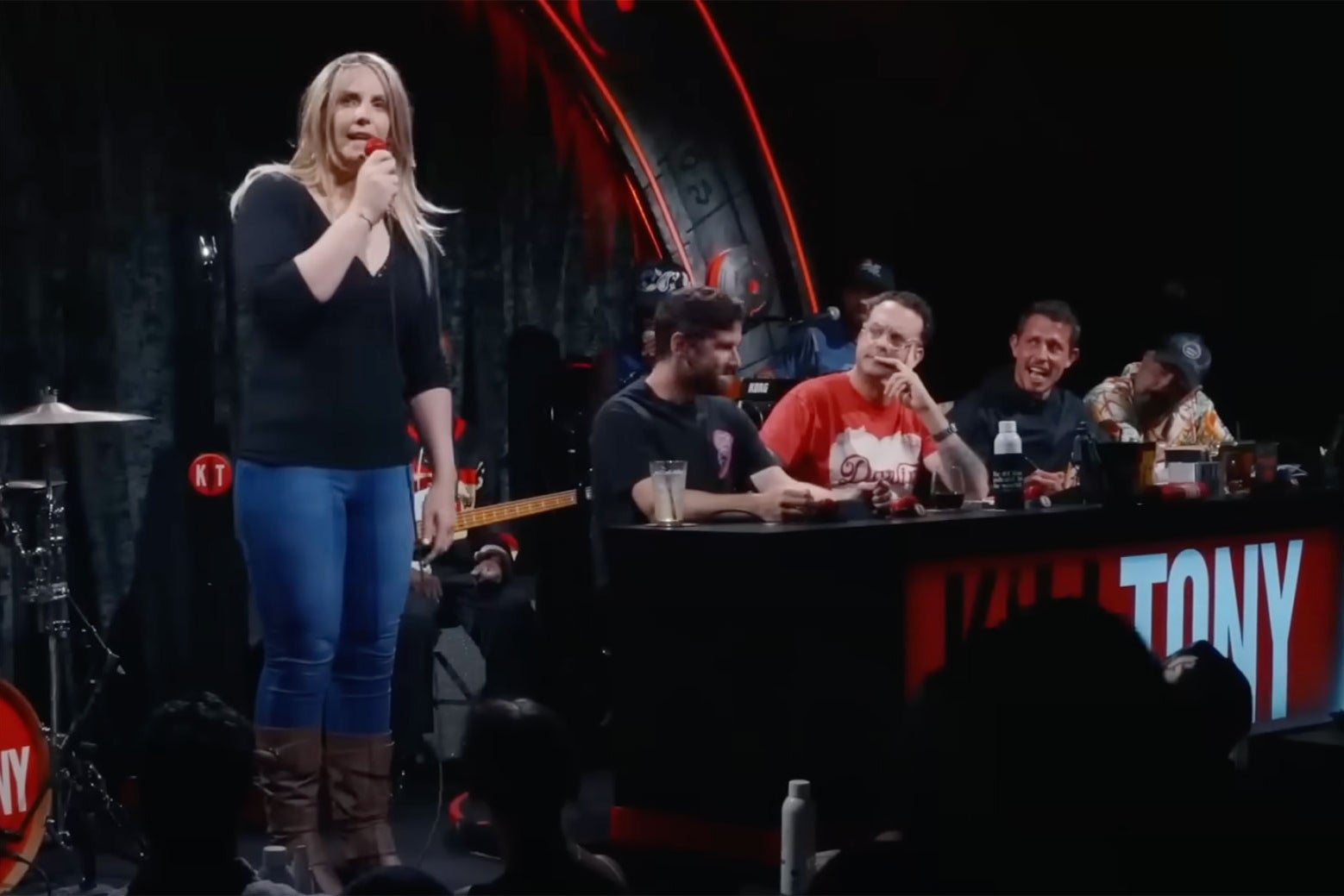
Three days after her performance, back home in Virginia, Ellis, 35, outlined her master plan. “I want to infiltrate the Austin comedy scene,” she told me. “I’m going to use everything in my tool belt to appeal to an audience that’s not hearing my story.” There is no liberal artifice in her approach. Despite her transness, Ellis does not detect much daylight between herself and the millions of red-blooded Americans who tune in to Kill Tony every week. She thought Hinchcliffe’s Puerto Rico joke was hilarious, she loves the Joe Rogan Experience podcast, she believes Democrats overreached dramatically during the 2020 COVID lockdowns, and while she’s no fan of Donald Trump—her 16-year career in the military just came to an end due to his anti-trans decree for the armed forces—she is also fed up by wokeness.
In other words, Ellis was the exact sort of person I kept running into when I traveled to Austin and witnessed the cultural realignment emanating out of the nation’s hottest comedy show. Regardless of their political or social affiliations, the comedians here were completely unhindered by any constraints on comedy imposed by any rapidly decaying orthodoxy. And no matter what they see or hear or are subjected to—and I saw some gnarly scenes in Austin—Kill Tony is where they feel most at home.
Kill Tony’s entrée into mainstream consciousness occurred at the height of the 2024 presidential cycle, and in retrospect, its rise symbolized the final extinction of the Obama–Biden social order. The show functions like a demented open mic: Every week, a legion of amateur stand-ups flock to the Comedy Mothership, a club in downtown Austin owned by Joe Rogan, and sign up for a chance to perform on the Kill Tony bill. Their names are written on slips of paper and mixed into a bucket on stage. Hinchcliffe, who serves as the emcee, pulls out one of those names, and the “lucky” comic selected is given a chance to perform a one-minute set in front of the packed house and the millions more watching online. After their time is up, the comic is interviewed by Hinchcliffe and receives a parting gift. Most can expect a Kill Tony–branded joke book as proof that they didn’t embarrass themselves, but on rare occasions—when a guest truly kills—Hinchcliffe hands out a Golden Ticket, guaranteeing the beneficiary a chance to perform another minute on the show whenever they want.
The influence Kill Tony wields is undeniable. In an increasingly fragmented comedy environment, where traditional gatekeepers like the late-night TV circuit are in free fall, Kill Tony represents one of the only opportunities available for an up-and-coming stand-up to capture a national audience. Episodes of the show garner more than 2 million views on YouTube, and when Kill Tony goes on the road, it sells out some of the most famous buildings on the planet. (Weeks before I visited Austin, Kill Tony had traveled to London’s O2 arena.)
Doing well on the program can be genuinely life-changing. Kam Patterson, an affable storyteller with a thick Florida accent, was working on a golf course when he first passed through the Mothership in 2023. He crushed his set. Two years and 500,000 Instagram followers later, Deadline reported that he’d be joining the cast of the upcoming Kevin Hart comedy 72 Hours. Meanwhile, Casey Rocket, one of stand-up’s brightest young stars, was living in his car when he moved to Austin. After becoming a routine player on Kill Tony, he’s now amid a nationwide tour. Ari Matti, a 33-year-old from Estonia who impressed Hinchcliffe enough to become a regular on the show, made his Netflix debut earlier this year.
On the other end of the spectrum, bombing on Kill Tony can leave a burgeoning comedy career in tatters. For every Patterson, there are scores more overmatched stand-ups who crack under the immense pressure of the moment. Punch lines are botched, pacing is muffed, flop sweat beads on foreheads, and those 60 seconds begin to feel like an eternity as the Mothership fills with icy, acrimonious silence. Hinchcliffe smells blood in the water. The post-set interview morphs into a brutal hazing. The subject then slinks back through the enveloping curtains at the rear of the stage, smarting from an unrecoverable psychic wound broadcast for the whole world to see.
“That was the worst moment of my life,” said Stephanie Robertson, a comedian who turned in an excruciating Kill Tony minute, in an interview with the A Dose of Reality podcast. “We all bomb in comedy, but everyone has access to my bomb. I was like, ‘My life is over. I’ve humiliated myself.’ ”
It is, without a doubt, a compelling format. The show has no vetting process for people who throw their hat in the ring—literally anyone can be selected to deliver a minute-long set. Tune in, and you’ll witness tiresome mediocrities, nightclub hacks, the legitimately unhinged, and the occasional flash of talent, all hoping to turn themselves into stars. The results are uncomfortably human, undeniably hilarious, and lately, increasingly polarized to the right. The brand’s biggest stars are often the ones who push this envelope the furthest. Kill Tony regular David Lucas opened his own comedy special with an extended riff about beating women. Another mainstay, Hans Kim, is currently on a tour titled “All Racism and Transphobia.” If cancel culture is dead, then Kill Tony dances on its grave.
Hinchcliffe, who declined to be interviewed for this story, is singularly emblematic of that shift. After moving to Los Angeles from his native Ohio in 2007 and sharpening his brusque style at the Comedy Store, the 41-year-old made career-altering friendships with Joe Rogan and Jeff Ross, both of whom made Hinchcliffe their opening act. A few years later, Hinchcliffe broke into the writer’s room for the Comedy Central broadcasts of roasts of Rob Lowe, Justin Bieber, and James Franco, and in 2013, started Kill Tony. (At the time, the show was called Hinchcliffe’s Notes, and operated more like a sincere workshop to help up-and-coming comics get better.)
Kill Tony picked up steam, and after he relocated to Austin in 2021, Hinchcliffe faced a few foundational cancellations of his own. The inciting incident occurred during a stand-up show shortly after Hinchcliffe moved. A Chinese American comic named Peng Dang was wrapping up his set and introduced Hinchcliffe to the crowd. Without missing a beat, Hinchcliffe grabbed the microphone and called Dang, among other things, a “filthy little fucking chink.” Dang, clearly insulted, posted the clip to his Twitter account. It went viral, and Hinchcliffe suffered the professional fallout standard in the Biden years. His agency dropped him, his shows were canceled, and Kill Tony’s previous home base—the historic blues venue Antone’s—evicted the brand from its weekly slot.
But unlike other comedians who’ve been admonished for a racist punch line, Hinchcliffe refused to ask for forgiveness from Dang. Instead, he doubled down. Two years later, talking about the backlash on the right-leaning YouTube podcast Triggernometry, Hinchcliffe referred to Dang as a “Chinese spy,” and facetiously speculated that the entire controversy was orchestrated by the Chinese Communist Party.
“I knew that what I had done was not wrong. It wasn’t even the worst thing I did that week,” he would later add in an interview with Variety. “It was so dumbfounding to me because it was a joke, and my stance is that comedians should never apologize for a joke.”
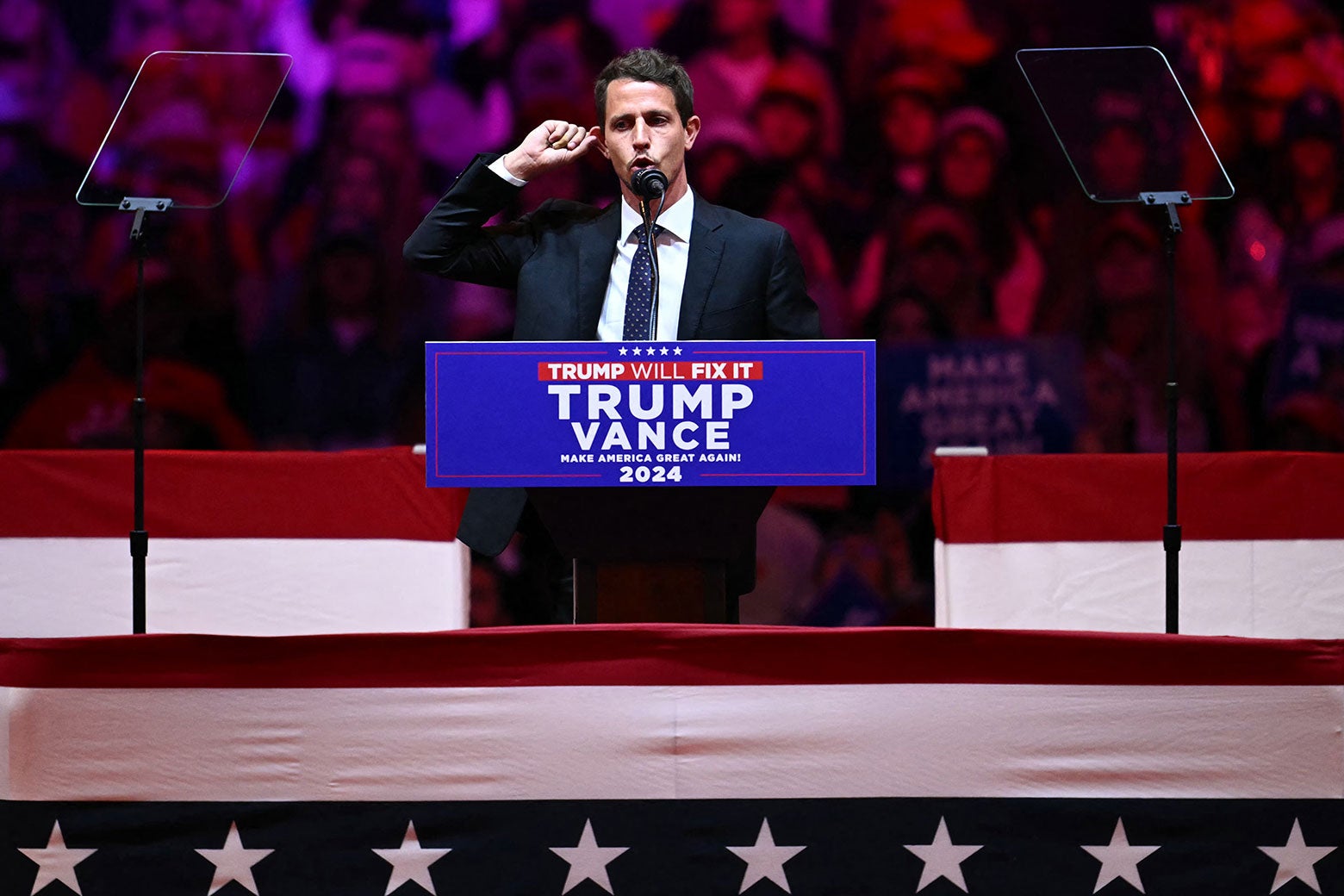
Naturally, in 2024, when the Trump campaign sought out disaffected vulgarians to mold into the overarching MAGA project, the comedian’s act—edgy, provocative, and vividly red-pilled—fit the bill perfectly. That is how he found himself warming up that Madison Square Garden rally, weeks before the election, with defiantly reactionary material. Hinchcliffe had jokes implying Jews are stingy and Arabs are primeval. He claimed to have “carved a watermelon” for Halloween with a Black friend. And, most infamously, he referred to Puerto Rico as a “floating island of garbage.” That last barb snapped a trip wire in the news media. At the zenith of a high-stakes election, Hinchcliffe became a household name. Democrats hoped that such a bigoted insult might push away Hispanic voters, who seemed increasingly open to Trump. For a moment, it seemed like that was in the cards. Veritable A-listers, like Bad Bunny and LeBron James, felt the need to denounce Hinchcliffe. Aubrey Plaza called the joke “disgusting.” So did Jennifer Lopez. Even the Trump campaign, perpetually obstinate, seemed spooked that Hinchcliffe might have inadvertently breathed new life into the doomed Harris coalition. “I have no idea who he is,” the president said about Hinchcliffe, in an interview with Sean Hannity. “Never saw him, never heard of him, and don’t want to hear of him.”
And yet, just a week later, those appeals to identity proved to be hopelessly anemic. Trump claimed the election with a broad coalition. Hinchcliffe celebrated by tweeting out a story from Axios. It reported that 46 percent of America’s Latino voters pulled the lever for the president-elect.
When the election dust settled, it became clear that the controversy had the opposite of the effect that Democrats had hoped for. The Puerto Rico debacle, and Trump’s subsequent victory, elevated Kill Tony into previously untapped echelons of pop culture. Four months after the Madison Square Garden rally, Netflix announced a partnership with the brand. A two-hour production—Kill Tony: Kill or Be Killed—debuted on the platform in April, and Hinchcliffe himself will be getting his own stand-up special later this year. The entertainment industry that once cast out Hinchcliffe has now, in the second Trump administration, proven to be almost entirely pliable to the show’s whims. In Austin, I wanted to get to know the people who have made Hinchcliffe the most powerful comedian in America. They didn’t look like I thought they would.
A few hours before showtime, with the sun boiling overhead, Kill Tony hopefuls ambled around Shakespeare’s, a two-story tavern adjacent to the Mothership that serves as the show’s makeshift greenroom. More than 200 comics were applying for that week’s episode, and all of them followed the exact same procedure. After signing a waiver and dropping their name in the bucket, they’d nurse a couple of gin-and-sodas while waiting to see if Hinchcliffe summoned them onto the Kill Tony main stage. The applicants ranged from giddy-drunk bachelor-party tagalongs signing up on a lark to open-mic habitués hunting down a long-awaited big break. Mike Gleeson, a 45-year-old from Chicago, told me he moved to Austin two months ago with the specific intention of getting on Kill Tony.
“I needed to find my audience, and I feel like this is my audience,” he said. Gleeson believed Chicago was too sanitized for the jokes he wanted to tell. So, here he is in Austin—a city, he asserted, more aligned with his tastes. Currently, he is living in a trailer park.
“Every other aspect of comedy shoves out those edgy voices. It’s more mainstream, everyone wants to get on TV,” Gleeson continued. “I had no interest in getting on The Tonight Show. I think Kill Tony is better than The Tonight Show.”
Most of the comedians in Shakespeare’s share some version of Gleeson’s story. Austin was always home to a robust comedy milieu, but historically speaking, the circuit was far more boutique and homegrown in comparison to the epicenters of New York and Los Angeles. That began to change after the pandemic. When Rogan opened the Mothership in 2022—Kill Tony took up residence a year later—the city evolved into a legitimate stand-up hotbed. The streets billowed with enterprising young comics. Almost everyone I spoke to at Shakespeare’s had moved to the city within the last two years, and none of them feel bound by the threshold of offense shaped by Austin’s previous generation of entertainers.
“It was night and day after COVID. You could immediately tell who was new. They were all young. They had all moved here from Iowa or whatever. And they all had a trans joke. All of them. It was like a signifier for them,” said Brian Gaar, a longtime Austin stand-up who also edits the Texas news outlet The Barbed Wire. “We could tell immediately who was here to get on Kill Tony. It’s a bunch of kids in their 20s trying to impress a bunch of dudes in their 40s.”
This disruption can be disorienting to watch. One of the comedians vying for a spot on the Kill Tony bill was Juan Denmark, a 31-year-old who flew to Austin from Portland and had already appeared on the show twice before. Denmark is Black, and he had spent much of his time on Kill Tony joking about race in a deliberately boundary-pushing way. During his most recent minute, he commented that Asian people would have made for better slaves because you could fit “five times as many of those motherfuckers under that boat.”
The evening prior, I had caught Denmark’s set at the Creek and the Cave, a formerly New York–based club that relocated to the city after the lockdown, and, like the Mothership, now boasts a reputation for red-pilled comedy. It was a roast night: Patrons and fellow performers alike were given free rein to heckle anyone on stage, and were encouraged to do so with as much taboo-breaking velocity as possible. So, when Denmark was called to the mic, he gamely chuckled through the jabs that ricocheted across the room. Most of the jokes remained fairly tame. (Denmark was wearing denim overalls. One comic called him the “Super Mario Brotha.”) But toward the end of the set, someone said, “Let’s get back to the basics”—and proceeded to call Denmark a “fucking n—r.” Hard R. That was the entire punch line.
The club then highlighted a white woman in the audience, implying she was behind the remark. (It was, according to the club, actually a male comic who it said is Sudanese.)* A flutter of laughs passed through the room. None of the patrons seemed especially taken aback. The roast night chugged along, business as usual. If Denmark was at all repulsed, he refused to show it—which is the price of admission in this crowd.
“That’s awesome dude. I come here for that,” he told me the following afternoon. “I live for honesty and transparency. I just want to see Americans be themselves, authentically.”
This is one of the golden rules on Kill Tony. The comics pulled from the bucket will be treated with the exact opposite of careful reverence, and everything about them is fair game. “I expected that my first appearance would be absorbed in how I looked, and that I was going to get played with like a toy,” said Jacob Barr, a comedian from Michigan who landed on Kill Tony last summer. Barr was born with a congenital disorder that caused him to have short forearms and malformed hands. During his interview with Hinchcliffe, Kill Tony’s longtime producer, Brian Redban, piped in the sound of a squealing dolphin. “It’s a humiliation ritual,” Barr continued. “My parents hated it—they did not like it.” But would Barr appear on the show in the future? No question. The exposure led to more bookings, and with them, and a faint pathway to a full-time career in comedy. If his name is ever pulled again, however, Barr hopes to deliver a “more technical” minute—one that isn’t completely overshadowed by the way he looks.
“It’s a weird experience,” Barr said. “I’m trying to be a stand-up, but I’m also trying to be a person.”
Other comics who signed up for the show relish the chance to be gawked at. Leaning against the balcony upstairs at Shakespeare’s was Karen Jones, a grandmother who told me that she has signed up for Kill Tony every week, except for the 90 days she was in jail. Why was Jones locked up? “Jan. 6,” she replied.
Jones had been on the show five times now, and it has transformed her into something of a folk hero in the Kill Tony universe. “People come up to get autographs a lot. It’s made me be able to laugh in the face of those who besmirched and defamed me,” she said. (She appreciates the pardon she received from Donald Trump, but won’t feel totally exonerated until, in her words, it comes to light that “Antifa” was behind Jan. 6.)
Jones is not an especially accomplished stand-up, and when she rolls up to Kill Tony, it can be difficult to determine if the audience is laughing with her or at her. That’s often the case: The show might be positioned as a meritocracy, but given Hinchcliffe’s roast-comic tendencies, it’s no surprise it occasionally transforms into something far more mean-spirited. There’s no better example than a recent episode filmed at Nashville’s Bridgestone Arena, where Hinchcliffe invited four previous Golden Ticket winners to the stage and pitted them against each other in a Hunger Games–style battle royale. The quartet was asked to perform a minute of comedy each—whoever delivered the best jokes would earn a spot on an upcoming Kill Tony date at Madison Square Garden, while the unlucky comic who came in last would be banned from the show for six months. The loser was Drew Nickens, a stand-up who has been open about a brain injury he sustained while serving in the military, which left him with a variety of speech disorders. When the laughs didn’t materialize and his fate was sealed, Nickens looked to be on the brink of tears in front of a stadium’s worth of people. Hinchcliffe asked him what was wrong. Nickens glumly responded, “It is what it is.”
Stunts like these are why some veteran stand-ups find themselves wondering if Kill Tony is less of a comedy exposition and more of a vindictive freak show. “There is a visible throughline here back to shows like Opie & Anthony,” said James Adomian, a hard-left comedian who has recorded reams of material skewering red-assed conservatives and milquetoast liberals alike. Adomian is referring to the wave of shock-jock talk radio shows that ruled the roost in the 1990s and early 2000s, all of which he described as “occasionally funny, but mostly just offensive.” His comparison makes even more sense when you recall how Howard Stern—before his latter-day ideological turn—routinely featured a troupe of personalities known as the “Wack Pack,” all of whom were named for a specific abnormality they had. (There was Hank the Angry Drunken Dwarf, Crackhead Bob, and, of course, Gary the Retard.) Stern exposed them from coast to coast. They, too, became famous. But at what cost?
Leyla Ingalls, a 26-year-old from Ohio, has asked herself a similar question. She flexed an uncommonly wry delivery during her star-making set on Kill Tony. (“It’s like being one of those little green aliens from Toy Story getting pulled out by the claw machine,” she said, describing the sensation of getting selected for the show.) Ingalls doesn’t have any visible medical ailments. Instead, she’s shackled by something even more dangerous in this ecosystem: She is hot. The morning after her episode aired, she found herself with 40,000 Instagram followers, 98 percent of whom were men. Two weeks later, standing in an auto-body shop while a mechanic replaced all four of her blown-out tires, Ingalls received a phone call. It was the marketing team at OnlyFans. They offered her a contract to join the platform.
“I was broke as fuck. I literally had $50 to my name,” Ingalls told me. “They said, ‘OK, you’ll get eight grand,’ and I had to act like I wasn’t desperate.”
Ingalls’ stand-up career is flourishing. After breaking through on Kill Tony, she has been invited to headline clubs across the country—all while posting her jokes, and the occasional nude, on her OnlyFans account. The brush with sex work has made Ingalls a controversial figure among the chauvinistic alcoves of the show’s fandom, which, naturally, is composed of the men the Trump campaign hoped to court when it brought Hinchcliffe to that Madison Square Garden rally. Ingalls has endured a wave of abuse in her Instagram comments from young men emboldened by both Kill Tony’s accord with Trump and the show’s gleeful license to cross lines.
Ingalls was blindsided by the ire. “I cried so much,” she said. “I found this thing that I was really passionate about, that I work so hard at, and people would be like, ‘Shut up and take your clothes off.’ ” For a time, Ingalls found herself internalizing the worst of what they had to say. Maybe they were right. Maybe she wasn’t funny. And maybe an OnlyFans presence did represent a betrayal of her ambitions. But Ingalls isn’t stricken by that angst anymore: “After I made thousands upon thousands of dollars, it got a lot easier to say, ‘You know what? Fuck the haters.’ ”
Like everyone else I spoke to for this story, Ingalls’ precipitous rise to fame and its consequences haven’t deterred her from participating in the Kill Tony orbit. She’s visiting Austin frequently and is eager to return to the Mothership stage. Her distaste for the misogynistic elements of the show’s fandom—or its chumminess with the hard right—is not projected onto Hinchcliffe himself. “I think he has a good head on his shoulders,” Ingalls said. “It doesn’t matter if you’re Black, trans, or whatever. If you’re funny, he doesn’t give a fuck who you are.”
It’s not untrue that a comedy show featuring both a Capitol insurrectionist and an ex-military trans woman is practicing its own form of radical acceptance. Kill Tony might be platforming the wild conspiracies of someone like Jones, but given its format, it also platforms everyone else. And to his credit, Hinchcliffe does have the capacity to display kindness, or at least curiosity.
That night in Austin, he didn’t end up pelting Jo Ellis with epithets like I feared. Instead, her interview on the show was framed by genuine questions about her transness, and the way her identity intersected with her military career. He was similarly amiable with Fiona Cauley, a wheelchair-using 29-year-old who has Friedreich’s ataxia, a rare neuromuscular condition in which speech, eyesight, and limb functionality deteriorate. (“Men brag about fucking someone so good they can’t walk the next day. I’m looking for someone to fuck me so good that I can,” she quipped hilariously during her first appearance in 2023.)
Cauley’s star has risen to the point that she’s become a bona fide touring act. Last month, she was booked to headline New York City’s Gramercy Theatre. Naturally, when Cauley shows up on the Kill Tony bill, the panel takes special pleasure in emptying their notebooks of every conceivable paraplegic cliché. But the results are close to affectionate. “You’re the hottest girl in a wheelchair I’ve ever seen,” opened Hinchcliffe, during that debut booking. “Ol’ Hot Wheels, over here.” (Cauley herself has embraced Hinchcliffe’s moniker. One of the T-shirts she sells on her website has her name stitched into the flame of the Hot Wheels logo.)
This was a reality I was forced to confront as more Kill Tony aspirants poured through Shakespeare’s. Despite my queasiness with the show, I no longer have the wherewithal to be outraged on anyone else’s behalf—particularly in the confusion of 2025. In fact, Kill Tony has achieved an ironic feat: The show has managed to forge broad, intersectional representation. The comedians come from all walks of life, but in a rebuke to liberal dogma, the values traditionally associated with such diversity—an adherence to a certain decorum—have been cast off entirely. Some of this has to do with Hinchcliffe’s influence: Stand-ups are obliged to kiss his ring and endorse his sensibilities. But the swift rise of Kill Tony feels connected to a more substantial ideological reshuffling. A huge number of Americans—across race, creed, disability, political disposition—have made the decision to laugh at jokes that they think are funny. They revel in the muck, together as one.
Two weeks after I returned home from Austin, Jo Ellis made her formal introduction to Kill Tony Nation. Her episode hit the YouTube channel and quickly racked up a couple-million views. Ellis has done well—her punch lines pop laughter off the screen, and she holds her own in the back-and-forth with Hinchcliffe. A few people in the crowd cheered when Ellis informed the room that Trump terminated her military career because she is trans, but that has not soured her on the experience.
“I knew who I was playing with. And I wasn’t going to give them the ‘I’m sad, I’m a snowflake’ treatment,” Ellis said. “I’m going to win you over with my jokes.” She’s already reaping the rewards from her minute. A comedy club in Richmond reached out and offered a 15-minute ticketed set, but Ellis is aiming higher. Currently, there are no Kill Tony regulars who are trans. She wants to be the first.
“It’s the most fertile ground to become a better comedian,” Ellis said. “And to be a representation in that world.”
Her gameness once again reminded me that if the rise of Kill Tony is reflective of anything, it’s how stressful comedy became after it was asked to carry so much political weight. For much of the previous decade, the conversations around stand-up seemed to focus exclusively on what someone was allowed to say on stage. That dialogue was initially productive, but over time, it grew circuitous and intractable, fomenting a status quo where everyone was crouched in a defensive posture whenever they walked into a club. We began to lose sight of the art form’s overarching purpose. Is the goal of a new Netflix special to provoke the anxious scrutiny of a punch line’s social resonance? Or do we just want to laugh hard enough to soften our worries for an hour? Stand-up, as it turns out, is pretty simple. We’re the ones bringing the baggage to it.
The emergent culture war bifurcated comedy fans into two supposedly opposing sides—the bleeding hearts and the PC-baiting louts. Both could be pedantic and tiresome in their own way, but Kill Tony has managed to largely sidestep the premise. The show’s profane transgressions are married with joyful foolishness, which is why so many of its fans aren’t hardcore ideologues. Their allegiance is grounded in something much more basic: In a world spinning out of control, they’ve grown tired of second-guessing their pleasures. That’s gone missing from the more recent examples of left-leaning stand-up, all encumbered by a decade’s worth of churning discourse. Maybe the best jokes shouldn’t be burdened with the responsibility of being right—so long as they’re targeting something that they know, in their hearts, is wrong.
Ellis is already plotting her return to Austin. In autumn, she will be moving to the city for three months, putting her name in the Kill Tony bucket every weekend, hoping to strike it big. “It’s my No. 1 priority,” she told me. “I’m all in.” Ellis isn’t afraid to play here. Maybe the rest of us shouldn’t be, either.
Correction, Aug. 8, 2025: This article originally said a white woman called a Black comic “a fucking n—r” during a roast at an Austin club. In fact, the club said, a Sudanese comic made the remark, and the club attributed it to a white woman as a joke.