Sign up for the Slatest to get the most insightful analysis, criticism, and advice out there, delivered to your inbox daily.
It’s got to be a challenge to start a food business around a dish that has a reputation of being unappealing—or totally unheard of—to large swaths of the general public.
“Chicken burgers don’t bring a joyous response,” says Jackie Cuscuna. “Yet.”
But haters be damned: Cuscuna and Brian Smith are the wife-and-husband owners of Ramblin’ Chick, a new restaurant in Brooklyn, New York, where the chicken smashburger is the very centerpiece of the menu. It may be just the right time for a chicken burger to become a significant stop on the American burger’s continual evolution—but whether beef-clinging purists will acquiesce to a poultry spin, or cry fowl, remains to be seen.
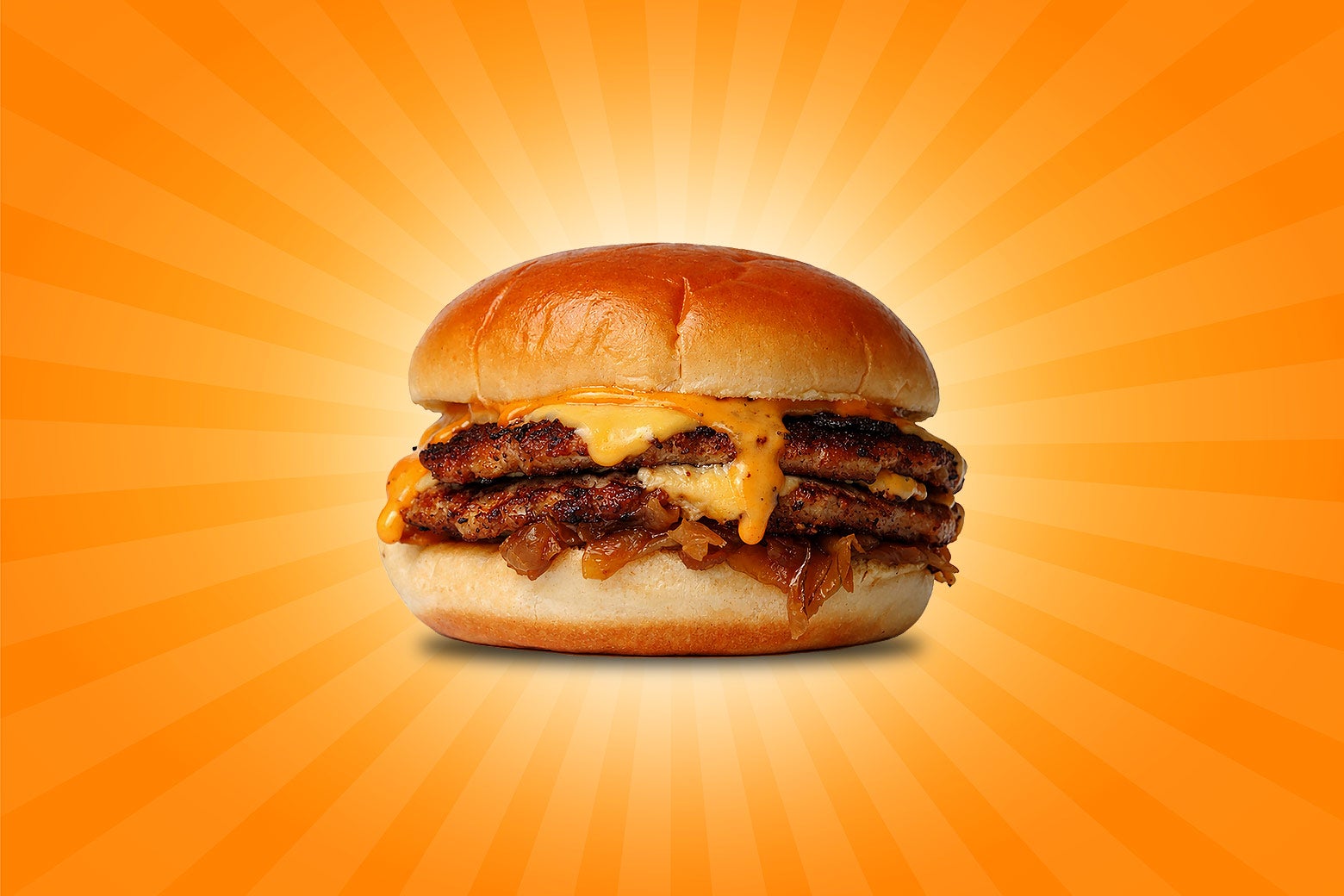
Ramblin’ Chick’s burger is made by marinating chicken thighs for 24 hours in buttermilk, mayonnaise, eggs, honey, vinegar, and a spice blend, before grinding them and forming them into patties. They go on a hot griddle, where clarified butter caramelizes the fat. They’re double-stacked with American cheese, caramelized onions, and a house burger sauce, all in a squishy Martin’s potato roll.
Those classic garnishes convey that this is not supposed to be a pretentious offering. “The whole thing is built around the idea of that roadside American burger,” Smith says. “It’s just through the prism of chicken.”
When I tried it—Smith cooked one for me a few days before the March 19 opening—I felt the same sensory experience of all the elements working together in a single bite. But it was distinctly chicken. “The goal isn’t for it to taste like beef,” he says. “The goal is for it to scratch the same itch that eating a juicy beef smashburger does.”
One notable difference for me was that the patty had a slightly softer exterior, meaning the other components were liable to slip and slide out of place. In the kerfuffle, I lost the bottom bun to the goo, and worked through my fair share of napkins.
They may achieve a crispier crust in time; Smith admits it’s still a work in progress, even after two years of countless iterations. It’s tricky because of how “chicken performs on a flat-top” grill, Smith says. “Chicken wants to fall apart when it doesn’t have enough glue.” The marinade also acts as the adhesive; they didn’t want to use easy-fix binders like breadcrumbs.
The R&D came with the territory: Smith admits he wanted to create something completely new. The couple had innovated at Ample Hills Creamery, their former ice-cream company known for its creative flavors. But that venture rather infamously ended in bankruptcy and being pushed out of their own business by investors. Smith knows when it comes to burgers, different can be risky. “The chicken burger, if it exists on anybody’s menu, is a sorry and second cousin to a turkey burger,” he says. “Which is in turn a sorry and second cousin to a beef burger.”
It’s unclear why the concept of the chicken burger is not so appealing to the masses. Perhaps it’s the riskiness of underdone chicken; Smith says the thin patties work in their favor in that respect, as does the dark meat that is “almost impossible” to overcook.
But I think the distrust goes deeper; it’s tied to the very question of what makes a burger a burger. A guiding principle is that a burger is ground meat—which is why something like the McChicken, a whole cut battered and deep-fried, is not a burger, but a sandwich. (To make things more confusing, I’m from the U.K., where we would call a fried-chicken sandwich a burger.)
Smith says theirs is “absolutely” a burger. But hamburger hard-liners might scoff. George Motz, a “burger scholar” whose documentary Hamburger America became the name of his own Manhattan restaurant in 2023, considers a burger to be ground beef only. Preferably chuck, no need for brisket; not ground lamb (that’s meatloaf), and not ground chicken (that’s still a sandwich). “A hamburger should be defined as some part of a cow that’s cooked somehow and put on bread as a vehicle for delivery,” he once declared in an interview. Smith would like Motz to try his burger one day, but “I don’t want him to punch me,” he says.
Agree with his strictness or not, but Motz’s burgers are a gold standard of the smashburger: a cold ball of ground beef smashed down on a hot griddle to create a Maillard reaction, the interaction between protein and sugar at a high temperature to cause browning. The outside becomes crusty, almost lacelike—which Smith admits is not fully achievable with chicken.
The smashburger became popular in the 2000s with the rise of chains like Shake Shack. But that was really just a resurgence; the first true American burgers of the early 20th century were basically smashburgers—including the beloved Oklahoma-style burger with onions smashed into it, which was an invention of the Great Depression.
Through the decades, some chains smashed but didn’t explicitly call it smashing, from Five Guys to Culver’s. But many fast-food chains got into the model of preformed, frozen patties, in the McDonald’s mold. And the thicker “pub-style” burger emerged as a sit-down alternative. That style has come back into vogue, with many of New York’s top-rated burger places today serving up those thick, juicy patties.
But most food trends are cyclical, and the smashburger looks like it’s back for another round. The National Restaurant Association anointed it one of the top food trends for 2026. New restaurants are having fun with names: Smish Smash in San Francisco; both Smashed and Shmash in New York.
Saying it is fun but doing it is even more fun, and TikTokkers are smashing everything in sight, from tacos to zucchini. “It’s the platform of smashing that is trending, and what you smash could be anything,” says Barb Stuckey, chief new product strategy officer at Mattson, a major food and drink developer for retailers and restaurants. Based on a confluence of trends, Stuckey thinks Ramblin’ Chick’s offering could take off. “It just has all the fixings of something that people would want to try,” she says. “It makes total sense to me.”
One reason it has a route into the mainstream: somewhat driven by the MAHA movement, there is a proclivity for protein, with 61 percent of Americans increasing their intake in 2024. And proteinmaxxers certainly have a preferred protein, one considered lean and clean. Chicken consumption has also been on the rise for a long time, with Americans eating 30 pounds per capita more than they did 30 years ago, and surpassing beef in 2010. Chicken is cheaper, more sustainable, and viewed as healthier. America loves chicken, and America loves burgers, so the mash-up makes sense.
And there’s a gap in the market for a new chicken thing. In 2019’s “chicken sandwich wars,” Popeye’s, Chick-fil-A, Wendy’s, and others tried to one-up each other with their offerings (and via exhaustingly sassy feuds on Twitter). It was lucrative business: Online spending on chicken sandwiches reportedly surged by 420 percent between January 2019 and December 2020. “Everyone and their mother has a spicy chicken sandwich at this point,” says Stuckey’s colleague Katie Hagan, a chief innovation officer at Mattson.
But Stuckey says that concept is now a bit “tired,” and she likes the idea of achieving crisp through smashing rather than relying on breading. Hagan adds that consumers today are also eager for textural differences in opposition to each other, like crispy with gooey.
In the social media era, all it takes is one snap of the ’gram or a TikTok that blows up. In the past it may have mattered that the Ramblin’ Chick restaurant isn’t in the buzziest New York neighborhood; it’s not in Williamsburg or the West Village, but rather in sleepy Carroll Gardens, on a block dominated by pizza joints. But the new word of mouth—posts from influencers and content creators—travels fast.
Whether that will happen remains to be seen, as well as whether more restaurants will try to get in on the action. They may be constrained by equipment, when a deep-fat fryer is cheaper and easier, or by the messiness. “How much McDonald’s is eaten in the driver’s seat?” Hagan points out. Many of these corporations now do have “quick-strike teams” dedicated to rapidly jumping on the next big thing—as Gatorade told me when I researched why the Shirley Temple was suddenly coming back. “If it’s a big enough opportunity, they’ll figure out a way,” Stuckey says. But the Mattson contingent thinks it probably wouldn’t be McDonald’s, which is not nimble enough. It may suit a Shake Shack or Five Guys. It could work as a sit-down concept, like at a Chili’s or Applebee’s.
Of course, Smith would like to expand their own concept ahead of the big guns. “Our hope is that we get to open a few more [locations] before McDonald’s starts making them,” he says. After the Ample Hills debacle, they’re taking this business more slowly than the “runaway train” of growth for growth’s sake, and are leaning toward a “concentric circles” model of expansion: borough to city, to state, then the rest.
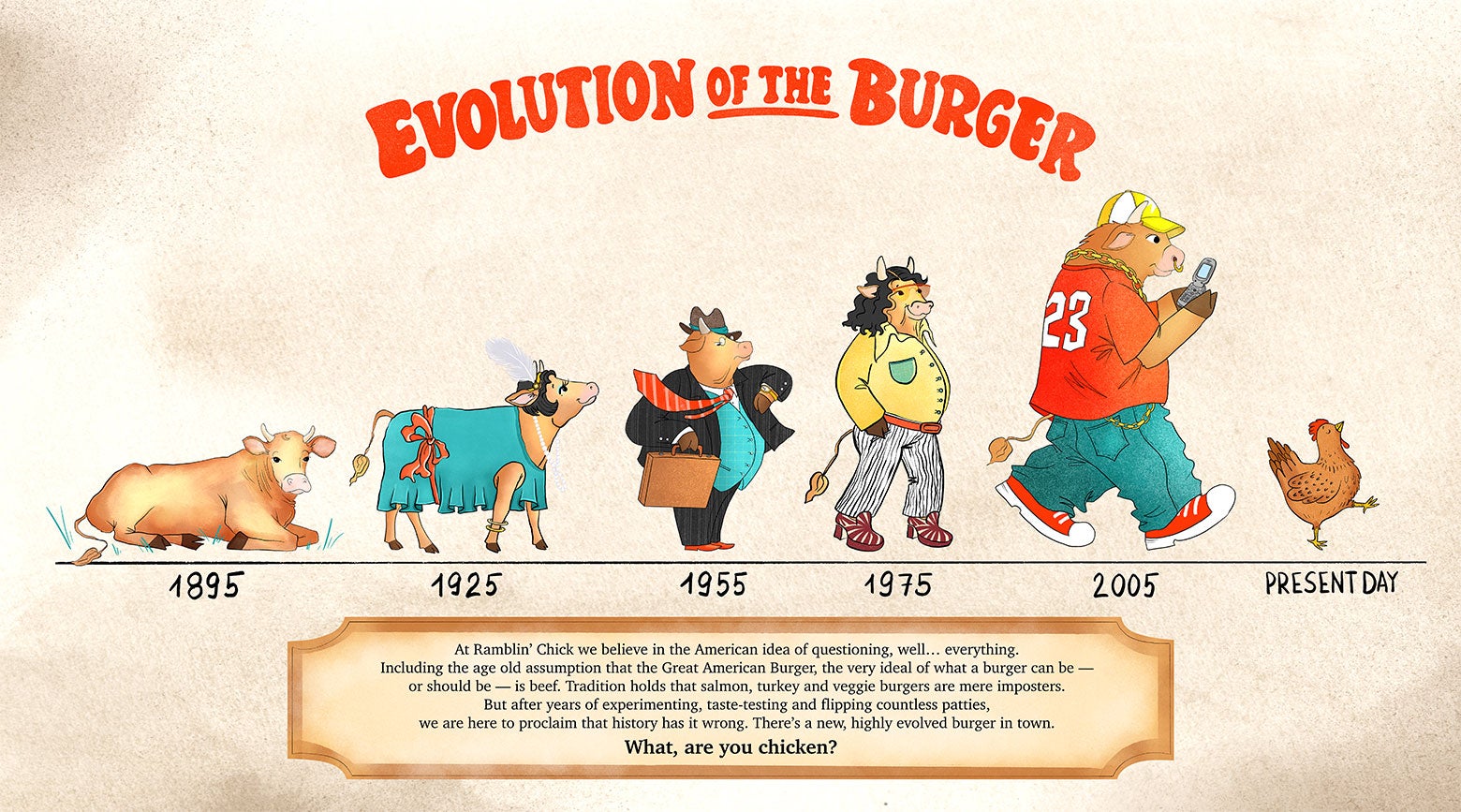
They’re also expanding the menu. There are already other burgers, like the chili burger I also tried—and that was my favorite—topped with an 18-spice chicken chili. There are nuggets and chicken-skin-dusted fries. Chicken hot dogs are on the way. But they want to build something to outlast fleeting fads. The entire concept leans into the long evolution of the burger; a picture on the wall shows a cartoon timeline from 1895 to today, like “The March of Progress” for burgers.
Smith says the concept, down to the name and mascot—a literal rambling chicken with a guitar in tow—was inspired by Woody Guthrie. It’s about the mythical spirit of pursuit in America: the constant search for opportunity. And for the next great burger.
In fact, on the storefront sign, right under the restaurant name, the tagline reads: “In Search of the Great American Burger.” It’s an ongoing quest, like the Great American Novel. (If the beef smashburger is Gatsby, and the pub burger is Huck Finn, what is the chicken burger? A Confederacy of Dunces?)
Smith is not so arrogant as to think that their burger will definitely be the next stop on the evolution chart. “Whether we get there or not is irrelevant,” Smith says. “It’s not necessarily an attainable thing, but the search for it is what, in its better moments, makes up the American spirit.”