Sign up for the Slatest to get the most insightful analysis, criticism, and advice out there, delivered to your inbox daily.
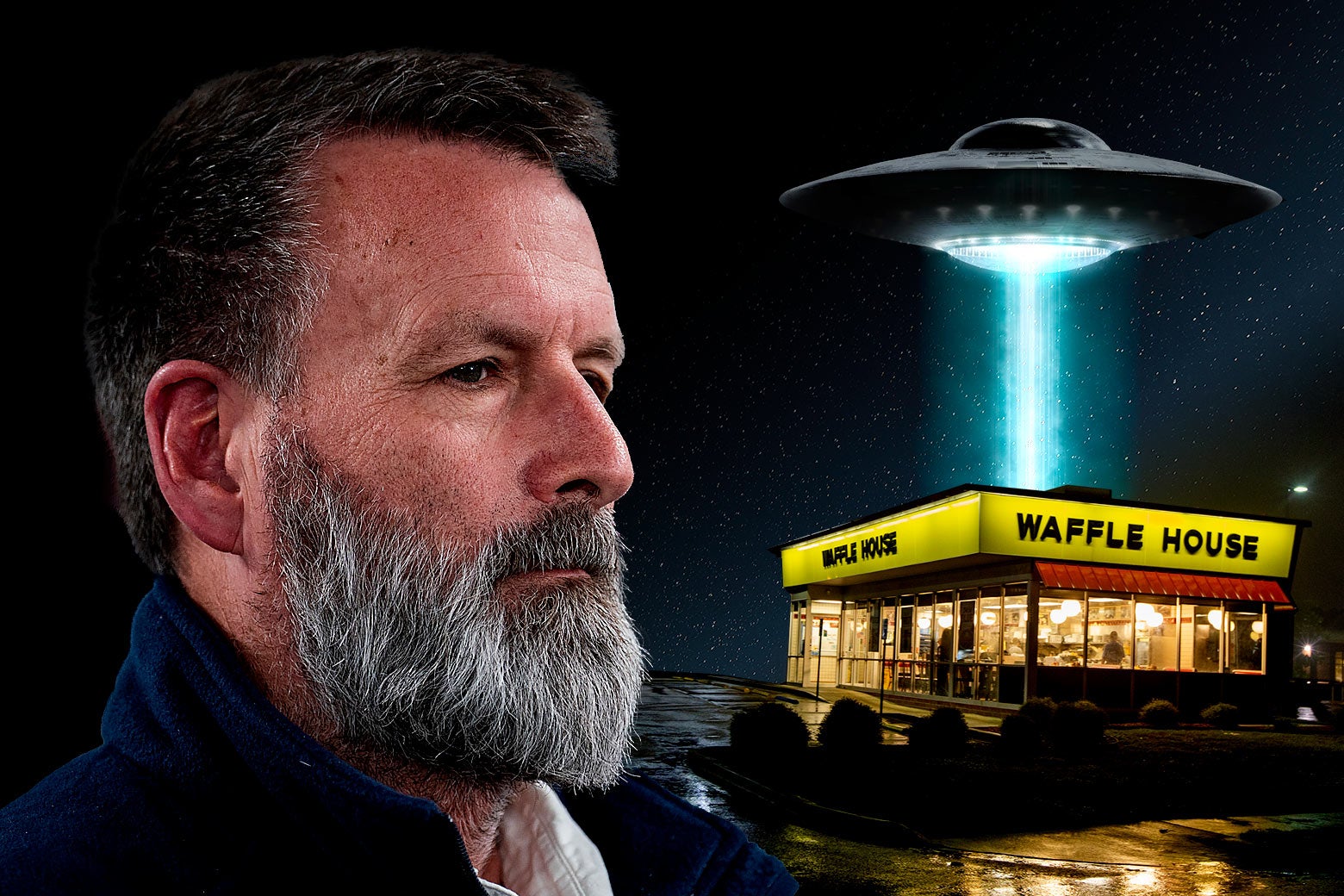
There’s no question: Gregg Phillips, a top Federal Emergency Management Agency official, believes he was teleported 50 miles to a Waffle House in Georgia.
When CNN first reported the story on March 20, based on older podcast clips, skeptics wondered if things had been misconstrued. He was joking, surely. Or perhaps it was hyperbole. But no: Phillips, who leads FEMA’s Office of Response and Recovery, has since made it abundantly clear that he believes he experienced a supernatural transportation, twice. (In the podcast episode he used the word “teleporting.”) Once, his entire car was “lifted up” while he was driving and was carried to a ditch outside a church 40 miles away. “I know what I’ve experienced,” he wrote on Truth Social on March 23.
Similarly, the following week, a clip circulated of Vice President J.D. Vance claiming that UFO sightings are actually glimpses of demons in the sky. That also was not a misrepresentation of Vance’s words: He appears to believe that aliens visit Earth, and that those aliens are actually demons.
These stories lent themselves to eye-catching headlines. Teleportation? Demon UFOs? Critics of the administration saw in them proof that the MAGA movement is led by kooks, rather than qualified, levelheaded professionals. But there’s something that the stories about these clips have missed, beyond the individual-level absurdity. Phillips and Vance may sound, to the scientifically minded, ridiculous. But the bigger story, if you look at the landscape of American belief systems today, is that they’re actually remarkably conventional.
This might seem surprising to anyone who has been, say, a lifelong United Methodist, for example, or to an atheist who has lost track of the trends in Christianity in general. But sociologists who study belief in America have found that there has been a kind of weirding of American faith in recent years. According to Joseph O. Baker, a professor of sociology and anthropology at East Tennessee State University, there’s been a growth in the belief in paranormal matters thanks to the decline in conventional religion. In the 1960s, for example, when most American Christians attended local churches that belonged to some kind of larger denomination, pastors or priests gave guidance for—and, often, curbed—what parishioners were supposed to believe when it came to the paranormal. Today, when so many Christians are nondenominational or don’t attend worship services at all, there’s a general lawlessness to popular Christian theology. This trend was accelerated by the pandemic, Baker said, which caused more people to leave physical congregations and find spiritual leaders or hone their personal doctrines through the internet. People increasingly cobbled together their own idiosyncratic beliefs. One 2021 Pew survey, for example, found that 30 percent of American Christians believe in reincarnation—a belief that would be considered directly contradictory to most formal Christian teachings about the afterlife.
But there are other trends at play in these supernatural claims, as well. Let’s take a look, first, at Phillips and his teleportation. Phillips has not spoken publicly about his own specific church allegiances, but based on his social media activity, it appears he aligns with charismatic evangelical Christianity. This means that he believes in the gifts of the Holy Spirit, such as faith healing, divine prophecy, and direct messages from God—miracles, in other words. People are most familiar with this in the form of Pentecostalism, but there are many flavors of charismatics out there. Generally, these charismatic Christians believe in an incredibly intense and often ecstatic personal experience with God, often conveyed through these Spirit gifts. And these charismatics are considered the fastest-growing religious group in the world. According to Ryan Burge, a professor at the John C. Danforth Center on Religion and Politics at Washington University in St. Louis, this is the only real and promising source of growth in American Christianity today, and it’s even coloring the larger evangelical movement. Even as little as a decade ago, Southern Baptists would have looked with scorn at people throwing themselves on the floor in a rapturous state; today, he said, this kind of Pentecostal-style worship is incredibly mainstream among Baptists.
Coming from that tradition, teleportation isn’t so outlandish. As Andre Gagne, a theological studies professor at Concordia University, noted, these charismatics perceive anything that is mentioned in the Bible as feasible today. God does not change, the thinking goes, so those same miracles mentioned in the Bible can and do occur now; this belief has extended, in one extreme case, to praying for the resurrection of a dead child. And, indeed, the Bible does have anecdotes of bodily transportation, something Phillips pointed out in social media posts. In those posts, Phillips said the experience was “part of my spiritual journey” as he was battling cancer, which he said was cured by a miracle. He also reposted others’ accounts of being physically transported. It may remain unclear why God would choose to transport this man to a Waffle House, but sometimes charismatics believe the point is often just that something marvelous occurred, proving the power of God, without there needing to be a legible purpose for it. Phillips wrote, in reference to the teleportation, that he believed “that God moves in ways we cannot fully explain.” On social media, this comment was met only with earnest agreement. A couple of decades ago, if someone heard you talk of teleportation, “they’d say you’re a weirdo,” Burge said. Now, in many evangelical circles, it doesn’t raise an eyebrow.
Vance’s faith tradition is quite different, but his viral moment is connected to this same trend. A Roman Catholic convert, Vance operates in the arcane and highly traditionalist world that tends to attract only hardcore Catholics—and, commonly, manosphere types who appreciate its patriarchal order and anti-modern spirit. Talk of supernatural evil is more common among this crowd than among cradle Catholics, experts said, in part because it’s more common among conservatives in general, and in part because it aims to tap into a more medieval version of the church. The Catholic Church does endorse the idea of demons and other supernatural phenomena operating in the world, but it treats such instances as rare and extraordinary, and its leadership has tended to downplay this belief in recent decades, focusing instead on more urgent societal issues.
According to Andrew Chesnut, the Catholic Studies chair at Virginia Commonwealth University, Vance and those like him appear to instead be pulling their beliefs from prominent traditionalist Catholic exorcists. And those exorcists, in turn, are inspired by Phillips’ people: “The real debt here to seeing demons in every corner goes back to Pentecostalism,” Chesnut said. “Traditionalist Catholics have borrowed that.” (Burge also noted that Vance is from Appalachia, Pentecostal territory, and may be naturally more comfortable with talk about demons.) Vance’s traditionalist faction is a small one, in the scheme of things, but it has a big imprint on the larger culture. There is undoubtedly a growing fascination with traditionalist Catholicism on social media and among high-profile elites.
The point is that neither Phillips nor Vance pulled this out of thin air. Phillips is part of a movement that has blossomed in the Wild West of modern American Christianity, and Vance, whether he knows it or not, is building off that movement. Both of these men, different as they are in their beliefs, are standard Christians. Millions of Americans think the way they do.
And millions more take the supernatural very seriously without necessarily tying it to a specific faith. This is in no small part thanks to highly modern conditions: algorithms that promote fantastical stories of the miraculous or the occult, social media that allow people to connect with other demonology obsessives, and online worship services that allow us to shop for pastors we like, including the theatrically occult-obsessed, without leaving our couches. There’s no reason to think these trends will reverse any time soon.
That being said, these incidents don’t only reflect benignly interesting demographic trends. There are genuine political consequences to these changes in American religion. Phillips’ ideology, with its everyday miracles, also infuses regular life with a kind of cosmic urgency that, if tied to partisan politics, can be quite radicalizing. Phillips has written on Truth Social of a “prophetic vision” he had that instructed him to “to move without hesitation” on his “mission” in “radical obedience” to God. He did not clarify exactly what this meant, but he did in a follow-up comment say he believes we are “heading toward the end of days” and prayed “people understand what is at stake.”
In fact, many of the leaders of the independent charismatic network he is connected to believe in “spiritual warfare” for control of America. In this view, the fight is not between Democrats and Republicans but between divine good and satanic evil. There’s no room for nuance in this view or even for operating under political norms: If the only thing that really matters is defeating evil, you can and should use whatever tools you have. Many of the faith leaders who championed the overturning of the 2020 presidential election came from this specific religious tradition.
And then, there’s the matter of conspiracy theories. We tend to think of conspiracy theories as an internet phenomenon, but if you spend any time immersed in conspiratorial spaces, you’ll often find religious language being bandied about. Conspiracy theories aren’t just fantasies about Democrats drinking the blood of children and Trump arresting his enemies; they’re also places where religious convictions about good and evil are interwoven with political narratives. There certainly are atheists among conspiracy theorists, but the embrace of the fantastical in the everyday, so common now among so many Christians, makes some conspiracy theories easier to swallow. “We find high correlations between people who believe in supernatural evil and accept conspiracy theories,” Baker said. “Conspiricism makes claims about hidden powers behind things that have malevolent intent. Ideologically it meshes really well with claims about supernatural evil.”
Longtime Trump adviser Roger Stone, for example, said that he saw a “demonic portal” appear above the Biden White House; if you can believe that, you can believe in QAnon-esque activity happening in that White House. Phillips, for his part, was granted his FEMA position as a reward for being a committed conspiracy theorist about the 2020 election. To Phillips, his campaign against the certification of the 2020 election amounted to a spiritual battle. He has spoken of it as a matter of personal faith.
To be clear, Christianity is not to blame for any partisan action; it can and is used to justify a wide range of behavior or beliefs, including progressive ones. But the destruction of traditional guardrails on much of the practice of Christianity has meant that the notions that used to seem odd and fringe are now mainstream. This great weirding of American Christianity has made it normal for people in power to talk of demonic UFOs and teleportation. It may also continue to scramble our political conversation for years to come.