Margaret Atwood’s 1985 novel The Handmaid’s Tale, about a world in which a class of “Handmaids” are forced to bear children for elite men, has made a deep cultural mark. The red-robe-and-white-bonnet Handmaid getup, worn by Elisabeth Moss’ protagonist June in the Hulu adaptation that premiered in 2017, became a protest costume in the literal-minded #Resist era during Donald Trump’s first presidency, and is still getting play at No Kings protests today. You can buy a whole bunch of “Not Your Handmaid” merch on Etsy: #Resist magnets, stickers with Handmaids throwing the middle finger, and infinite variations on this theme.
This cultural uptake suggests that the story had real political impact and reach, but it can also feel as if the seriousness of both Gilead and the real world are reduced by these incessant comparisons. The Gilead cosplay is helped along by the fact that the Handmaid’s Tale show went on for five seasons, with its plot far outrunning Atwood’s, and had by the end significantly altered the tone of the grim novel, with its ambiguous ending for a resigned June, into an action-packed spy show about the power of women. By the time the series concluded last year, June was a full-on operative in the resistance organization Mayday, planning and executing Harriet Tubman–style extractions from Gilead—a total badass, and a much more obviously aspirational figure than her book self. Whether it’s because of this shift to a “You go, girl” outlook or because there are so many subsequently published dystopias that feel a little Handmaid’s Tale–ish in their trappings—Suzanne Collins’ Hunger Games, with its over-the-top public punishments; Veronica Roth’s Divergent, with its immutable factions based on personality—some parts of Gilead now feel a little bit (forgive me) YA.
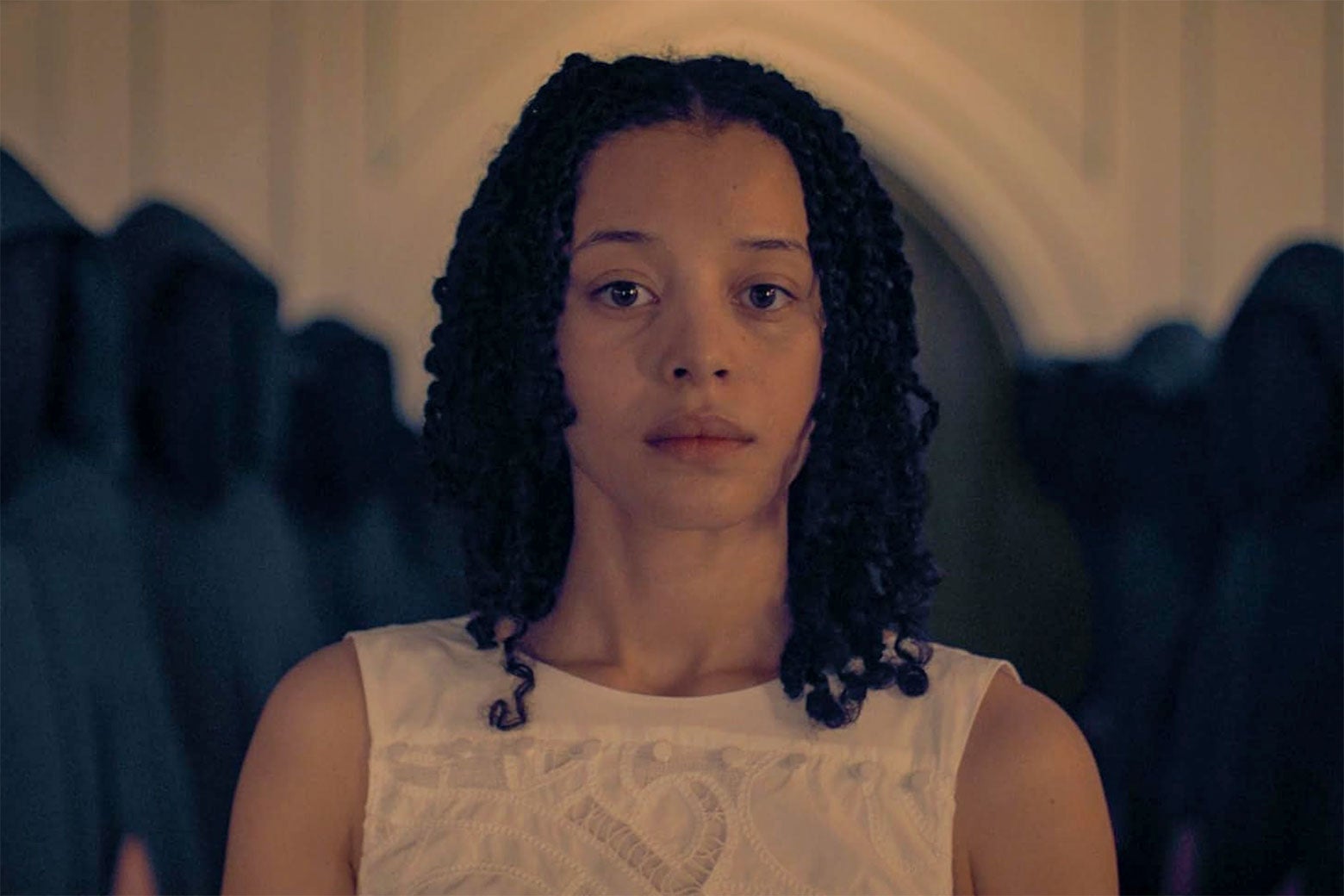
The Testaments, the new Hulu adaptation of Atwood’s 2019 follow-up to The Handmaid’s Tale, is just as full of action and adventure as its parent show. For those wary of The Handmaid’s Tale’s YA turn, this sequel presents a new challenge: It’s about actual teenagers. This is a next-generation coming-of-age story—the two central protagonists, Agnes (Chase Infiniti), who grew up in Gilead, and Daisy (Lucy Halliday), who grew up in Canada and enters Gilead as a spy for Mayday, both have ties to major Handmaid’s Tale characters. Agnes and her friends are the Plums, those privileged daughters of Gilead who hope to become eligible for marriage to the ruling class of men, Commanders. Elite-born girls in Gilead wear pink when they’re little, change into purple as tweens, and, if they reach menarche, wear green for a brief time, until they’re married into blue.
The Plums are teenagers under great pressure from their parents, even though their school, held in a beautiful old mansion, doesn’t teach them to read or do math. Their equivalent of “getting good grades” is “getting your period and making a good match,” things over which they have little control. (In this world, many girls do not reach menarche, it’s implied, because of the same environmental circumstances creating the reduction in fertility that leads Gilead to mandate the use of Handmaids.) We find out that Gilead’s rigid social structure around marriage-making recalls the world of aristocratic British debutantes—matches are achieved via the deliberation of the elders, in a very brief time frame, with little if any input from the girls, who often find themselves married off to much older men. The girls’ ability to achieve gracefulness in pouring tea, managing servants, doing needlepoint, and dancing has very high stakes. It’s clever of The Testaments to show how dark this world, which looks so pretty in Bridgerton, could truly be.
This show may attract viewers solely because it stars Infiniti, who a lot of people think deserved a Best Supporting Actress nomination for her recent role as Willa Ferguson in Paul Thomas Anderson’s Best Picture–winning One Battle After Another. Infiniti is extremely good at beaming out sweetness and innocence, and Agnes is a very sweet and innocent person, far more demure than Infiniti’s Willa. “Praise be His mercy, for not making me look too gawky,” Agnes murmurs in Episode 1, a perfect expression of this young girl who’s been well schooled in religious belief and self-abnegation. She’s been raised in a big, beautiful house—upon first entering her bedroom, Daisy describes it as looking like a “mood board,” much to Agnes’ confusion—with a doting Commander father, memories of a kind mother who’s now deceased, and an evil stepmother who has completely bought into the social system of Gilead. As the series starts, Agnes is a total child, seeming much younger than the worldly Daisy, despite her greater age.
We follow Agnes and Daisy through their days at their school, held in a big, beautiful estate and run by Aunts, the caste of intellectual women who wear brown and act as administrators and indoctrinators to their fellow women. (Among Gilead women, only Aunts are allowed to read. The fearsome Aunt Lydia—Ann Dowd, who returns in The Testaments, which will fill in some of this character’s backstory—is their leader.) Agnes’ classmates have a range of relationships to Gilead, from Agnes’ best friend Becka (Mattea Conforti), who silently resents the idea of marriage, to Shunammite (Rowan Blanchard), an insecure, chattering girl who wants nothing more than to marry perfectly. The Agnes storyline is about a girl emerging from indoctrination, with the help of a blossoming illicit crush, a sketchy encounter with a male predator (the exact kind of man that thrives in Gilead), and the presence of Daisy, a comically bad spy who can’t help but panic and blaspheme when required to witness punishments, or make little acid comments on how messed-up Gilead is, or try to explain sex to the Plums. “Your worth has been decided for you. You don’t even need a personality,” Daisy meanly says to Agnes. But she does have one—as Daisy will eventually find out.
These are the interesting parts of The Testaments—the parts about what this childhood did to Agnes, like the moment when, in voice-over, during a scene in which the Plums castigate Daisy as a group, she admits that she really enjoyed these struggle sessions. “I’m ashamed of how much I miss it,” she reflects. On paper, this plot sounds great, politically vital and interesting. Unfortunately, in its execution, the show struggles not to embellish, adding cheesy lingo—the girls tell one another to “plum up”—and inserting unfortunately on-the-nose needle drops. Do we really need “Sweet Jane” soundtracking Agnes’ childish dream of slow-dancing with her crush in front of a fireplace, Bridgerton-style strings for the ballroom scene, and a lugubrious cover of “California Dreamin’ ” while girls harvest honey from beehives? These things may make The Testaments more appealing to some viewers, but they blunt the gravity of the situation, pulling us back from this world where a man guilty of a minor transgression gets his hand cut off by a saw in front of a group of girls, who must watch and learn. The show’s setting may feel YA, but the reality it seeks to depict is anything but.