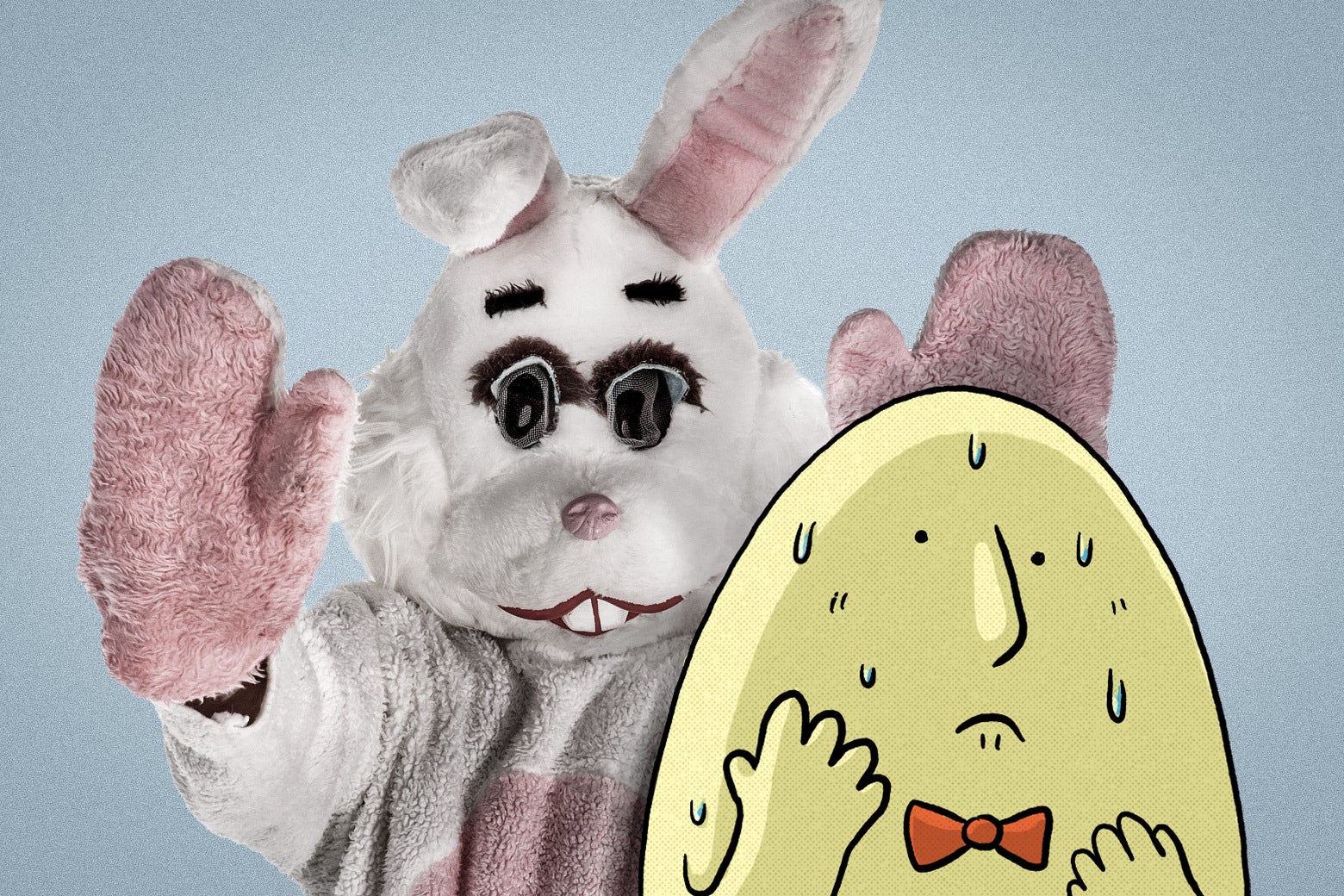
This is part of Egg, an attempt to explain why Americans absolutely lost their minds over egg prices. The Eggsplainer briefly considers some of our weirdest behaviors around eggs.
The Easter Bunny is, you know, a bunny. A rabbit. Where did it get all those eggs?
An egg-toting Easter Bunny visiting children’s houses like a leporid Santa is weird enough. But it turns out the original version of the rabbit didn’t just carry the eggs—it actually laid the eggs. As in, it would literally squat and pop out eggs into “nests” (usually hats) left out by the children. So, leave alone why the Easter Bunny has eggs—what on earth was it doing laying them?
That original figure dates back to Germany sometime before the 1680s. Its first mention isn’t in a fantastical book of stories, as one might assume, but rather a doctoral dissertation written by a German doctor (he would go on to become the personal physician to the Danish king). The essay, titled “De ovis paschalibus” (or “On Easter Eggs”), was published in 1682 and explained a preexisting folk myth (in Latin, of course):
In Alsace, and neighboring regions, these eggs are called [hare] eggs because of the myth told to fool simple people and children that the Easter [Hare] is going around laying eggs and hiding them in the herb gardens. So the children look for them, even more enthusiastically, to the delight of smiling adults.
Who came up with the myth of an egg-laying hare? No one really knows. According to the German American Heritage Center & Museum in Iowa, it might have derived from an older legend about a poor woman who decorated eggs to surprise her children; they couldn’t believe the eggs came from a regular chicken and wondered if it might have been the work of a nearby hare. Hares also give birth to their young above ground in grass-lined depressions, which could appear something like a bird nest. It’s not hard to imagine someone inspired to imagine—or tricked into believing—that hares were laying eggs.
As far as how eggs and bunnies became associated with Easter, that’s also fairly speculative. You’ll see one explanation thrown around a lot to this day: That Easter derived its name from a pagan spring festival celebrating the goddess of fertility, Ostara, associated with rabbits and eggs for, well, fertility reasons. However, folklorist Stephen Winick at the Library of Congress’ American Folklife Center argues that there’s really no evidence for either Ostara’s existence, or her association with rabbits and eggs, and that it’s just one of those baseless stories that refuses to die.
Instead, Winick suggests, an explanation might lie in the holiday’s date: springtime, when eggs are laid and baby animals are born. It makes sense that the two might get tied together, both by Christians thinking about the rebirth of Jesus and by parents weaving a yarn. In fact, in other parts of Germany, the egg layer in the folktale may have been played by other animals, including a fox, rooster, and the more reasonable cuckoo bird—so the hare’s persistence may have come down to dumb luck. But for whatever reason, it was the Easter hare story that ended up spreading across Germany and, in the 1700s, over to Pennsylvania by German settlers. Through the years, the hare evolved into a bunny (common mix-up), and the bunny started bringing the eggs instead of laying them (maybe someone finally decided it was too weird), and just as Jesus turned water into wine, the eggs—blessed be His name—became chocolate.
