Sign up for the Slatest to get the most insightful analysis, criticism, and advice out there, delivered to your inbox daily.
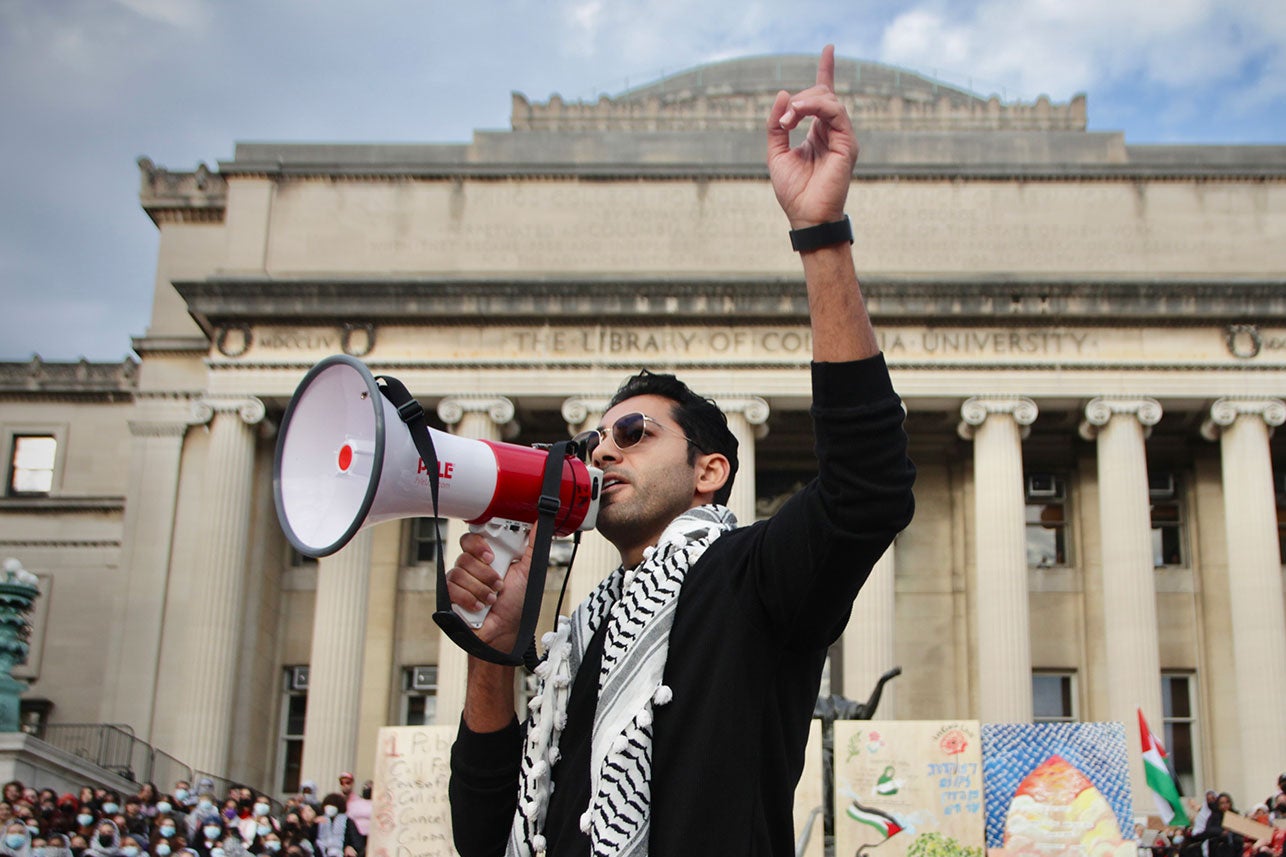
When Mohsen Mahdawi, a Palestinian former student activist at Columbia University, walked free from federal detention this week after a Vermont judge ordered his release, it marked the first major legal setback in the Trump administration’s sweeping effort to deport pro-Palestinian students. Mahdawi, a legal permanent resident in the U.S., had been targeted under a rarely used immigration provision that labels individuals as threats to American foreign policy. Among the 94 letters submitted in his defense was one from Roberta Wall—a Jewish activist and former civil rights lawyer in New York. The judge cited those letters as influential in his decision to grant Mahdawi bail. In this as-told-to essay, Wall explains her connection to Mahdawi and what happened since the arrest.
I learned about his arrest first in a headline. It said the student was in Vermont, and I knew Mohsen lived in Vermont, and I just knew right away it was him. The last time we had met in person, he was so excited because he thought Columbia students were finally moving toward creating a joint organization of Palestinian and Israeli students. Mohsen wanted me to do training, and I’m actually in touch with that group now.
But that was the last time we met in person. April 7, I sent him a picture of me holding up a sign outside of Columbia, and it says, “Hands off Khalil.” And then he wrote back, “Thank you. I am safe and in good spirit.” So that was April 7. And then, he was seized not too long after that.
We met in January 2024. I lived in the neighborhood near Columbia University, and I have been very involved in Palestinian activism. For many years, I’ve traveled back and forth to the West Bank and Israel, and we have trainings sometimes in nonviolent communication—some trainings just for Palestinians, some trainings just for Israelis, and then bringing people together.
A Columbia student who I met said, “Oh, you need to meet my friend Mohsen.” Mohsen reached out to me. And he wrote ,“I am a student at Columbia University and currently co-leading the Palestinian movement on campus. It would be a pleasure to hear your thoughts and intentions.” Mohsen and I met a number of times. It turned out that his high school principal, in the refugee camp where he’s from, is one of my very dear Palestinian friends and students—an amazing peacemaker.
I’m Jewish. Mohsen grew up Muslim. It turns out that we both are practitioners of Buddhist meditation, so we had all this sharing of activism and connections in the West Bank, as well as Buddhism. In January 2024, I invited him to a Friday night Shabbat service in the Harlem Jazz Museum, but he already had a Shabbat dinner that night.
What is so just horrifyingly outrageous is that the entire justification for arresting him is that his stance is a threat to U.S. foreign policy. This is someone who is just an open, free human being. And at the same time, that he’s a fierce leader, an advocate for Palestinians, he’s such a teacher. He is really modeling peacemaking to me, for me. Because not only does he stand for everyone’s humanity and not to demonize anyone, he stands firmly for Palestinian rights. So, from my perspective, he’s not watering down the Palestinian liberation struggle—he’s just sourcing it in a bigger playing field.
After the arrest, the first thing I did was reach out to some rabbis and Buddhist communities I know in Vermont to mobilize them. And there was this horrible disinformation campaign from this Jewish self-proclaimed journalist, just picking apart his life and his statements. I felt sick to my stomach. It was just how it was all so demeaning of this human being that I know, who has been on a journey for 15 years to make sense of what’s happened to him in a way that embraces his own and everyone’s humanity. I really felt sick to my stomach. And then I learned that some of the rabbis I know were actually affected by that. And for me, it’s humbling to see how fragile people’s goodwill is.
I actually had an experience of how this disinformation can get into your own brain. I had a moment of, like, “Whoa, could this incredible human being have been pulling the wool over my eyes?” I mean, I’m more than twice his age—a civil rights lawyer and activist in New York City—I’m not a naive person. And yet, you hear these things, you read these things, I felt humbled to be able to say, “No, I trust my experience with this human being, and I’m not going to be swayed by these fearmongers who are saying things that have nothing to do with my own experience.” It was humbling to see how it gave me pause. And Mohsen is such a contrast to that.
Next, I joined others in drafting a letter in support of Mohsen. I am a retired civil rights lawyer. I’ve drafted depositions, I’ve done all kinds of things in support of people whose civil rights were being compromised or attacked. But I had never done one myself in support for someone I knew.
In the beginning, I was worried, like, “Oh, my God, what are they going to do to him?” But as it all unfolded, I didn’t feel worried about him at all. I had complete trust that he was prepared for whatever would happen.
I was jubilant when I saw him freed this week. It’s great to have a small win at this point in time, though his case is ongoing. And I feel an urgency to remind people that everybody else was sent to the 5th Circuit in Louisiana, which is probably the circuit court leading the charge to destroy whatever remnants of democracy we have. We need to protect all the other political prisoners—so Mahmoud Khalil, Yunseo Chung, and Rumeysa Ozturk. This is the tip of the iceberg.
I don’t think of myself as someone who’s had many illusions about this country, and yet I still feel shock at what’s going on. Someone I know—and someone who I think can really create understanding between Jews and Palestinians—is attacked. And then, as a Jewish person, I feel terrified that these racist assaults and attacks are being carried out in my name. My family is very frightened by this, because the whole singling out minorities in this country always ends up being a threat to our safety, and this attempt to separate Jewish people out from that is naive and scary.