Sign up for the Slatest to get the most insightful analysis, criticism, and advice out there, delivered to your inbox daily.
When Stephen Harrison was in law school during the early 2010s, his social life revolved around a Thursday-evening get-together with a quippy name, common among juris students: Bar Review. It functioned as a happy hour for those submerged in the muck of legalese—a way to ditch the knotty intricacies of patent protection and tort claims with a couple of cold ones. Students and professors alike would gather at an off-campus pub to get to know their colleagues, bat around some scuttlebutt, and, most importantly, savor the levity of college life. Harrison loved the way Bar Review added enriching color to dreary weeknights; how the ritual could snowball into dinner, after-dinner drinks, and, eventually, lasting friendships. So when he became an adjunct professor at the University of North Texas in the 2020s, Harrison wanted to revive the tradition for a fresh generation of pupils. “I was only seeing them once a week,” said Harrison. “I thought a Friday happy hour could let me interact with the students and fellow instructors more.”
However, when Harrison floated the idea in his classroom, his plans went down in flames. Happy hours, he was told, were a thing of the past. In fact, some of his students were downright scandalized by the suggestion.
“They were kinda shocked by the idea—like, that it would be improper for a school to host a happy hour,” Harrison told me. At first, he thought it could be a liability issue with a public university, but after speaking to some colleagues at the University of Texas at Austin, he discovered that they had a version of Bar Review. “So it’s just been this cultural change that’s happened over time,” he continued. “I found myself worrying about it. My students are just hanging out less in general. It’s not like they’ve replaced the happy hour with a trip to a coffee shop, either. They’re just showing up to class and going home.”
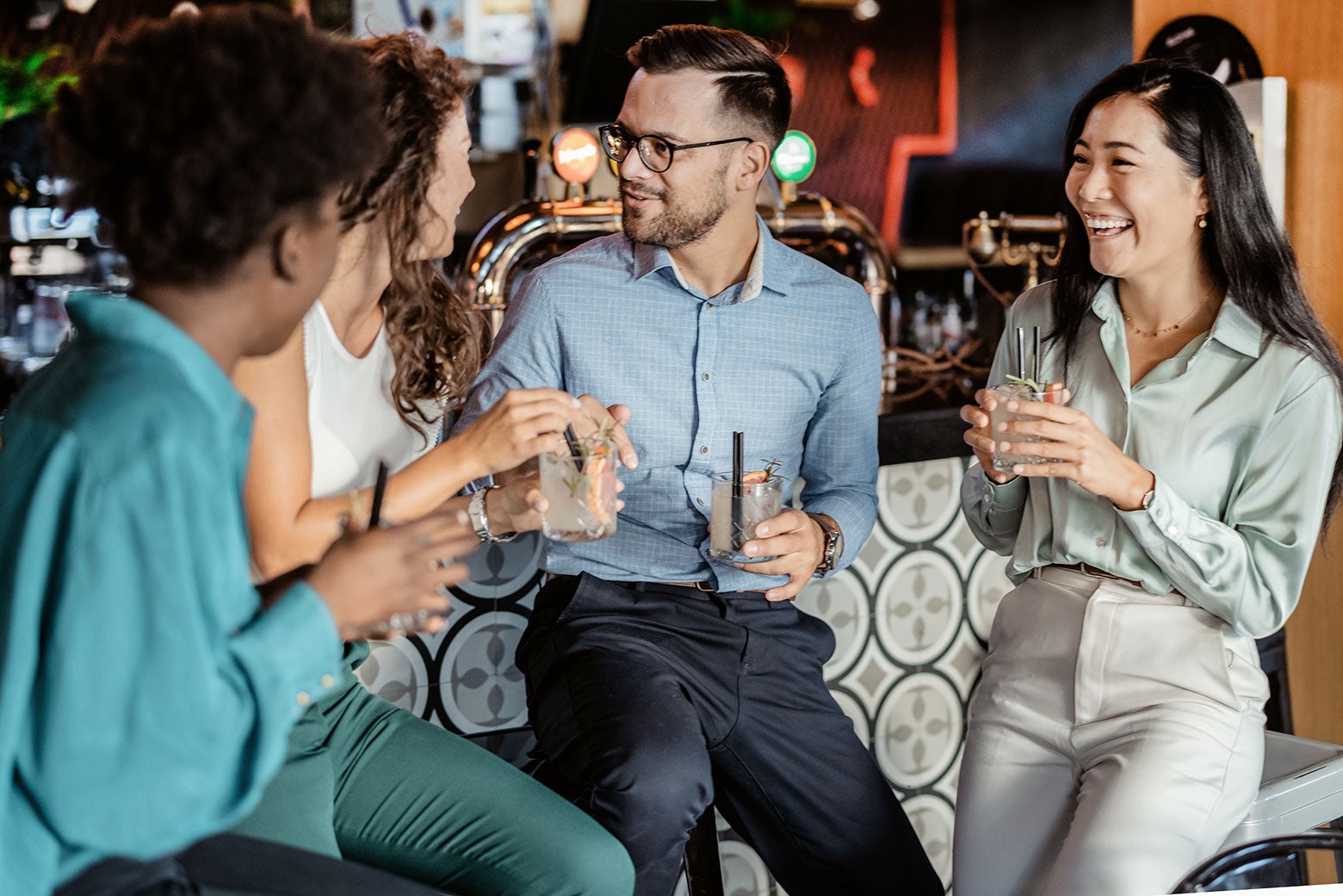
Of all the titanic shake-ups to the American workplace during this decade, the experience that Harrison describes might be the one I’ve felt most acutely. Indeed, there was a time when an after-work happy hour—loosely organized among a gaggle of officemates, all searching for a hit of debauchery to burn off the resentments of an annoying shift—was one of the sacred rites of employment. During these gatherings, acquaintanceship could be hammered into familiarity, the awkwardness of hierarchical leverage could melt away, and dirty laundry could be aired free and easy without the panoptic paper trail of Slack. And yet, for so many reasons, our sacred after-work happy hour has become an endangered species. This is something I began to notice slowly, then all at once. I used to know the people I worked with, right? Weren’t my personal and professional lives a bit more entwined? I swear, my colleagues used to have fun around the office. Why does that all feel so long ago?
This is a difficult trend to prove empirically, but Alison Green, Slate’s resident workplace expert, has noticed a shift: We simply don’t hang out with our co-workers like we once did.
“I used to get a ton of questions in my mailbox about happy hours, or drama that happened at happy hours, or even from people who didn’t want to go to their office happy hours,” she told me. “I get far fewer letters like that now.”
Unsurprisingly, Green first noticed this change during the lockdowns of 2020, which disrupted every element of our professional routines. Marshaling a troop of drinkers to a bar isn’t easy when your office floor is empty, and that hindrance would persist deep into our age of institutionalized remote work—in which face-to-face intraoffice interactions are filtered exclusively through the cloudy lenses of MacBook cameras. Tori Mattei, a New York–based PR professional, becomes melancholy when she considers the “HH” appointments that once appeared on her calendar. She told me that happy hours used to be integral to her commute—they were the one thing she relished on a long train ride home. “Someone you knew was hanging out at the bar along your route,” explained Mattei. “The drinks were $10, and someone had already ordered wings. Why not stop in?”
Ryan Broderick, who also lives in New York and considers himself a veteran of the digital-media happy-hour circuit, can relate. He too can remember a time when everyone at work was eager to sever professional boundaries, and he believes that this camaraderie was one of the many casualties of COVID-19.
“I feel like most journalists feel a bit silly admitting this, but we all got into this job to, at least partially, meet cool and interesting people. That was the fun part for me,” said Broderick. “A lot of the post-COVID era is learning what you lost, and I think the big one for me is I lost an industry, and all the good—and bad—parts that come with that.”
I felt this displacement myself when I was hired by Slate in summer 2023. The New York office, once bustling with life before lockdown, had been fossilized into a Chernobyl-like stasis. Some days, as few as four employees are scattered across the ample cubicle banks—most of which bear the nameplates of co-workers who haven’t made the trip up the elevator in quite some time. It was clear to me that my colleagues had good relationships with one another, but also that those relationships were kindled before COVID—when a management-sanctioned after-hours nip in the office kitchen was far more common. For anyone like me who showed up in this awkward hybrid era, that watercooler rapport was well out of reach. Eventually, I took matters into my own hands by resurrecting a casual Slate happy hour. It was almost surreal, like a high school reunion. At last, a chance to meet the people I’ve ostensibly been working with for the past two years.
In that sense, you could argue that the story of COVID, and of the 2020s in general, is the detachment of the office from civil procedure. But on a broader level, apart from the spatial reordering of the pandemic, American society does seem to be in a period of reappraisal with its relationship to work. How much of themself should anyone give to their job? The conclusion, at least lately, seems to be as little as possible. This is most true of young people, whose reluctance to attend office happy hours has become the subject of leering coverage from the reactionary press. In 2022 the New York Post offered the blaring headline “Gen Z Party Poopers Have Ruined After-Work Drinks,” a story that put a tremendous amount of weight on a single quote from a 27-year-old asset manager in Dallas, who said he prefers “to not hangout” with his colleagues.
The thesis of the report was a little thin, but it’s not hard to find portions of its sentiment reflected elsewhere. In 2023 Business Insider reported on a viral Twitter thread flambéing the so-called mandatory fun enforced by offices; just a year earlier, a “certified life coach” had uploaded a video to TikTok sharing his No. 1 “corporate survival skill”: Never hang out with your peers under any circumstances. “Go to work and go home,” he said. (The clip has been liked over 100,000 times.) In fact, as America was waking up from its COVID slumber, health reporter Angela Lashbrook took to the pages of Slate to advocate for the enduring abolishment of office happy hours. Her argument? Getting ahead at work shouldn’t hinge on your willingness to party, especially if you’re not a big drinker, and especially if you’re a woman and aren’t interested in hanging out with inebriated men you don’t trust. (Of the many sins the #MeToo movement uncovered, the most pervasive might be just how often after-hours work gatherings can breed sexual harassment.) This might explain why Forbes recently reported that happy hours are being replaced with lunches: A time-constrained daytime hour keeps things far more buttoned up than a debauched evening meetup.
“We give our employers enough as it is: The 40 hours a week they pay us for, and often more,” Lashbrook wrote. “Why would you drink with co-workers when you could hang out with your friends or family, anyway?”
Lashbrook’s conclusions gesture toward another glacial trend in the United States. Gen Z is emerging as the most sober generation on record, consuming significantly less alcohol than the Americans that came before it. (One study found that young people are consuming as much as a third less beer and wine compared with millennials, X-ers, and boomers alike.) The teetotalism, combined with the supposed vigilance with which Gen Z guards its work/life balance, complicates the conventional after-5 libations. Green calls this a legitimate culture clash: the sort of dynamic that makes older folks in the workplace—those who can recall an era of Sterling Cooper–style indulgence—bristle. “Ultimately, though, I think it’s a good thing that people are questioning what they should prioritize once they’re off the clock,” added Green.
And yet, when I spoke to people—mostly millennials—who are mourning the decline of the happy hour, I was surprised to hear that it wasn’t quite the intemperance of the ritual that they find themselves missing. Yes, there is an exhilarating splendor to getting loaded with a co-worker—the way it can invert relationships, shatter false images, and reveal thrilling gossip. But the basic appeal is far more wholesome. Who are these people ensconced within impermeable home offices? The ones hiding behind the veils of Slack? With extinguished cameras during Zoom all-hands? Some of our colleagues just want to grab a beer and find out.
“I miss getting a sense of what the people in my office are excited about. Now that I’m in senior management, it’s been tougher to know what the more junior members of my team really like about their work, or what they don’t like about their work. I feel like I’m missing out on that more emotional side of the job,” said Asher Kohn, who lives in Chicago and works in city planning. “Like, I get that they don’t want to tell their boss that they’re bored with what they’re doing. Scheduling a meeting to talk about that stuff feels very serious, in a way that being at a happy hour does not.”
If I’m hearing Kohn correctly, it seems that the thing he enjoyed most about his office happy hours is how they were the only part of his day-to-day professional responsibilities that felt like something other than work. This might be a controversial thing to advocate for in this era of resentment—when the specter of downsizing haunts us all and it’s impossible to feel as if any of our superiors have our best interest in mind—but I can’t help but trust that we are a happier people when there is stuff to look forward to from the shadow of the grindstone. Shouldn’t there be at least one component of our professional routine that doesn’t kill our soul? After the pandemic, a lot of Americans have forgotten that such a thing is possible. It is true that nobody loves what they do for a living all the time, but it’s also true that we used to have a compromise right in front of us: eight-buck well drinks before sundown and a whole lot of shit talk about Sandra’s new boss.
“I met so many friends when I first moved here through happy hour, mostly friends of friends and co-workers of other friends. That’s how I met the first guy I went on a date with in NYC,” said Mattei. “It was such a reprieve from my two-hour commute to Long Island or my first shitty apartment.”
Mattei thinks that if the office happy hour is ever revived, it will probably be because management begins strong-arming employees into off-the-clock recreation—ideally with a company card and an alluring open tab. It’s a vision of vast budgets and lush expense accounts, which is all to say that her dream feels utterly unobtainable in 2025. Naturally, when I asked Broderick why he thinks the corporate after-5 agenda dried up, his answer was straightforward. “The venture capital money in digital media and its adjacent spaces all went bust around 2014,” he said. “The happy hours curdled as they turned more into layoff drinks.” Perhaps the only way the happy hour can be rejuvenated is if Americans fall in love with work again. I wouldn’t hold your breath.