Sign up for the Slatest to get the most insightful analysis, criticism, and advice out there, delivered to your inbox daily.
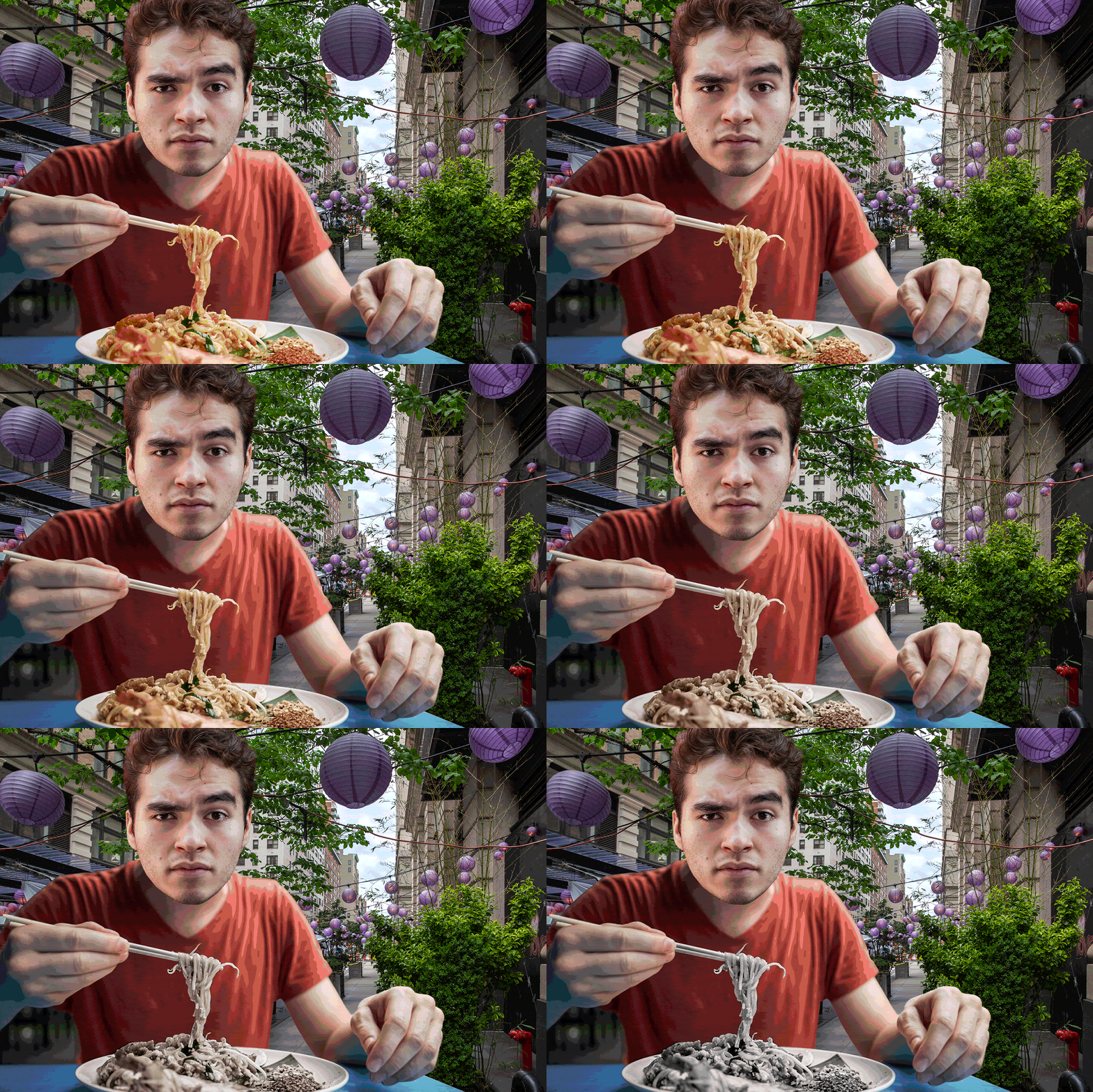
It’s a suspicion I’ve always brushed off as ridiculous when heading to an Asian restaurant—that is, until a few Chinese friends and my Indonesian girlfriend suggested it unsolicited. They’d try my dish and remark that it lacked spice (as in heat), then inform me in complete seriousness that the chef probably lowered it because I’m white.
“Let me order the spicy dish for you next time,” I’d be told, like a child.
The purported association between whiteness and spice tolerance is amusingly frustrating, considering how much I love spicy food, as I imagine many other white people do as well—especially those of us who have an unhealthy fascination with hot sauces. But sometimes when I order, the heat level does at least seem less than described, and when I do request a higher level, I’m occasionally warned with “Are you sure?” It’s understandable if so. There must be overly sensitive white people out there, constantly demanding refunds before bursting into flames, who are ruining it for the rest of us. They do that with a lot of things.
Gaze across the whiny internet landscape and you’ll find countless Reddit forums and Quora questions and X posts wondering as much. One Redditor tells of asking the server at a Thai restaurant for a spice level “as hot as if they were feeding their family,” at which point the chef came out to confirm he actually wanted that, saying that no refunds would be issued. Another Redditor claims he worked at an Indian restaurant, and “they’ll definitely make it a bit milder for white people.” Speaking of South Asia, my editor related a tale to me of a white woman who went with some Indian friends to order takeout, and when the friends asked for the food to be “Indian spicy,” the server just shook their head and refused until it was explained that the woman was ordering separately.
Over at X, Jeremiah Johnson writes, “There’s a real struggle I go through whenever I find a new southeast Asian or Indian place, where I have to really work to get them to give me actually spicy food instead of spicy-for-white-people food.” But he later adds, “In their defense, I’m so visually white that I border on translucent, so I get it.”
Even considering the hefty weight of these totally anecdotal testaments, I still have trouble taking the mechanics of such vague assumptions seriously. How would it work exactly? Does the server walk into the kitchen and subtly nod to the cook to ease off on the red pepper? Is a small W written on the order ticket? Do they install a special Caucasian button underneath the table so the waiter can press it like a clerk during a bank robbery? There must be code words for liability reasons: “We’ve got a macaroni and cheese sitting at Table 3,” he whispers into his collar. “Put that fire out.”
Chef Nick Wong, who co-owns the Asian American diner Agnes and Sherman in Houston, and has worked with the Momofuku Restaurant Group in New York, doesn’t entirely buy that restaurants have the time to adjust spice levels depending on what census box you tick.
“You mean you have this entire other set of SOPs [standard operating procedures] in place?” he asked. In restaurants, he said, “it’s like a decision tree, if this, then this—servers have enough to do that maybe they’re not trying to figure that out. OK, if they say they want this, we should knock it down one level, and it’s because of these specific parameters. That’s a lot of mental juggling to deal with on a Friday night at 7:30 dinner rush.”
This is not to mention that the classic spice star (or 🌶️ 🌶️ 🌶️ or 🥵 🥵 🥵) system isn’t set according to some centralized rulebook, any more than movie review star systems are, so a three-star drunken noodle dish at one joint may taste like a one-star at another. Of course, if restaurant staffers see a pattern of complaints about heat levels in a dish, they might adjust accordingly, perhaps in suburban areas or among older clientele, for whom higher spice levels and certain more pungent flavors might not be as prevalent or familiar.
“I can see it from a business owner/chef’s perspective: We keep getting complaints about this—let me just preemptively strike this, as it were, and make it a little less spicy,” said Wong. “So it could be a thing, even though I’ve never personally experienced it.”
There is another obvious wrench in the whole whitewashed spice narrative, and it’s probably covered in hot sauce. You may have noticed an entire area of the country called the South, where there’s a beloved subgenre of food singed in numerous forms of heat, and it often can be found with a white person sweating over it. But even without that, one can’t help but notice that white people throughout the country have an irrational obsession with hot sauce. There are festivals and shows and stores dedicated to the stuff. So the idea that all white people are getting the vapors and fainting after consuming a three-star pad thai is a bit hard to take. Plenty of communities obviously like hot sauce, but white people—usually guys lacking hobbies, let’s be honest—take it pretty far.
“I don’t think a lot of other ethnic cultures are like, ‘Let me get the 10-million-Scoville hot sauce,’ ” Wong joked. “They’re just eating food. No one’s trying to reach these altered-state-of-mind spice levels.”
The myth of white people getting served lightweight food is thought to occur not only at Chinese and Thai and Indian restaurants. It’s projected onto Mexican, Middle Eastern, African, Latin American, and Vietnamese establishments—basically, anywhere they don’t serve chicken fried steak, a white person is supposedly being cheated out of spice. While this notion of white people not handling their heat may be an exaggeration, it belies a much bigger and pernicious one: Not all so-called ethnic food is hot and/or spicy, and many white people have this silly idea that all nonwhite people grew up eating piles of chilies for breakfast, lunch, and dinner. They don’t, of course, and can be as sensitive to heat levels and different aromatic flavors as anyone else.
When I first reached out about this article idea to Krishnendu Ray, professor of food studies at NYU Steinhardt, he responded, before I’d asked any questions, with a bullet-point dismantling of generalizations around spiciness and racial or ethnic palates:
Such claims usually confuse aromatic spices and chilies;
Most cuisines of the old world (India, China, Vietnam, Thailand, etc.) did not use chilies until ca. 1900;
Elite White Europeans used a lot of spices in their food until around ca. 1750 [when it gradually fell out of fashion, on which more below];
There is nothing “authentic” about Black or Brown people using more chilies;
Authenticating associations of non-white food with chilies is reductive and unimaginative.
It’s not necessarily something you’d put at the beginning of a menu, but it does have a Ten Commandments feel, doesn’t it? The debate focusing on heat in food tends to mischaracterize the subtlety of flavors and creates a needless binary in which all parties involved either eat only spicy food or never touch the stuff.
“Most of this is just ill-informed stereotypes of each other’s food,” Ray said. “A lot of this argument about spiciness conflates new world cultivar—chilies—which come mostly from Central America, and spiciness. For me, it’s a classic, peculiar form of Orientalism, where you conflate all the nonwhite people, East and West, into one kind of spiciness. This conflation leads to the assumption that [in cooking] you don’t need skill, you don’t need subtlety, all you need is a heavy-handed use of spice to make it authentic.”
While Ray told me he enjoys the jokes about white people and spice, he doesn’t actually believe that restaurants are automatically lowering spice levels as a result. He sees the opposite, with heat levels in food needlessly raised to cater to them and others.
“I’ve been watching in New York City, and the spice levels have been ratcheted up so much as a sign of authenticity that I find most of the Indian food here inedible,” he told me. “In some ways it’s a dialogue, and it’s a dialogue where we are not explicitly talking to each other. We are assuming things about each other. … It’s a good joke, but I don’t think it’s true.”
That said, the spice queasiness association is not without historical context. As Ray explained, although European elites did use many spices in their food until around 1750, they began to “de-spice,” in a sense, as the continent rose in power, and cultivated their own identity around food, often prizing herbs instead of spices. In Europe, the notion emerged that food should taste of itself, and one can see how that approach may have filtered its way down to British and some American cuisine over the years. Even white Americans make fun of the blandness of British food (which is fine, if a bit unfair), but then don’t also complain when an ethnic restaurant makes the same mistaken assumption and lowers the spice level on you.
Clearly what’s needed to find the truth here is a totally unscientific experiment. The ridiculous parameters are simple. I’d show up to a local Thai place and continue to be white, and my lunch companion would continue to be Southeast Asian. We’d order the same high spice level of the dish covertly at separate times, with me ordering alone first, and her arriving at my table a little later to place her own. Then the crux of the test would be conducted, by casually doing what we’ve done dozens of times already: trying each other’s food. We’d compare notes afterward.
Now, I’d love to tell you that my girlfriend received a volcanic pad see ew while I got a cold plate of egg noodles with ketchup, but there was no difference between the two. Both were respectably spicy, and in fact, she found hers too much so to finish. “Too hot?” the owner asked her when she requested a to-go box. “It’s too hot for me as well. I always get mild.” So what can be learned from this NASA-with-full-funding-like study? People have different tastes, apparently. And, somehow, I didn’t settle all racial tensions by ordering food I already like.
Are there some ethnic restaurants in certain regional areas lowering the heat level when they see a horde of white yokels approaching? Perhaps. It may have really happened to this yokel a few times too. But we also can safely assume there are other restaurants needlessly jacking up the heat for a table of white coked-up Wall Street execs obsessed with Scoville units. That’s multiculturalism for you.
No matter what race or ethnicity you belong to, there’s always a small minority embarrassing the rest in some form. Perhaps we could try to understand that there’s more to food than white-hot levels of heat, and not take it seriously when the spice level is a little lower or higher than it should be because of a bad assumption. Just leave a good tip regardless, and maybe don’t start an international incident over a bowl of curry.