Sign up for the Slatest to get the most insightful analysis, criticism, and advice out there, delivered to your inbox daily.
Ask any Catholic-school kid—current or former—and they’ll tell you: Wednesday Mass sucks.
Once a week, the school steals an hour from lunch or recess and forces you to sit in a hard wooden pew designed by sadists and kneel on kneelers that give you the back pain of a 50-year-old before you hit puberty. To pass the time, you count the stained glass windows or stare at the light fixture dangling from the ceiling, wondering which unlucky kid it’d flatten if it came loose. Easily, though, the hardest part is pretending to solemnly worship as a child—all the while surrounded by all of your best friends, who are also children. Jesus may have fed the 5,000, but I imagine even he’d struggle to keep a second-grade class quiet.
From kindergarten until I left for college, I attended four different Catholic schools in Sioux City, Iowa. Each one compelled me and my fellow students to attend Wednesday school Mass every week. We trudged through snow. We crossed busy streets. We adhered to an unspoken creed that felt older than Rome: Neither snow nor rain nor heat nor the deepest Midwestern gloom keeps these students from their Wednesday Mass—and Iowa had plenty of all four.
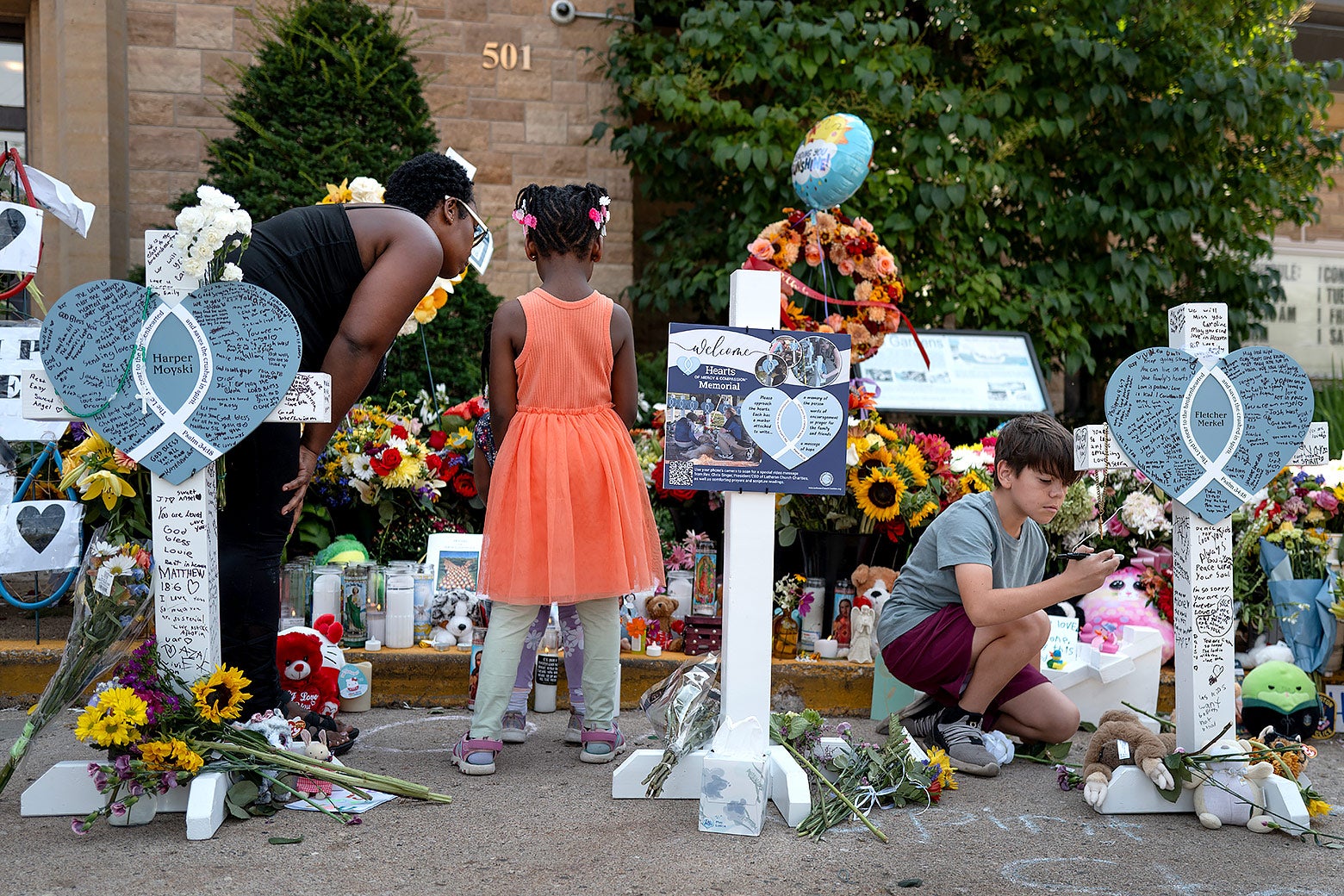
Last week, a shooter opened fire through a stained glass window during Wednesday school Mass at Annunciation Catholic Church and School in Minneapolis, Minnesota. Two children were killed: 8-year-old Fletcher Merkel and 10-year-old Harper Moyski. Twenty-one others were injured, including 18 children and three elderly parishioners. As I write this, two students have required surgery, including 12-year-old Sophia Forchas, who had part of her skull removed in an emergency procedure.
Fletcher’s death hit one family particularly hard. His best friend’s mother, Kacie Sharpe, told reporters how her child lost a person they’d grown up with. Someone they probably whispered to and joked with at Wednesday Mass. I can’t stop thinking about that—because Wednesday Mass was where I was surrounded by my own best friends, too. It’s what made the boredom bearable, even enjoyable. The thought of one of them not making it through school Mass, of an empty space next to me in the pew, of me walking back to class alone, guts me completely. That’s what these kids are living now.
Ask any Catholic-school kid—current or former—and they’ll tell you: Last week was a nightmare. It felt surreal—far too close to home to be real, yet completely undeniable. A reminder that no matter how numb you think you are to the harshest buzzsaw of modern-day America—violence, mass shootings, war—something will always be there to pull you right back into its teeth.
The fallout was depressingly predictable. Rumors and disinformation raced across X, with conspiracy theories developing that were focused on the shooter’s identity and motives. FBI Director Kash Patel vowed to investigate the shooting as an “act of domestic terrorism and hate crime targeting Catholics.” Right-wing figures like Matt Walsh, Charlie Kirk, Marjorie Taylor Greene, and Laura Loomer latched onto the suspect’s transgender identity, framing the tragedy as “trans terrorism.” President Donald Trump ordered flags across the nation to be flown at half-staff in honor of the victims, and added in a Truth social post: “Please join me in praying for everyone involved!”
By this point, “thoughts and prayers” has become a meme. Like The Onion’s “ ‘No Way to Prevent This,’ Says Only Nation Where This Regularly Happens” headline, it’s a well-worn chestnut, to be dusted off and deployed in case of any horrific tragedy: In case of a school shooting, break glass. While there was once a time when it would have been unconscionable to criticize this, then there was a time where only very online liberals would do so, now there have been enough school shootings that major Democratic media figures and politicians have pushed back on it.
“Prayer is not freaking enough,” MSNBC host and former White House press secretary Jen Psaki wrote on X. She added, “Enough with the thoughts and prayers.”
“These children were literally praying as they got shot,” California Gov. Gavin Newsom wrote on X.
“Don’t just say this is about thoughts and prayers right now,” Minneapolis Mayor Jacob Frey said at a press conference. “These kids were literally praying.”
Vice President J.D. Vance—who is a Catholic convert and visited Annunciation on Wednesday, with his wife Usha—pushed back on this. “Of all the weird left wing culture wars in the last few years, this is by far the most bizarre,” Vance posted on X. “‘How dare you pray for innocent people in the midst of tragedy?!’ What are you even talking about?”
He later appeared on Fox News to continue to defend prayer in response to the gun violence that prayers have regularly failed to prevent. “When I see far-left politicians say, ‘How dare you offer thoughts and prayers? You need action. I don’t care about your prayers. I care about what you are going to do to prevent this from happening.’ Why does it have to be one or the other?” he said. It reminds me of the time he called school shootings “the reality we live in” at a campaign rally in Phoenix, Arizona, nearly one year ago to the day.
I’d like to confess something: I’m still a Catholic. More specifically, I’m what more hard-line, traditional Catholics (aka the annoying ones) call a “cafeteria Catholic,” one who picks and chooses which teachings of the church to believe while pretty much ignoring the rest. Call me a CINO: Catholic in name only. I eschew the church’s stance on things like abortion, gay marriage, gender equality, premarital sex, birth control, and masturbation. I bear false witness. I haven’t remembered to keep holy the Lord’s day in years. And, if you ask them, I do not honor my mother and father enough.
But I’m still a Catholic—and the lessons imparted to me in the church and schools are still with me to this day. I learned how to add and subtract in the basement of St. Boniface. I got into my first fight in the line to Wednesday Mass at St. Joseph’s. I fell in love for the first time at Blessed Sacrament. And I learned that I wanted to be a writer at Bishop Heelan Catholic High School. I made my best friends and learned my biggest lessons before and after crossing myself walking into Wednesday Mass.
It was where I became aware of how potent prayer could be. When I was in high school, a doctor discovered a precancerous tumor on my dad’s pancreas. The growth caused his blood sugar to crash dangerously low at random times—often while he drove his car. I remember going to Wednesday school Mass for an entire year where the only thing I ever prayed about was for the tumor to disappear. For him to feel better. For me to get my dad back. Eventually, he went to a hospital in Iowa City to get it removed and, thankfully, it hasn’t been an issue since. While I know the work of a team of doctors and nurses helped my father, a small, childish part of me holds on to the idea that it was a miracle—that my prayers had been answered.
Try as I might over the years—and, trust me, I really did try—I could never quit it. To this day, when I’m anxious or nervous, I’ll pray. I always say three Hail Marys and one Lord’s Prayer because Father Kevin told me to after my first confession. I still believe the Pope is the infallible voice of God the almighty Father, and believe that when the priest consecrates the bread and wine, it transubstantiates and becomes the flesh and blood of Jesus Christ, our Lord and Savior, amen.
I believe in miracles, like when 10-year-old Weston Halsne survived last Wednesday’s shooting, only for doctors to discover later that a bullet fragment had lodged near his carotid artery—a hair’s breadth away from killing him. Or like when God heard me cry out on the carpet of my childhood bedroom and in the pews of the Cathedral of the Epiphany for him to please heal my dad and please, please, please, don’t take him, don’t let him die.
I don’t like cynicism when it comes to prayer. I don’t like the way conservatives use it as an insincere, empty response to the uniquely and unquestionably American issue of gun violence—hollowing out something sacred into a mask to be worn to avoid the blood and grief and dead schoolchildren in front of them. I don’t like how I know that despite the fact that the parents of the victims of the Annunciation shooting are begging him to do something about gun safety, Vance is going to go back to Washington and do the opposite.
I don’t like that the liberal response is nothing but performative outrage. They attack the hypocrisy of “thoughts and prayers,” using their offense as mealymouthed, ineffectual cover, without (Sen. Chris Murphy, President Joe Biden, and the Bipartisan Safer Communities Act aside) doing a single goddamn thing to change it themselves. They act as if the very act of prayer were the problem itself, as if grieving parents and scared kids have to defend their faith before burying their sons, their daughters, their friends. In the end, they leave us the same thing as the right: no safer schools, no fewer funerals, and no reason to believe next week will be any different.
More than anything, though, I hate that everyone makes me feel like an asshole when I pray, like I have to choose: faith or outrage, grief or change, silence or rage. I want space to pray and grieve, without my prayer and grief being drafted into someone else’s culture war.
Prayer without action is just shouting into the void. Static on a busy frequency. But the inverse is just also hollow. Action without prayer is motion without meaning—a body moving with no soul guiding it. What is the point of doing anything—anything—without soul, or purpose, or hope?
Church is a lot of things. For me, it’s a space to hope—a place to imagine a better future. You go to church to pray for good health, for more money, for a happy family. You pray for the Bears to beat the Packers, for your lottery ticket to hit, for the lump that showed up in your dad’s X-ray to be nothing after all. You pray for your kids to be safe. But God doesn’t answer all prayers. And so church is also a space to grieve, as it was for the families of 8-year-old Fletcher Merkel and 10-year-old Harper Moyski. As it will be for so many of us.
I haven’t been back to Mass on my own volition in years. But, this Sunday, I’m going to wake up, brush my teeth, put on some nice clothes, and walk a few blocks to the Catholic church in my neighborhood. When I get there, I’m going to dip my fingers in holy water and cross myself before making my way halfway up the aisle to sit down in a hard pew. I might let my mind wander—count the stained glass windows, or imagine who’d get hit if a light fixture fell.
But first, I’m going to kneel down and pray.