Sign up for the Slatest to get the most insightful analysis, criticism, and advice out there, delivered to your inbox daily.
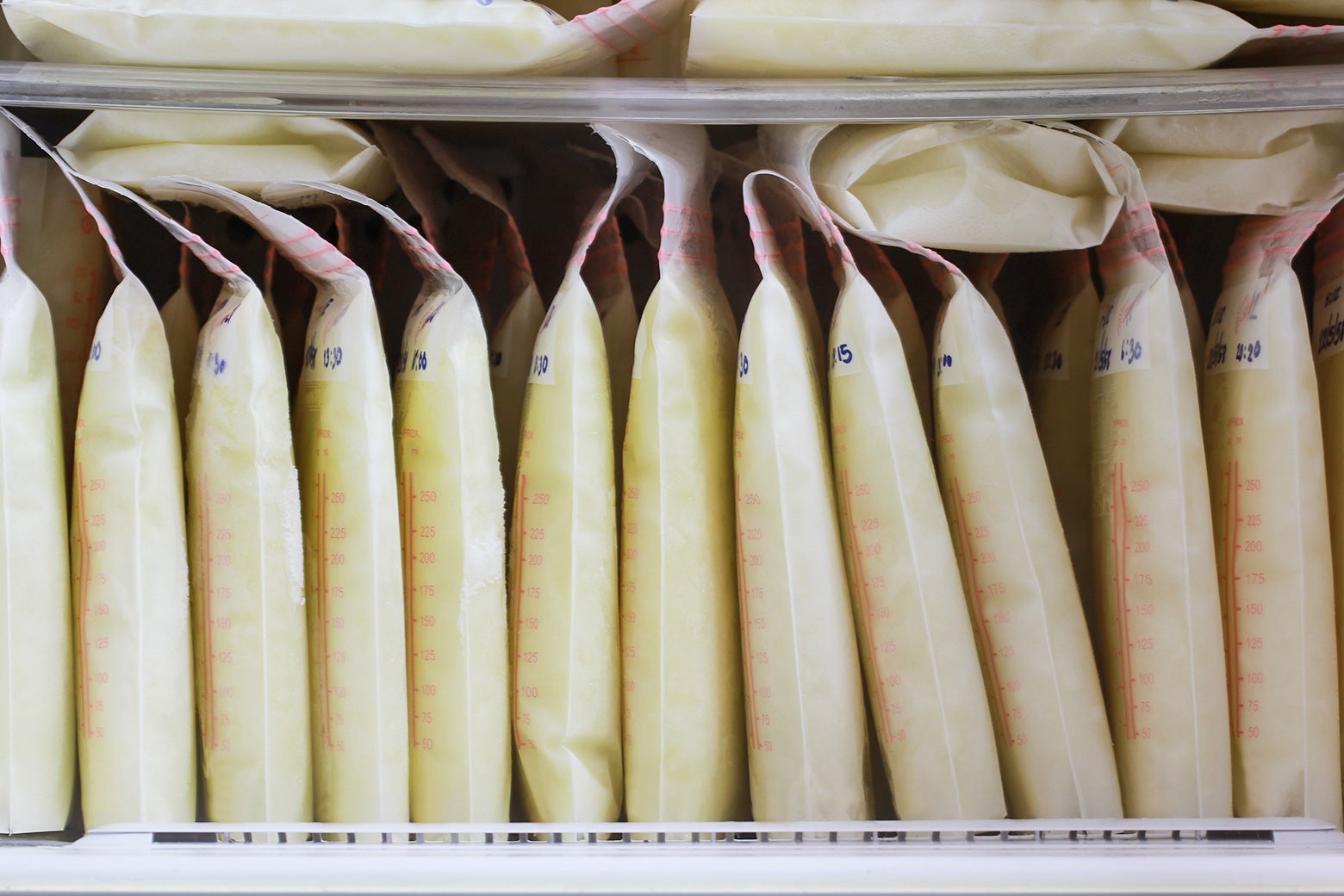
On a recent Tuesday at 3 a.m., I was cradling my 5-month-old daughter’s head against my left breast while doomscrolling the depths of motherhood TikTok when I came across an aptly served post from user @Mama_Pey. The video begins with a close-up of the shelves inside Pey’s freezer, a towering, upright, industrial-appearing appliance that is nearly overflowing with staggered bricks of glistening, butter-yellow frozen breast milk.
“This is why I’m weaning,” the self-described “Girl Mama of 2” announces to the 1.7 million users who have viewed the post so far. “I need to use all of this.”
I scrolled away. Immediately, I encountered Bailey Kisiel, a nursing student turned stay-at-home mom to two children under 3, who has also filled her grid with high-dairy content. In Kisiel’s most popular TikTok post—5.7 million views and counting—she casually speaks to the camera while pouring bottle after bottle of pumped breast milk into 48-ounce mason jars until several stand gleaming and full.
“For some reason, every time I sit down to combine my milk from the past four days, I feel like I have more every time,” Kisiel says to the camera with a sly smile. “What is happening?”
I was wondering the same thing.
To be fair, there is a certain soothing, ASMR-friendly rhythm to the sound of a full-fat beverage splashing, copiously, against the translucent glass walls of a cylindrical vessel. Even so, in the sleep-deprived delirium of my postpartum existence, these videos stirred a viscous mix of intrigue, envy, outrage, and fear. While I have no reason to think my own breastfed baby isn’t getting enough to eat, I also don’t produce anywhere near that kind of surplus. And so, as I watched these women perform an unequivocally extreme—and extremely public—version of a traditionally intimate act, I felt a sharp stab of maternal inadequacy.
What I had stumbled upon was the oversupply side of social media, where women who produce extraordinary excesses of breast milk show off their bounty. If these moms are nowhere near your algorithm, this very niche corner of the internet might seem simply innocuous, if odd. But for breastfeeding mothers and experts, these milkfluencers, as I’m calling them, are a highly visible source of misleading information, doing more harm than good. Nicki Davis, who is a lactation consultant certified by the International Board of Lactation Consultant Examiners and goes by BabyWhisperer Nicki on TikTok, has seen her in-person clients have an emotional response to these videos. “If I could put the tears into jars, I’d have a hundred gallons of moms crying about how these videos affect them,” she told me.
Oversupply is the colloquialized term for hyperlactation, a condition in which the amount of breast milk produced by the mother is beyond what a baby needs to properly grow and thrive. Some women develop an oversupply naturally, but most cases are self-induced by long and/or frequent pumping sessions that signal to the body that demand is high, prompting production to ramp up.
According to Dr. Chandria Lynn Johnson, an OB-GYN and lactation consultant certified by the International Board of Lactation Consultant Examiners who facilitates an evidence-based breastfeeding group, intentionally cultivating an oversupply can come with significant downsides: breast soreness, milk leakage, clogged ducts, mastitis, and nipple pain. And that’s just for mom. “With an oversupply, once the letdown starts, the flow can be like a water hose,” Johnson told me. That high-pressure output can cause babies to cough, choke, gag, bite down and, sometimes, refuse to nurse altogether.
None of these risks are highlighted on the profile pages of TikTok’s most popular oversuppliers. Instead, the algorithm rewards spectacles such as the “First pump of the day,” where women, often in low-cut tops, poke at their engorged breasts before cutting to scenes of full pump reservoirs, followed by the slow, reverent pouring of milk into pristine and inviting containers.
In ads for baby bottles and burp cloths, breastfeeding itself is often portrayed as an effortless, beatific experience. And, sometimes, it is. With both of my children, I’ve had nursing moments that have bordered on the euphoric. But I’ve also known the strain of trying to pump enough milk during the workday, the dips in supply that accompany illness or heightened stress, and the overwhelming panic that takes hold when output falls by even a single ounce (as it turns out, a very particular breed of grief tends to arrive alongside the realization that your body is failing to meet your child’s most basic needs).
“In the early stages of motherhood, many women experience deep self-doubt and an almost instinctive need to measure their worth as mothers,” Dr. Marianna Strongin, a psychotherapist in New York City, explained. “In the postpartum period, breastfeeding often becomes one of the most powerful, and painful, ways of doing this.”
One can see this maternal disquietude play out in the comments beneath the oversupply videos.
“The things I’d do for an oversupply as an under-supplier,” one user writes.
“How do you do it I don’t get enough for my baby to eat,” writes another.
The lactation consultants I spoke to feel that they’re fighting an uphill battle against a flood of breastfeeding falsehoods circulating through social media, many of them perpetuated by oversuppliers. Even the academic research community has taken notice. A study published in August found that TikTok #breastfeeding videos had been viewed roughly 86 million times. But more than a third of them contained content that wasn’t evidence-based, or offered outright misinformation.
Karolina Ochoa, a board-certified lactation consultant and owner of Inland Breastfeeding Center, constantly reassures her clients that they should not believe everything they see on social media. “We mention very often, like, hey, what you’re seeing online is not the norm,” said Ochoa. She is also bothered by the commonly used term just-enougher, which refers to moms who make exactly the amount of milk their babies need. “I mean, even the word, that’s something negative. It’s as if you’re almost not enough, instead of, ‘You make the perfect amount for your baby.’ ”
But perfectly ordinary motherhood rarely goes viral. And without mass appeal, the collabs simply won’t come knocking. Many popular milkfluencers post sponsored content or earn commissions from brands that sell everything from pump parts and storage bags to “milk-boosting” supplements (most of which have little, if any, scientific backing).
“What drives me insane,” Ochoa said, “are influencers who show off their oversupply and say, ‘Oh, it’s because I take this colostrum supplement.’ Then a week later it’s some other product. There’s just so much dishonesty.”
As a physician and researcher, I’m trained to parse data and recognize unsupported claims, but nothing disarms those credentials quite like the restless uncertainty of motherhood. Like so many other parents, I have, not infrequently, found myself desperate to believe that a magic bullet does, in fact, exist—one that will stop my toddler’s tantrums and potty train him overnight, while guaranteeing my infant’s brain development, making meal prep effortless, and, yes, increasing my milk supply. Might this divine panacea even be shoppable at the link in bio?
On platforms like TikTok and Instagram, motherhood culture seems to thrive on the unconquerable pursuit of abundance, be it of time, patience, cleanliness, gadgets, obedience, or control. And nowhere is that pursuit more literal than in oversupply posts, where a freezer bursting at the seams is a trophy case of effort and endurance. But this pageantry of abundance leaves little space for contentment. The more excessively motherhood is performed, the more impossible it becomes to inhabit. For those watching oversupply videos, the lesson is quietly corrosive: Whatever you have to give, no matter how obviously and undeniably sufficient, it is not, and never will be, enough.
When faced with criticism, milkfluencers have argued that they are simply sharing information and empowering other mothers. “Are we not allowed to be amazed by what our bodies can do?” Kisiel asked her followers in a May video defending her content.
But you don’t have to linger on oversupply TikTok for long to realize that many of these women are also motivated by a deep-seated fear of failure. In fact, in that same video, just moments later, Kisiel’s tone subtly shifts as she recounts the disappointment of her first breastfeeding experience.“I was told by a lactation consultant that I should not pump in the beginning because I am going to create an oversupply,” Kisiel explains. Heeding this guidance, she fed her daughter only at the breast until returning to work. But, as often happens when maternity leave ends, her output then dipped and, with no reserves to rely on, her ability to exclusively breastfeed came to an end much sooner than she wanted it to. “It was so, so hard for me to go to the store and buy that can of formula,” Kisiel says as she pours freshly pumped milk into a Dr. Brown’s bottle.
In a similarly themed post, Niki Jensen, an Arizona mom whose breast milk storage videos are among the most popular on the app, dances elatedly to an up-tempo tune while showcasing bags and bags (and bags) of frozen breast milk. “Went from barely making enough with my first to having an oversupply with my second,” the caption reads. Ostensibly, the tone of the video is lighthearted, even joyous, but there is a palpable undercurrent of anxiety in Jensen’s revelry that is reinforced by viewers’ responses to the video: “When I started actually producing more then enough milk I cried tears of relief lol,” an exemplary comment reads.
The nervousness, if not the reprieve, is something I can relate to. A few days ago, I came home from work to find out that our nanny had used an extra two bags of stashed milk to keep up with our daughter’s growing appetite.“That’s way too much!” I snapped, panicking. It is already a struggle to fit pumping sessions in between patient visits, and I knew immediately that I would never be able to keep up with that amount of intake.
“It can be really stressful to new moms who are already tired and stressed and having to leave their babies to go back to work far too early—in the United States, at least,” Johnson, the OB-GYN and breastfeeding expert, told me. Given this reality, it’s really no surprise that so many mothers fixate on building a surplus, or that oversupply videos attract such fervent attention.
Sarah Banks, a mother from Manchester, Tennessee, who also regularly posts about having more breast milk than she needs, expressed no ambivalence when we spoke recently. “I stuck to a strict schedule to get an oversupply,” she said. “And I’m very proud of myself for being able to produce this much milk.”
However problematic these videos may be to some, that pride is understandable. The act of making, and measuring, milk, especially in a culture that severely undervalues maternal labor, can feel like tangible proof of competence and productivity. But it also reinforces the notion that our value must be constantly quantified, and displayed—which is why Johnson still feels that oversupply influencers have lost the plot entirely.
“People promote these enormous freezers full of milk and show off like it’s this amazing accomplishment to have fed your freezer,” she says. “But, really, the goal is to feed the baby.”