Sign up for the Slatest to get the most insightful analysis, criticism, and advice out there, delivered to your inbox daily.
In the past few decades there have been numerous incremental changes to grocery stores, like the crazed proliferation of snacks and frozen food, security cameras tracking anything that moves, and self-checkout robots flashing in panic because they can’t detect your Twix bar in the bag. But by all appearances, shopping carts and baskets waded through that swirl of advancement mostly unaffected.
Carts remain the open-ceiling prison cells on wheels they were 50 years ago, and baskets don’t look much different either. If you were somehow able to travel back in time via a flux-capacitor-equipped shopping cart to an A&P in 1969 and take it for a spin around the store, no one would look at you weird. Just your pajama pants, perhaps.
The cart’s stubborn tech resistance is under pressure, however, as companies are looking to take something which totally ain’t broke and create new problems under the guise of convenience. Several stores are testing smart carts that are essentially self-checkouts on wheels, letting users scan items while bumping into another person because they’re not watching where they’re walking. The Caper by Instacart, for instance, automatically scans any item you toss in, includes built-in weight measuring for that far-too-ripe produce, and takes payment as well, likely threatening the job security of both actual cashiers and those anxious stationary self-checkouts (sounds like grounds for the first human-robot union to me).
You probably haven’t seen any of these carts from the future at your local market, though, because they’ve been adopted at a pace as slow as a buggy (as they call them down South) with a wobbly wheel. Most grocery stores appear satisfied with the standard grocery receptacles we’ve been using for decades. They just work too damn well. And it was the invention of the shopping cart in the first place that remains the enduring golden goose of American consumerism.
Leaning on a cart while mindlessly meandering around a giant supermarket may seem rudimentary, but it wasn’t always this way. In the general stores of the early 1900s, you didn’t stroll around shoving items into a receptacle; instead, you presented a generic list to a clerk, who reached for the stacked items piled high on shelves, often allowing for ragamuffins to steal things from the counter while his back was turned. What you acquired were mostly dry goods, and so if you wanted bread and meat as well, that often necessitated separate trips to the bakery and butcher.
But in 1916, the best-named grocery store to date came into existence and changed how we shop: Piggly Wiggly. It was where Memphis resident Clarence Saunders put a rather innovative idea into practice. What if we actually displayed the items by category, let customers walk around the store and place what they wanted into a wooden basket, and then had the cashier check them out? At the time, it must have felt like too much power for one customer to have.
It wasn’t, though. The idea of self-service sold like hotcakes during a time when people actually used that expression. The streamlined approach saved on labor costs and inefficiencies, and those savings took off even more with the advent of supermarkets, which introduced volume discount selling, loss leaders (items priced below market value to lure you into also buying those with higher markups), and warehouse-like buildings usually located outside the town center. It was epitomized when former Kroger employee Michael Cullen launched the 6,000-square-foot King Cullen in 1930, generally considered the country’s first supermarket.
“A lot of them are consciously, explicitly modeled after a theme attraction. This is something you would come to tour because it was so exciting and innovative,” says Benjamin Lorr, author of The Secret Life of Groceries. “We’ve gone to all this trouble to create this bounty-land where you walk in and you’re astonished by how much is available to you.”
Yet a core problem remained. Human beings have frail limbs that can only carry so many groceries, and most of us don’t know how to juggle. So customers back then would do this crazy thing where they stopped shopping when they couldn’t carry any more, and then would just, you know, head home. This was clearly a barbaric state of affairs and needed to change.
“The whole model is trying to get you to buy, buy, buy, more, more, more,” says Lorr, “and we’re limited by our puny human frame, so we had to invent this other thing to truly load up to our heart’s desires.”
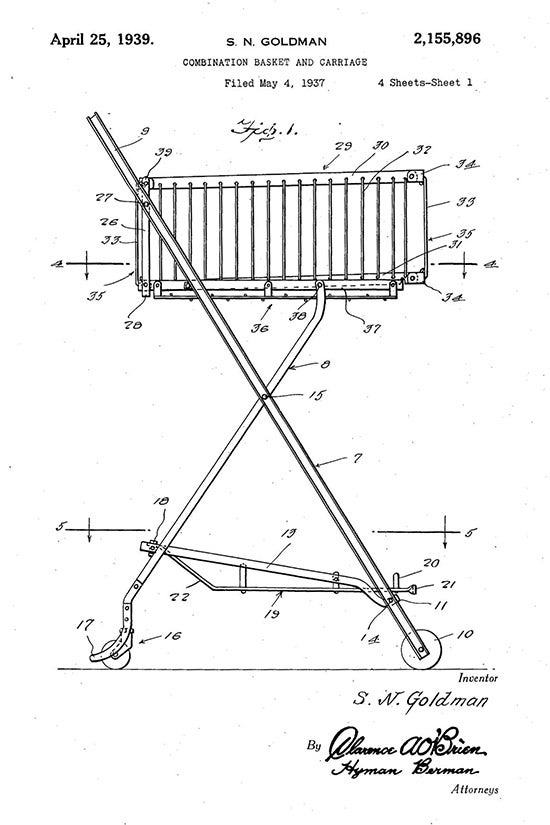
Enter Sylvan Goldman, a successful grocery owner in Oklahoma who purchased the Humpty Dumpty chain in the mid-1930s. He couldn’t help but notice the above drawback, and worked with mechanic Fred Young on a prototype for the shopping cart. Picture a folding chair on wheels with a basket on the seat and a platform at the wheelbase to hold another basket. That’s essentially what the first patented shopping cart was: a contraption for holding two baskets.
Did this newfound chariot of abundance cause a shopping cart stampede? Not exactly. There was a great deal of resistance, with men reportedly finding the carts a bit effeminate, and women not enjoying the feeling of pushing around what felt like another baby carriage. So Goldman secretly hired models to walk around the stores pushing the carts and create the impression that all the sexy cool kids liked them. It totally worked, as that tactic usually does.
Only one finishing touch remained: The lonely carts had no ability to hug each other, and took up a ton of room like dumb metal cows, almost needing an extra supermarket-sized space just to store them. But in 1946 Kansas City engineer Orla Watson developed the so-called nesting feature, which involved a swinging one-way rear door that allowed the carts to fit together. Goldman was like “Hey, I was going to do that,” and took Watson to court; however, he eventually recognized Watson’s design and acquired an operating license as part of a compromise.
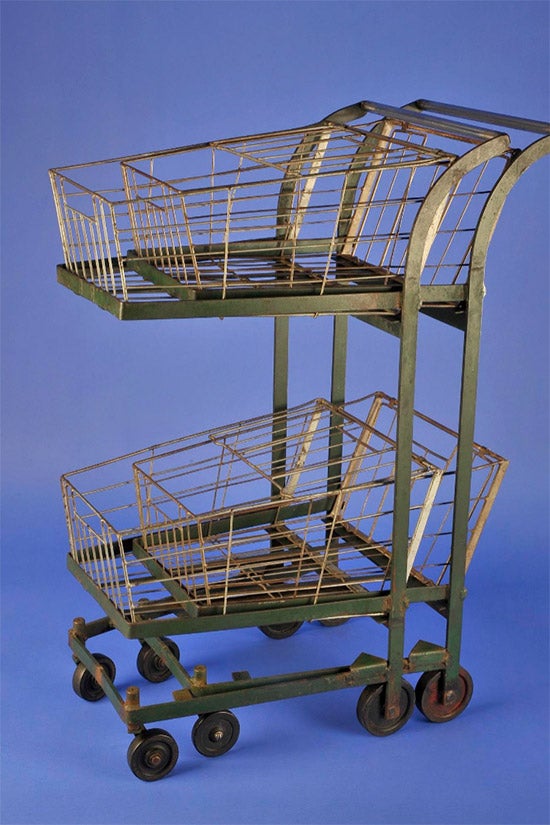
Now it should be noted here that Goldman didn’t really invent the cart qua cart, which obviously had existed in various forms for thousands of years. When asked what the country would have been like if he hadn’t invented shopping carts, he amusingly responded, “Oh, I’ll tell you, it’d be just like it is now because somebody else would have.” His innovation, rather, was transporting the age-old concept to the context of a self-service grocery store, which, along with the proliferation of supermarkets, automobiles, and refrigeration, cultivated the impulsive consumer culture we know and love today. Whereas once people were mindfully selecting items and placing them into a basket, now they could mindlessly shovel them into a cart and forget what’s in there.
“It accelerated a kind of visual scanning, encouraging the eye to spiral around miscellaneous brands in a horizontal aisle-by-aisle manner, which is definitely today continued in the vertical bottomless scrolling of shopping onscreen,” says University of Leeds professor Andrew Warnes, author of How the Shopping Cart Explains Globalization. “Goldman’s patents engendered a kind of acceleration of self-service that, yes, leads to a kind of forgetting, a too-rapid movement to the next item in a rapid repetition of impulse buys.”
Having initiated a new frontier of shopping, the wily basket and the oaf-like shopping cart became the go-to grocery receptacles for decades, and except for slight alterations to size and material, the addition of child seats (to carts, not baskets), and the creation of tiny versions of carts to get the kids addicted young, they mostly remained unaltered. But the past few years have seen companies trying to change that.
Amazon is testing the Dash Cart at select Whole Foods stores in the Bay Area. After signing into the cart (you read that right), customers can scan items, use the screen map to remember what aisle those elusive sun-dried tomatoes are in, and check out by simply rolling through the specialized Dash Cart lane. It’s like preboarding in reverse. Woolworths (in Australia) and Walmart (in Chile) are testing their own versions as well. And since your average brutalist cart and basket might be lacking in style for some people, now companies like Roulette are pushing the sexy luggage-like shopping trolley, so your groceries can feel like they’re going on a trip. Hopefully it matches your outfit.
We may look at grocery stores with smart carts, self-checkouts, online ordering, and elaborate security apparatuses, and think that it’s all a sign of massive transformation. But the core model remains virtually unchanged. Tech-wise, it’s a rather slow-moving industry with razor-thin margins, customers resistant to change, and an environment rife with potential glitches for testing new technologies. Which is partially why these brainy carts don’t seem likely to displace their slow-witted elders en masse anytime soon.
The other reason for their stickiness (aside from the remnants of rotting fruit)? In a sense, the shopping cart is the enduring, iconic symbol of our mentality toward impulse shopping for comfort. But as Warnes describes, modern companies thought it would stay only that: a symbol.
“I tried to suggest in the book that it’s a failed skeuomorph—that when Amazon and other internet providers first started using [the cart] as an icon in the 1990s, they had this belief that their services would soon render it obsolete. So that it would become a kind of weird dead link for the technology that killed it, like the paper clips and rulers and pencils that you see on Microsoft Office toolbars,” he says. “I do find it interesting that shopping carts dodged this common fate—although many have shrunk in size, if anything they are used more today than ever, and not least because many of us visit the supermarket more frequently than we used to.”
One can imagine the shopping cart and basket perched like angels above the fray, watching the decades go by as the country and grocery stores change all around them. We may one day see drone baskets that hover alongside you while you shop, and carts that return themselves to the corral. But for now, they remain our primary hunter-gatherer tools as we wade into the grocery jungle, only taking our hands off them during those rare moments when someone’s items are a little too close to ours on the conveyor belt and we slap down the divider.