Sign up for the Slatest to get the most insightful analysis, criticism, and advice out there, delivered to your inbox daily.
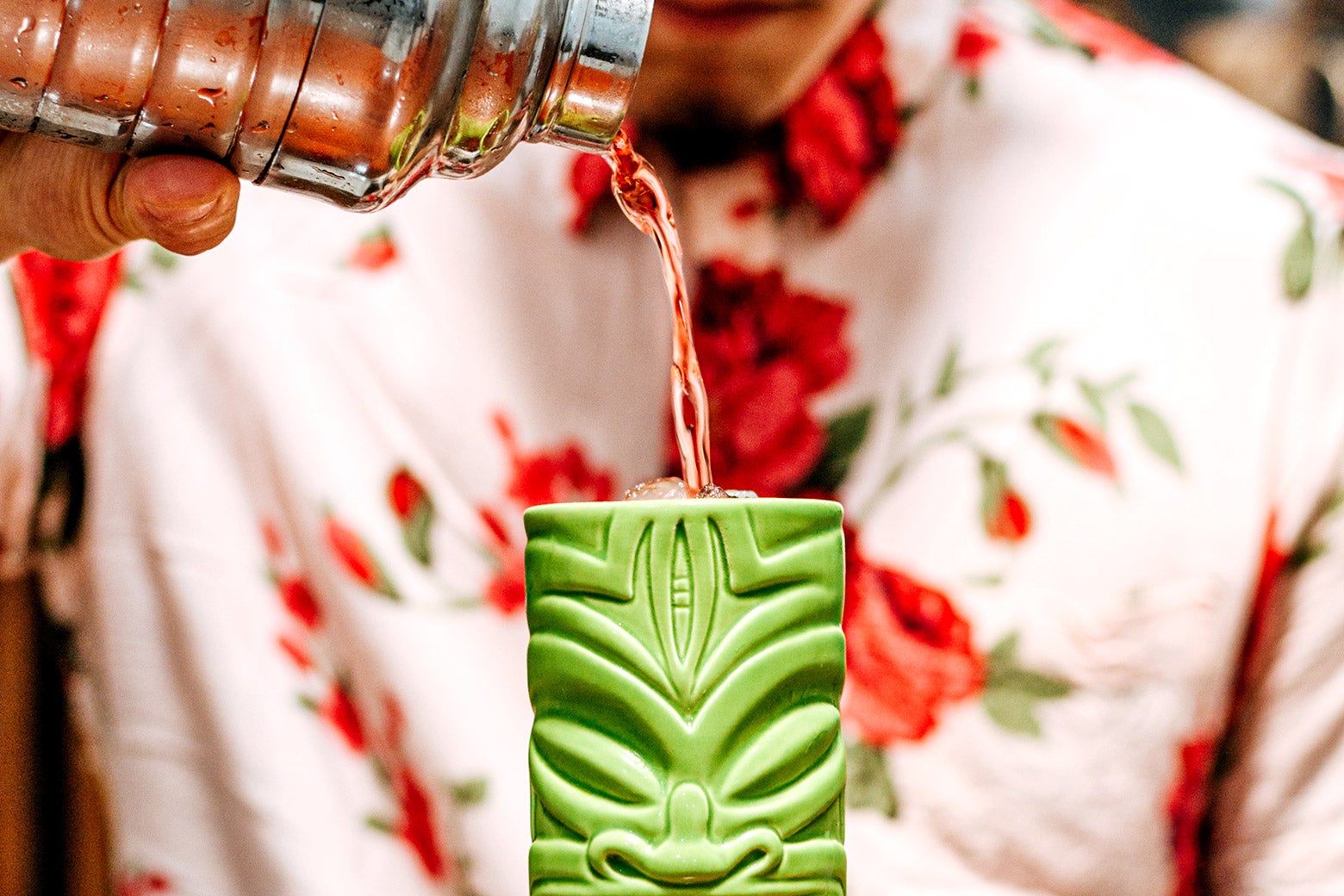
If the Easter Island Moai-shaped cup in front of me had his way, we would all be drinking more rum. As I drain the last drops of the mai tai mélange of orgeat, curaçao, lime juice, and rum from the cup’s pebbly matrix of crushed ice, I’m feeling sympathetic to his vision. But apparently not everyone is so gung-ho about the backbone of tiki mixology.
For nearly a decade, evangelists of dunder and molasses have been forecasting a boom in sales of the sugarcane-derived spirit. Rum’s proponents have found favorable comparisons in the recent successes in the worlds of whiskey and tequila. Barrel-aged rums, they observe, offer similar sipping qualities and ages as high-end bourbons, but often at much more attractive price points. Clear, cane juice rums, they note, serve up some of the same herbal, piquant, and mineral flavors that agave aficionados have thrown so much weight behind. Why wouldn’t the drinkers who have flocked to these categories in such great volumes develop a taste for rum as well?
The rum zealots’ optimism may emanate from the eternal sunshine of the piña colada, but the harsh reality is that the boom has yet to materialize. In fact, rum sales have contracted. It has been one of the worst-performing spirit categories in the U.S. The IWSR, the global leader for beverage alcohol data and insights, provided a snapshot of rum’s compound annual growth rate from 2018 to 2024 at a disappointing –3 percent, the lowest of any category it measured across that period. (Compare this to +11 percent for agave spirits.) That rate has dropped even lower, to –7 percent, from 2022 to 2024, a slouch matched in rate of decline only by dusty old brandy.
“Rum is kind of stuck in neutral,” says Bryan Inman, who goes by “the Rum Champion,” bartends at West Hollywood’s Lucky Tiki, and works as the national brand ambassador for Haiti’s beloved Rhum Barbancourt. “The mass opinion is that rum is just Captain Morgan and Kraken. The other idea that is hurting the category is that rum only belongs in umbrella drinks. We need to say it works in any cocktail you like.”
In terms of volume, over 90 percent of rum sales come from the standard-and-below category (i.e., mass-market, affordable rum). The family-owned Bacardi and Diageo’s Captain Morgan spiced rum still very much define the offerings most consumers are familiar with (though spiced varieties have fared relatively worse than white and gold options in recent years). In other words, the American rum drinker is not necessarily primed to understand what a good-quality rum tastes like, never mind conditioned to pay a premium for top-shelf stuff.
The issue is complicated by the sheer diversity of rum. Unlike whiskey, which is produced primarily in “Commonwealth” nations and some neophyte markets, like Japan and Taiwan; unlike agave spirits, which come from only one country (for now); unlike brandy, which follows in the wake of wine’s landscape; and unlike vodka, which carries the trappings of Slavic and Nordic tradition, rum is everywhere. Sugarcane migrated out from the tropical forests of New Guinea millennia ago. It has spread across the world like almost no other edible commodity.
Sugar unites us all, and rum is its more-adult stepbrother. From vast, populous countries like India and Brazil, to tiny islands like Mauritius and Barbados, rum has weaseled its way into traditions in disparate places. It’s hard to capture the diversity of what rum stands for without delving into cane varietals, production techniques, climatic conditions, and cultural contexts. Most of us hardly get past ordering anything more than a rum and Coke or a Dark and Stormy; of course the nuances of a shared global spirit are lost.
But as drinkers found themselves homebound during COVID, rum benefited from a surge of interest and, perhaps, a newfound need for escapism. This was a momentary boon for the category. Single-cask, higher-proof aged rums were coming to the U.S. market to meet drinkers engaging in a liquid form of armchair travel. A taste of Brazil, Barbados, Jamaica …
“During COVID and lockdown, there was a big move towards exploration and really unique stories that transported you to a different place, and that was a good moment for rum,” explains Maggie Campbell, CEO of American Cane, a spirits company focused on elevating rum’s reputation in the U.S. “But something that hinders rum is that there are so many communities and countries making it. People want to lump it into one thing.”
Since 2022, as we saw, rum’s growth has cratered. Drinkers have traded in their homemade Cuba libres for the liberty to go where they please. Indeed, the surge in premium spending on spirits that we saw in the pandemic years across nearly all categories has subsided.
Under the current sobering economic conditions, those cask-strength, 10-year bottles that sparked our imaginations are a harder sell. “All price bands of rum, with the exception of the top price band, prestige plus, declined in volume in the U.S. from 2023 to 2024,” an IWSR representative noted to me. (Prestige plus is defined as over $214 for a fifth of liquor and represents only 0.01 percent of the market by volume.) Inman adds, “People are less interested in paying for bottles north of $150. People are looking for a good rum that can go in a cocktail or be drunk neat.” The moment for a 14-year, pot-stilled Barbados rum from Foursquare comes around less often.
A surfeit of $350-a-bottle, 18-year-old scotch means that scotch had a tough time selling 15 years ago. Rum is having the opposite problem. Aged, premium products haven’t fomented mass adoption of the category, so it’s time to turn to younger, cheaper bottles as a solution.
Some savvy rum brands see the tightening of the consumer belt as an opportunity to reintroduce rum, from the bottom up. “As the economy has changed and things have become tougher, people are looking for things that are budget friendly, low effort, comforting, and fun,” says Campbell. “This is opening a new opportunity in rum. People want unique and incredible expressions, but they also want a go-to table rum.”
Where rum previously wanted to position itself on the credenzas of connoisseurs of other fine spirits, it forgot to acquaint itself with the common American drinker. There is work to be done rehabbing the spirit’s reputation at neighborhood bars across the country, where rum-infused riffs on classics like a cane juice rum Paloma or, as Inman suggests, a rum Paper Plane are still lacking. But in the meantime, rum brands are pitching the spirit to price-conscious drinkers by emphasizing the value for the quality they offer.
Campbell and American Cane have intentions to build a distillery in the U.S. one day, but they don’t feel the consumer is ready to value rum where they think it should rank. “For American Cane to have real long-term success, we need to do the educational part first,” Campbell explains. Their solution to bridge the gap: launch a good-value, quality rum sourced from trusted producers. Banter, its flagship line of white and amber rum, delivers on quality in bottles that are both under $35. The white rum belies the Bacardi blandness we might expect at this price point—it’s crisp, zesty, even nutty.
The brand Inman represents, Rhum Barbancourt, has its Haitian Proof white rum, which is 55 percent alcohol by volume. “I will say, with 100 percent bias,” he jokes to me, “for the price and the proof, there is nothing on God’s green Earth better. It has a lot more flavor than the misconception that white rum is very neutral.” Sometimes retailing at around $20, it provides a bang for your buck that’s hard to argue with, and the spirit is something Haiti can be proud of. Other smaller islands like St. Croix offer smooth, mixable white rums, including Cruzan Aged Light Rum, which is less than $20 a bottle.
If Americans continue to associate rum with beaches and pirates, distillers need to be more strategic in how they coax consumers to part with their precious doubloons. Pricey bottles with jargon-filled labels miss the point. Rum, for all its hype, is still in its tequila-is-only-for-taking-shots phase. It has always been a fun and flirty tipple, but it’s time to up the level of commitment. While the industry once swashbuckled its way toward premiumization, it seems time to veer back to the safer harbors of familiarization.
Yes, there are already quality, sophisticated bottles on the market for connoisseurs, but the category’s success is dependent on selling quality to the most price-sensitive drinkers. What can rum do without repeat customers? Lucky for us, some brands are already catching on and losing none of the tiki fun. “We want Americans thinking of themselves as rum drinkers,” Campbell concludes. “We want people to jump in the pool with us.”