Sign up for the Slatest to get the most insightful analysis, criticism, and advice out there, delivered to your inbox daily.
O’Doul’s is a doleful name. A sonorous Gaelic dirge that could travel a distance and still be heard. A lament nearly homophonous with “Oh dear!” Yet, it is the designation of America’s most distinguished near beer. But increasingly, it sounds like the lugubrious echo of drinking in decades past.
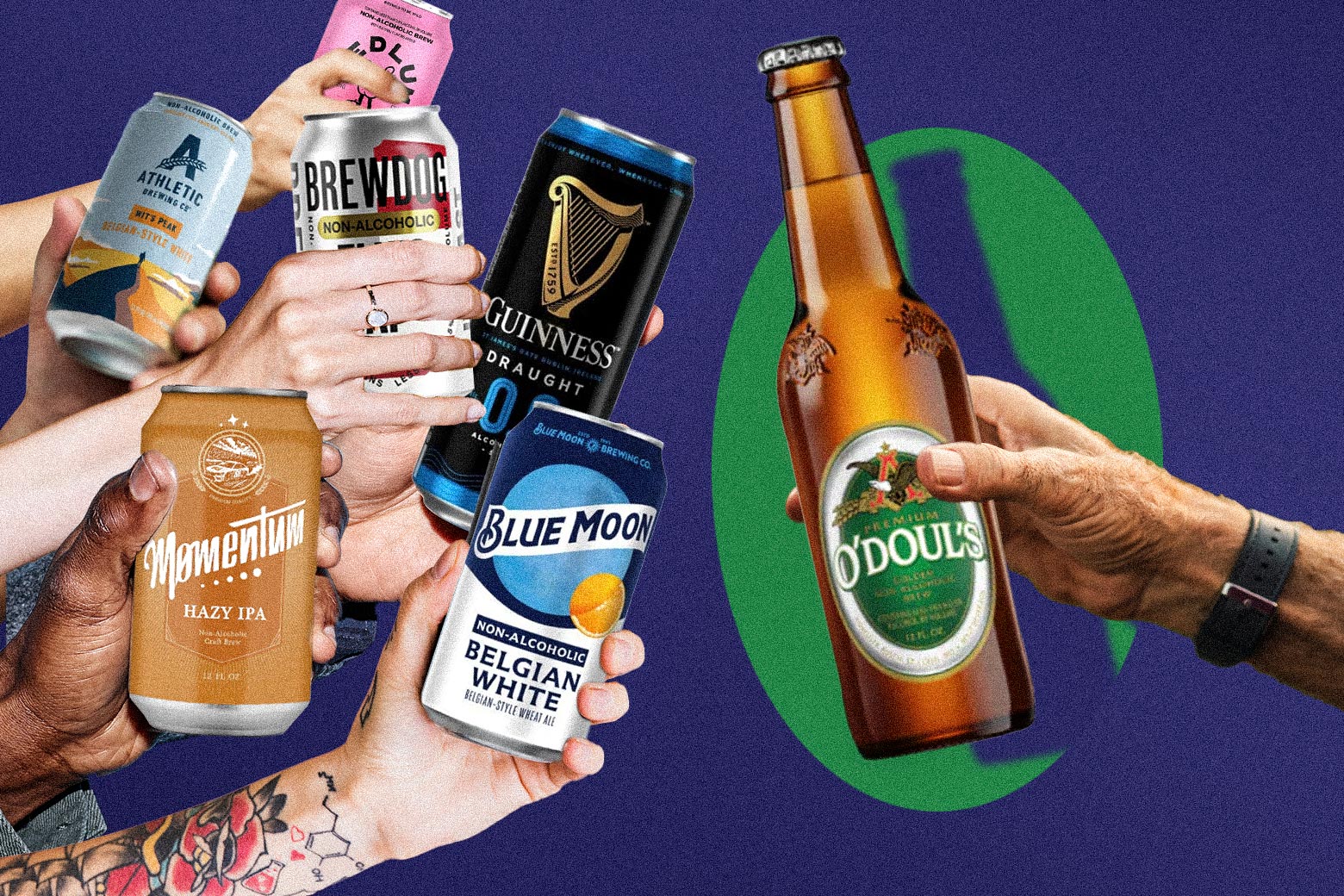
The green-labeled brown bottles, containing less than 0.5 percent alcohol by volume, fit well in the dusty halls of “breweriana,” the nostalgic collections of long-forgotten beer labels and brewing paraphernalia of defunct maltsters. Each bottle emblazoned with the Anheuser-Busch eagle and a tied barley bow is a classic, but O’Doul’s former prominence as America’s go-to nonalcoholic sip has slipped away. Now, standing in front of the merchandise refrigerator at the package store, modern sober-curious drinkers are spoiled with beer options with little if any alcohol. O’Doul’s is still there, though it seems more a reminder of a different sober moment than a tempting option in our current one. But the history of its persistence also underscores an unappreciated truth: In America, sobriety is (probably) just a fad diet.
Anheuser-Busch (now AB InBev,) the brewer behind Budweiser, launched O’Doul’s in select markets in March 1989 to gauge American interest in a new boozeless brew. Later, on Jan. 8, 1990—the date is a happy coincidence; Dry January didn’t really begin until 2011 in the U.K.—the world’s largest brewer pushed out O’Doul’s to the entire country. But Anheuser’s take on the dry drink was hardly a first-mover; competitors had already pounced on the category in the years prior.
All the largest brewers in the U.S. and Europe were aware of stagnating beer sales and a growing chorus of vociferous anti-alcohol campaigns by the late 1980s. In quick succession, macrobreweries brought more sober offerings to market. While the legacy Prohibition-era brand Kingsbury Near Beer held nearly 40 percent of the nonalcoholic market in the U.S. at the time of O’Doul’s 1990 launch, others were eagerly piling in. Guinness, early to the game, actually began production of Kaliber Alcohol Free Lager in 1983 (but launched in the U.S. in 1986). Heineken had launched its nonalcoholic Buckler in 1988. Miller Brewing (now owned by Molson Coors) came out with Sharp’s in 1989. O’Doul’s was only the latest member of the on-the-wagon bandwagon.
Derek Brown, founder of Positive Damage Inc. and pioneer in modern mindful drinking, points to the formation of Mothers Against Drunk Driving in 1980 and the subsequent 1988 passage of the federal Drunk Driving Prevention Act as key signs of a zeitgeist souring against a drunken society. “The decade culminated in the general perception of alcohol as unhealthy within certain contexts (namely driving, pregnancy, and for people in recovery),” Brown explained over email. “That must have informed Anheuser-Busch’s decision to release O’Doul’s. And, if I were a betting man, I would place drunk-driving at the top of that list.”
The threat of fatal harm resulting from ethanol and intoxication were (and still are) top of mind when it comes to discussions of indulgence in, temperance with, and abstinence from alcohol. Anheuser-Busch attempted to mollify the public by launching its 1982 “Know When to Say When” campaign (a precursor to the contemporary ubiquity of “Drink Responsibly”). But brewers also saw another cause to launch these beers: Americans wanted to be healthy like never before.
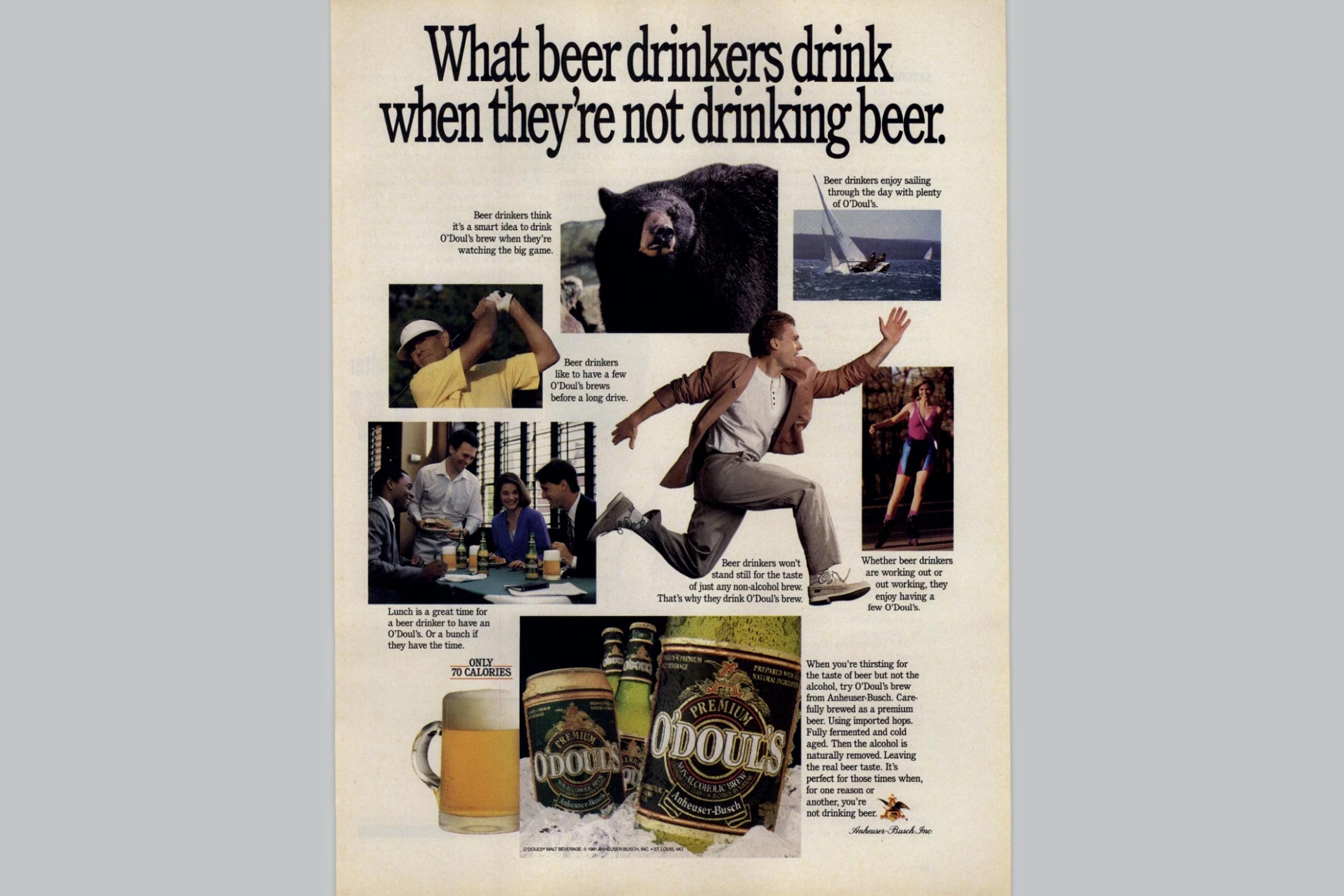
Following the launch of Sharp’s beer, experts explicitly cited a market shift to focus on fitness trends. O’Doul’s went on to publish a cheeky 1991 poster that addressed both drunk driving and fitness by printing a photo of a golfer next to the line “Beer drinkers like to have a few O’Doul’s brews before a long drive.” The volley of nonalcoholic beer launches was a symptom of the particular concerns of the ’80s, but the story of these breweries leaning into popular health trends dates to the advent of the modern workout era, which was even earlier.
Mass-market nonalcoholic beers like O’Doul’s stood on the shoulders of the booming success of light beer. In a 1989 interview with the New York Times, David Krishock, new-products director for Miller, noted, ”I see the same potential in this product [Sharp’s] that the brewery saw in Lite beer 16 years ago.” In just over a decade, low-calorie beers—like Miller Lite (1975), Coors Light (1978), and Bud Light (1982)—had conquered 25 percent of the American beer market.
The clustering of these brands’ emergence points to a broader trend in American drinking. American per capita alcohol consumption following Prohibition peaked in 1980, at around 2.75 gallons of pure ethanol per person annually. Light beers ratcheted down the alcohol content compared to a Budweiser from 5 to 4.2 percent abv and dialed back about 50 calories per can. A decade later, nonalcoholic newcomers undercut light beer’s alcohol content a great deal more, dropping down to 0.5 percent abv or less and shedding another 50 calories per drink. More than being a solution to sobriety, O’Doul’s and its ilk were selling a changing concept of health to an American audience that was increasingly interested in working out.
The swollen (or maybe just swoll) bubble of exercise culture that currently envelops us began to grow starting around the 1969 invention of Jazzercise. Your neighborhood gym rat would be startled to learn that he is a direct descendant of Judi Sheppard Missett and her gaggle of dancers clad in leotards and tights. (The evolution is irrefutable. In 1970 New York City hosted its inaugural marathon with only 127 runners. In 2025 a total of 59,226 official runners finished the race, now the largest in the world.) The five-decade arc that runs through the Atkins diet fad of the ’70s, the Jane Fonda fervor of the ’80s, the yogic trance of the ’90s, the Zumba buzz of the aughts, the CrossFit cult of the 2010s, and the Peloton push of the current decade has influenced our beer from its very beginning.
Where the advent of light beer capped off the inaugural American decade of working out in the ’70s, nonalcoholic beers were the adaptation meant to close out the ’80s. The sober trend dragged into the ’90s as the no-pain-no-gain mentality led to actual injuries, facilitating the uptake of yoga as a fitness practice. From the 1980 peak in boozing, alcohol consumption continued to decrease annually until the late ’90s. But around the turn of the century, the Y2K paranoia must have reintroduced Americans to an existential need for drink. Per capita consumption of ethanol gained steadily until 2019, underscored by the renaissance in the cocktail industry and the birth of a booming craft beer market. Since 2019, though, our boozing has fallen off yet again.
As we see hundreds of millions of dollars invested in new nonalcoholic beer brands today, how much has really changed? The longevity of Ol’ Reliable O’Doul’s serves as a through line, connecting this nonalcoholic moment to the sweat dripping from Richard Simmons’ perm. Consider that the current nonalcoholic beer craze is crowned by one brand in particular. Valued at $800 million in 2024, the first-in-class brewer in the nonalcoholic space today has reignited a passion for sobriety at bars, barbecues, and sporting events alike. The new brewer has even chosen a historically fitting fitness moniker: Athletic!
The name says it all. Athletic Brewing is openly welcoming the gym-class heroes of the world. But so did O’Doul’s when it courted athletes in that 1991 ad, saying, “Whether beer drinkers are working out or out working, they enjoy having a few O’Doul’s.” Miller went so far as to run a Gatorade-like 1990 campaign, depicting a montage of various exercising models taglined, “Next time you work out, change your routine and grab a Sharp’s from Miller.”
A workout beer is a hard sell, but it isn’t a new one. Athletic is the rebirth of a well-worn idea. Brewing, fitness, and the vicarious fitness that is sports fandom continue to be tightly intertwined. Budweiser has sponsored the World Cup since 1985 and pivoted toward selling nonalcoholic Budweiser Zero at the 2022 Qatar World Cup, when the Qatari government banned alcohol sales. Budweiser’s parent company, AB InBev, will now go on to be the official sponsor of the Milano Cortina 2026 Winter Olympics in February, intentionally selecting the nonalcoholic Corona Cero as the “first-ever no-alcohol beer sponsor of Olympic Winter Games.” The hype is certainly louder, but the gist is still the same.
Breweries have been walking this treadmill for decades, reading recirculating patterns of sweat droplets on the tread as tea leaves. It is time to market low-calorie, low-alcohol beers. Again. There have been many mass-produced temperance beers, yet only O’Doul’s survived in the public consciousness between eras of American sobriety. Though Heineken may have modernized its original Buckler brand (it’s still available in Ethiopia) with the 2017 launch of Heineken 0.0; though Guinness may have shifted its marketing away from Kaliber (which it still produces) to the 2020 launch of Guinness 0.0; though Molson Coors may have culled Sharp’s once and for all in 2022 without a flagship nonalcoholic replacement; though the behemoth AB InBev has sundry other nonalcoholic options in its portfolio, the steadfast green label of 1990 stands resolute.
While I understand that modern political sensitivities preclude a German American brewery from naming a new nonalcoholic beer after an Irishman in 2025, the O’Doul’s name is a good one, and I’m glad it has persisted. It’s comfortable and classy, and it reminds us not to get ahead of ourselves. Everything is good in moderation, including hype around America’s current turn toward sobriety.
We have been focused on exercise for a long time. Many have indicted the “beer belly” as a key obstacle to achieving their “dream body.” But brewers are cleverer than we give them credit for. They’ve been there over the decades, patiently pushing out the beer best suited for the moment. Some of those brews, it just so happens, stick around. When O’Doul’s finally does disappear, it won’t be the last near beer we drink. Likely, it will quietly dissolve in the ever-expanding portfolio of the world’s largest brewer—a final, sober Irish goodbye.