Sign up for the Slatest to get the most insightful analysis, criticism, and advice out there, delivered to your inbox daily.
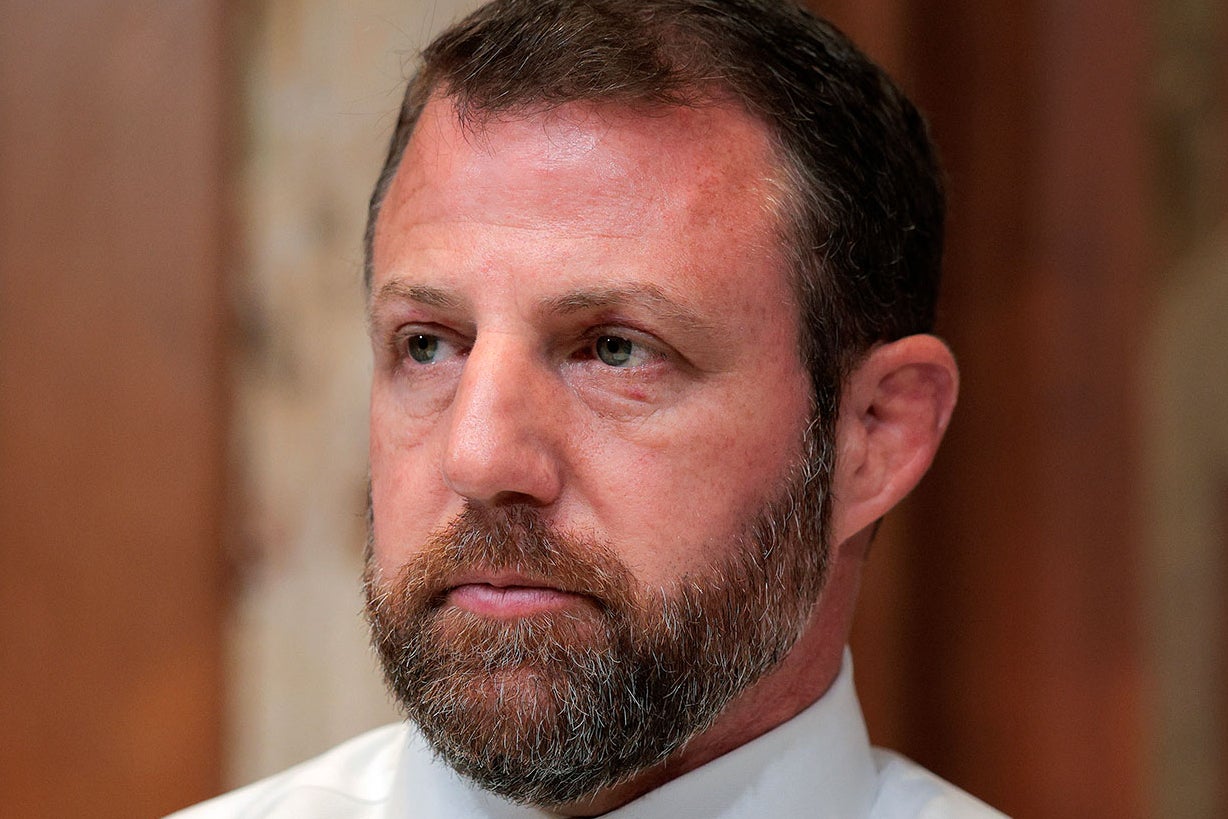
Last week brought the news that Kristi Noem had been dumped as Donald Trump’s secretary of homeland security. After a litany of controversies, the former South Dakota governor was finally jettisoned in favor of Sen. Markwayne Mullin, an Oklahoma Republican who, Trump says, will “make a spectacular” addition to the Cabinet.
You might have had a couple of reactions to this news: It sure is about time Noem got fired! But also … Markwayne?! Even though Mullin has been in Congress since 2013, serving a decade in the House before entering the Senate in 2023, seeing his name flash in news alerts on Thursday still gave me pause. Sure, I’d previously thought “Markwayne” was a peculiar name, but there was something about his new main-character role that made me do a double take. I wasn’t alone. “Somebody looked at a baby and said, ‘Let’s call it Markwayne,’ ” comedian Charles J. Moore wrote on X. “Bro. His name is MARKWAYNE,” the guitarist Zeke Sky added on Facebook. “Like if a NASCAR dad and a WWE announcer had a baby and named it after both of their exes.”
The name Markwayne isn’t the only weird thing about Mullin. A former mixed martial arts fighter turned plumber, he once challenged the head of the Teamsters to a fight during a Senate hearing. He was also once accused of carrying out a “middle school prank” wherein he put his fingers in the noses of colleagues and their spouses as they slept on a bus during a trip to Israel in 2015. But his name is certainly unusual—odd enough that it had me wondering just how common such a name is, and where on Earth it came from.
“I’ve been studying names for almost 25 years now, and I’ve definitely never seen it before,” Laura Wattenberg, author of The Baby Name Wizard and founder of Namerology.com, told me. Wattenberg is used to seeing “John-Wayne” as a name, presumably as a nod to the legendary Western star, but says seeing it combined with Mark is practically unheard of. “When I first saw the name,” Wattenberg said, “I instantly went to say, ‘What’s the story?’ ”
Mullin is from Westville, Oklahoma, a small town in the foothills of the Ozarks, near the Arkansas border, that sits on Cherokee Nation land. (Mullin is an enrolled member of the tribe.) Born in 1977, he was named in tribute to two of his father’s seven siblings who did not have any sons, Mullin told Roll Call in 2014. His mother put both names on his birth certificate, intending to return and pick one, but ultimately never did, he told the Spectator in 2023. Mullin said he was embarrassed having such a distinctive name as a child because it meant that other kids instantly knew he was in trouble when his name was read out over the loudspeaker.
Although it’s written as one word, Markwayne is essentially just a double-barrel name that has done away with a hyphen in favor of smooshing two separate names together—i.e., John-Paul vs. Johnpaul. The more common blended name, in contrast, often occurs when parents take separate elements of names and invent something entirely new, much like the monikers the tabloids give to celebrity couples, such as Brangelina or Kimye. According to Wattenberg, some parents opt to stylize a double-barrel name without any space or hyphen to ensure that people don’t shorten the child’s name by omitting the second half. Still, this isn’t a particularly widespread practice. “I think people notice Sen. Mullin’s name because seeing both names pushed together like a compound like his is a little less common,” said Hannah Emery, a sociologist and naming consultant.
Maryann Parada, a California State University associate professor of sociolinguistics, an onomastician (i.e., a scholar of names), and an auxiliary officer for the American Name Society, says Markwayne stood out to her because neither Mark nor Wayne is a particularly common option to appear double-barrel, let alone fused as a single word—although she has some sympathy for why that might be the case. Her birth certificate lists her name as Mary Ann, but she started stylizing it as Maryann in college because she was frustrated by people never getting her name correct. “I get the temptation to do that,” Parada said. “It drove me nuts over my life.”’
There’s no real way to know how many Americans have double-barrel names in part because of the lack of standardization in how they’re styled, but also because of Social Security data stripping punctuation and spaces from names. That’s why we know that Johnpaul was the 967th-most-popular name in 2006, the last year it was in the top 1,000, but don’t know exactly how many John-Pauls or John Pauls are out there. (Unsurprisingly, Markwayne has never appeared in the top 1,000 names.) In 2022 the baby-name website Nameberry searched what data it could get its hands on and concluded that fewer than 1,400 boys were given a double-barrel name that year in the U.S., with almost 20 percent of them beginning with John. The most common names the website found were John-Paul, Muhammad-Ali, and Miguel-Angel for boys, and Eva-Luna, Mary-Jane, and Maria-Jose for girls.
Double-barrel names began to rise in popularity in the mid-20th century in states across the country, according to Wattenberg, around the time tennis legend Billie Jean King, actor Billy Bob Thornton, and architect Johnpaul Jones were all born.
But double-barrel names in the U.S. have come to be particularly associated with the South, with several theories as to why. According to Southern Living, it’s likely that the trend was popularized because of European immigrants to the region in the 19th century. These new arrivals had come from places with strong ties to the Roman Catholic Church, such as France, where it was common to name a child after a saint and add another name to make it more distinctive. Still, Wattenberg is skeptical of these theories, arguing, “The idea that somehow the Southern U.S. is shaped more by Catholic traditions than the Northeast doesn’t make a lot of demographic sense.”
Many Southerners who give their children a double-barrel name do so, like Mullin’s parents, in order to pay tribute to a family member. “We in the South do love our family history,” Linda A.B. Davis wrote for the Pensacola News Journal in 2015, noting that boys in particular tended to receive a name associated with family lineage. “Many families end up with multiple same-named males, so there has to be some way to know whom they’re discussing. The name line might start at grandfather Robert Ray and then go to father Robert John and to son Robert Paul,” Davis wrote.
But the Southern accent may play a role too. Three-syllable names in particular, like Billy-Ray or Billy-Bob, “are the perfect cadence to roll off a Southerner’s tongue,” Southern Living declared. Per that outlet, a “cardinal rule … permanently etched into the Southern code of etiquette” is that you should never assume that “Anna Grace just goes by Anna, or that James Wyatt goes by James.”
Despite Mullin’s increasing national profile, don’t expect the name Markwayne to suddenly experience a boom in popularity. For one, neither Mark nor Wayne (the 246th- and 686th-most-popular names in 2024, respectively) is particularly hot right now. But more than that, politicians don’t tend to be popular sources of naming inspiration. “In my experience, people tend to shy away from naming after politics,” Emery said. “There was no Donald bump. There was also no Barack bump. No Hillary bump. I think people are like, Let me not name my kid even after this politician.”
And although new names can take time to be widely accepted in society, Wattenberg said, there’s just something about this particular one that doesn’t sound quite right to her. “Every name tells its own story,” she said. “As for Markwayne—honestly, I think that one just stumped everyone. I think everyone’s just plain surprised.”