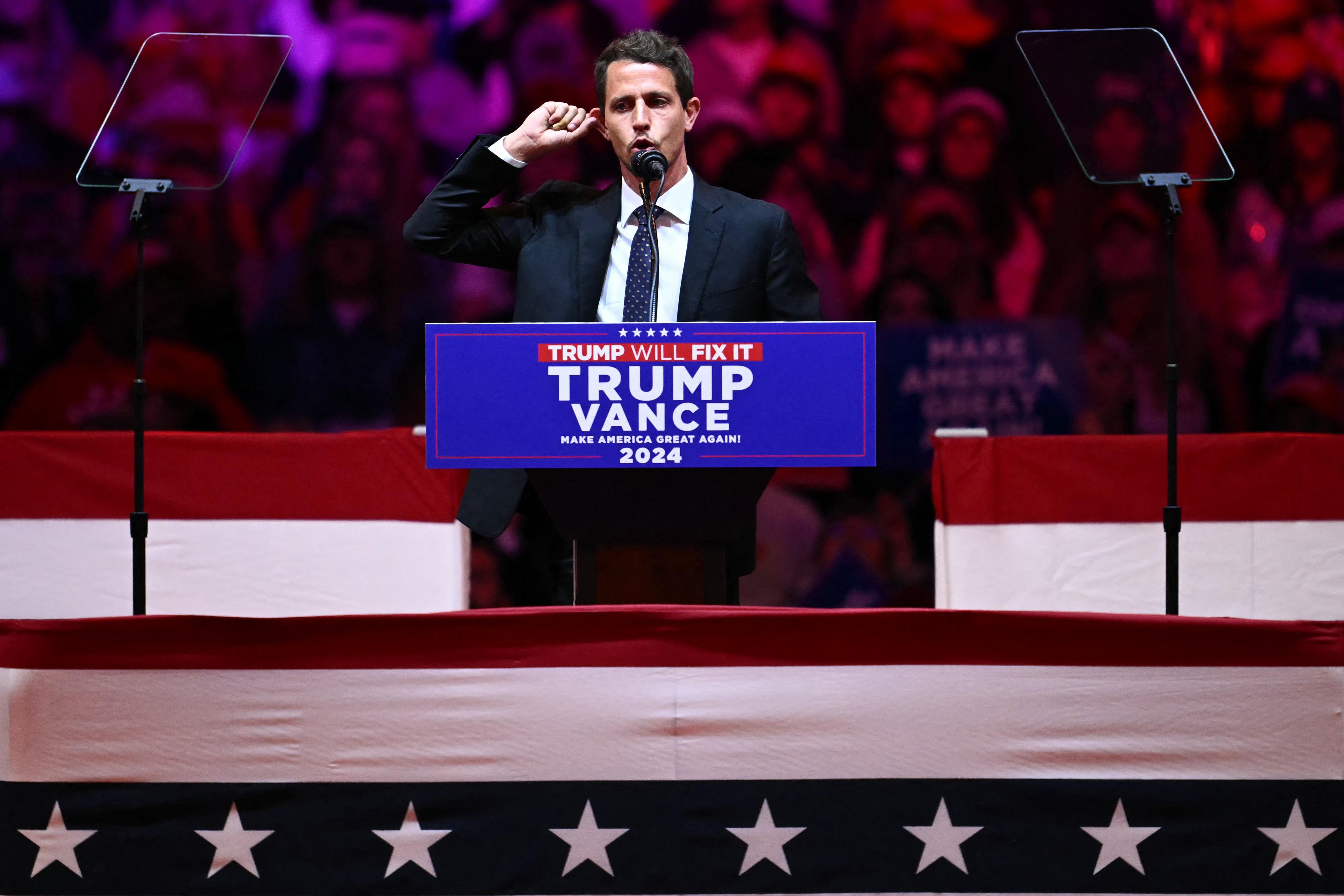
When Camille Rivera saw the clip of Tony Hinchcliffe calling Puerto Rico “a floating island of garbage” at Donald Trump’s Madison Square Garden rally over the weekend, she wasn’t exactly surprised.
“We always knew that MAGA and Trump were racist,” said Rivera, who’s a board member of the national Puerto Rican advocacy group La Brega y Fuerza. “We always knew how they had felt about the island. But to say it so grotesquely, in particular to Puerto Ricans who are independent voters and on the fence, I think it has reverberated.”
Puerto Rico is an unincorporated territory of the U.S., and people from the island can freely move to live in the 50 states, and once they do, they can start voting in presidential elections. There are more than 5 million Puerto Rican voters living throughout the country, and roughly 900,000 live in battleground states that both candidates are desperately trying to win.
The key swing state of Pennsylvania is home to about 500,000 Puerto Ricans, and the backlash there has reportedly been stark. One nonpartisan Puerto Rican group drafted a letter urging its members not to vote for the former president, and the Trump campaign has been trying to distance itself from Hinchcliffe’s remarks.
I caught up with a Puerto Rican voter who lives in another swing state: North Carolina, where about 115,000 people of Puerto Rican descent reside.
Hope Alfaro, 39, was born and raised in North Carolina. Though she told me she usually votes Democratic and already decided she would be casting her ballot for Vice President Kamala Harris before Trump’s rally on Sunday, she said she is unaffiliated with any political party. Alfaro used to volunteer with Poder NC Action, a voter advocacy group focused on engaging North Carolina’s Latino community. We talked about what effect Hinchcliffe’s joke may have in her community and how both Trump and Harris should be thinking about this voting bloc. Our conversation has been lightly edited and condensed for clarity.
Shirin Ali: What was your reaction when you first learned about Tony Hinchcliffe’s joke equating Puerto Rico to an island of garbage?
Hope Alfaro: A friend of mine sent me a clip of the comedian who made the joke about Puerto Rico and asked me, “Did you see this?” That was the first time I heard it, and honestly, I was hoping that it was fake or that there was context that I was missing. I really struggled to believe that a campaign approved this line of comedy, because no way was he allowed up there without first showing his set and what he planned to say to somebody.
That was my first thought: Who thought this was a good idea a week before an election? Even if it wasn’t the party I was planning on voting for, I really struggled to believe that either party would approve of jokes like that, that would very clearly upset a large group of voters. You can’t vote for the U.S. president on the island, but post–Hurricane Maria, a lot of Puerto Ricans moved to the United States and can vote now.
Do you think the joke could influence Puerto Rican voters who are still undecided in North Carolina? Or even those who were planning on voting for Trump?
I think there’s a large number of people who are not necessarily leaning strongly in either direction who are upset. Puerto Ricans, especially those from the island, are super proud of who they are, and the joke was a direct insult to who they are, not just a particular subset of Puerto Ricans. He called the entire island trash, and I’ve heard from communities that are upset; I think things like this joke make Puerto Ricans feel pushed out. My aunt also called me to ask if I heard about the rally and the joke, so I know people are talking about it.
I think if you know yourself to be a Latino Trump voter, there’s a certain amount of willful blindness and ignorance you have to accept. Or you have to be a one-issue voter, and there has to be one thing that the Republican Party has not abandoned you on. In their minds, they’re thinking, “Fine, Trump can insult me as long as the economy is strong.” They aren’t necessarily interpreting his words to mean he doesn’t care about our humanity. Within the U.S., Puerto Ricans have experienced years of Americans not realizing that the island is part of the United States. Everybody only remembers paper towels getting thrown at us by Trump. I personally wasn’t on the fence before Trump’s New York City rally, but it was one of those upsetting, but not super surprising, moments. There were plenty of other jokes made about Latinos and Black men, but there’s still going to be Latino and Black males who vote for Trump.
Do you think the Harris campaign has an opportunity here to reach out to Puerto Rican voters who are now potentially disenchanted with Trump?
I have been a voter in North Carolina long enough to see it move from “lean purple” to “lean red,” and even see it elect a Democratic governor while still going for Trump in 2020. Honestly, I haven’t seen either party trying to cater to the Latino vote at all in North Carolina. I think this has alienated some voters enough to just not vote.
It’s important to understand that North Carolina Latino voters are overwhelmingly young and first-time voters. I think pushing voter registration and early voting is important, but also talking about the importance of having a say. In Puerto Rico, during elections, you can only cast your vote on one day, so the turnout is high. [Puerto Rico does have early voting but only for certain eligible individuals.] And culturally, we really love the idea of voting, so campaigns should be emphasizing the importance of why you should vote and how voting directly affects your community. This doesn’t mean just translating commercials from English to Spanish, because there are plenty of Latino voters who don’t speak Spanish. My 13-year-old daughter is a Latino, and will one day be eligible to vote, but she doesn’t necessarily speak fluent Spanish.
Voting is so important to my father, who was born in Honduras and is a naturalized U.S. citizen, because he didn’t have that option in his home country. I think there are so many people like him that then have children that will vote and who the campaigns could be speaking to.
Following Trump’s rally, Bad Bunny posted a video clip to his Instagram account, which has 45 million followers, of Harris talking about her plans for Puerto Rico. Do you think his post will have an impact on any voters?
I actually think it does move the needle a little bit. I always hear people criticize a celebrity or public figure who makes a political comment, but I think especially younger people see them as not just people, but as aspirational. I think Bad Bunny lives very much in that category and he’s catering to young 18-to 30-year-old Latinos who have the ability to vote but are very much feeling left out of the conversation and not recognizing how it’s going to affect them. When you’re young, you think you’re going to live forever, and you’re not worried about retirement, Social Security and all that. However, it does affect things like them going to college, finding a job or being able to afford a house, or all the things that were the American dream to their parents when they first immigrated to the U.S.
Having someone like Bad Bunny bring up politics starts the conversation in a way that feels like, “Oh, that’s what the adults are talking about, right?” I think it is so important to have someone like Bad Bunny talking about Puerto Rico, because for years there’s been conversations about the island becoming a state, or will it remain the status quo? Everybody knows that what’s happening now in Puerto Rico isn’t working. This election matters for that reason.
Do you think Puerto Rican voters are overlooked?
I think because of how the island exists, the American political parties don’t know how to treat Puerto Ricans. Immigration isn’t necessarily important to Puerto Ricans in the way that it would be to, say, Central Americans, Mexicans, or South American families because if you’re Puerto Rican, you were born a U.S. citizen. That being said, yes, Puerto Rico is part of the United States, but culturally it is like a different country. Immigrating from Puerto Rico to the U.S., you may have the necessary papers, but that doesn’t mean that you speak English or that you have a full understanding of how things work here.
I think the political parties here don’t know how to treat Puerto Ricans because of the nebulous ways in which the country exists. They’ve chosen to just treat them like any other American, which is nice, but also it means that culturally, they’re being ignored. We still came here looking for a better life, just like any other immigrant. A lot of Puerto Ricans came to the U.S. after Hurricane Maria because they lost everything, so issues like the climate and economy are important to them, but they have to be discussed in a way that’s culturally relevant. That’s where the struggle for any organization, company, or campaign lies. It’s about figuring out how to speak to people on their level.
It also feels odd to me that despite being in a battleground state with a large and growing number of Latinos, I don’t feel like I’m getting anything that’s speaking to me, other than from the Latino organizations that I was already involved with. But the presidential campaigns themselves, I haven’t felt like they’re trying to talk to me, and I consider myself to be fairly tuned in. I’ve voted in every election since I turned 18, including primaries, and if I haven’t felt like either party cares about me, how are first-time voters feeling?