Sign up for the Slatest to get the most insightful analysis, criticism, and advice out there, delivered to your inbox daily.
As of next month, we’re going to have a president in the White House who has been uniquely hostile to the press. Donald Trump has threatened to take cable networks who are too critical of him off the air, and to jail reporters who don’t give up their sources.
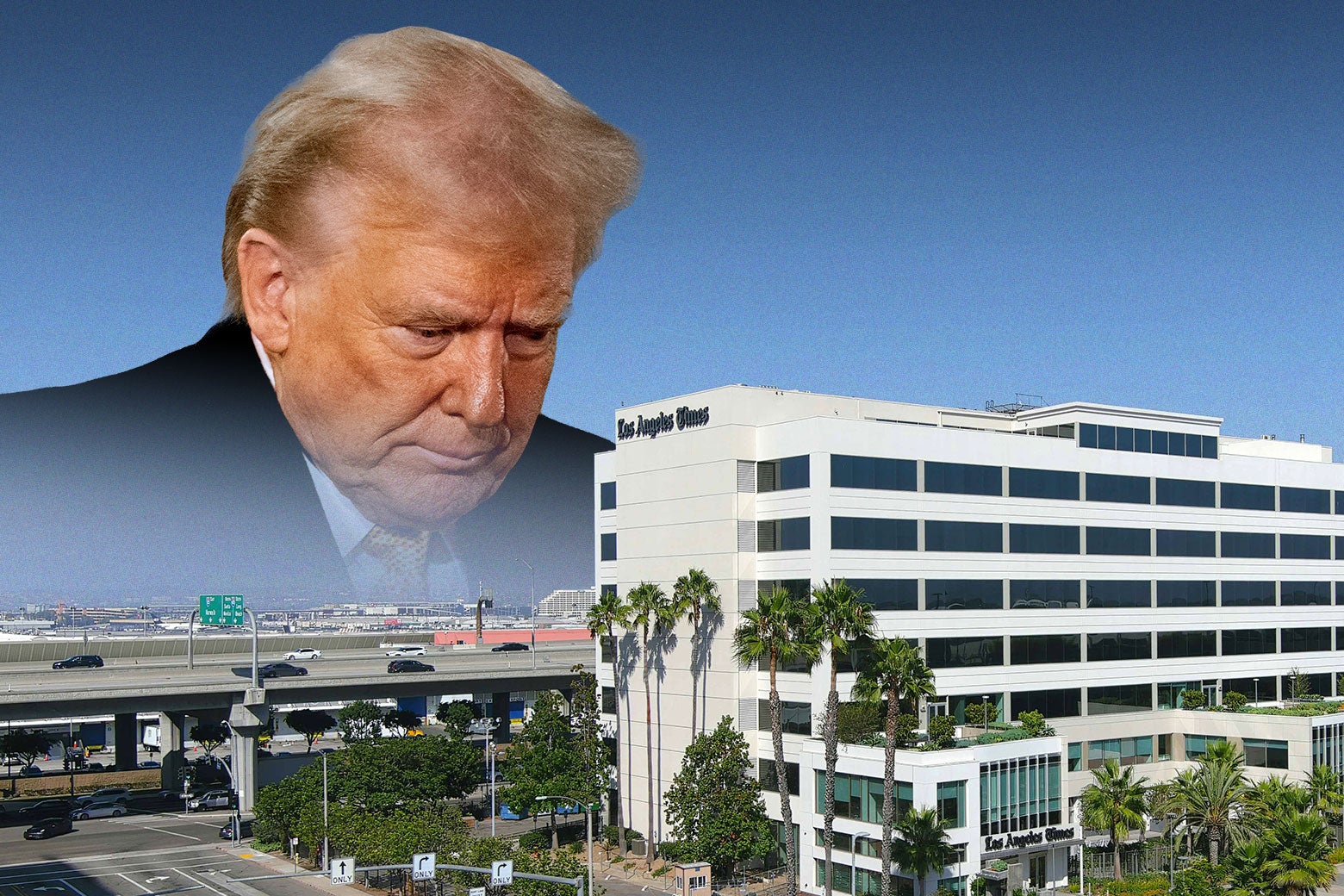
In the weeks before the presidential election, the billionaire owners of two of the nation’s biggest newspapers—seemingly anticipating a Trump win and wanting to get in his good graces—made some troubling moves. Washington Post owner Jeff Bezos demanded that the paper, for the first time in decades, not endorse anyone for president. It will also cease offering endorsements in future presidential races. And the owner of the Los Angeles Times, Patrick Soon-Shiong, killed an already-drafted endorsement of Kamala Harris at the last minute.
Soon-Shiong and Bezos both defended their decisions by arguing that this will allow readers to make up their own minds about candidates while also helping their papers mitigate a perception of bias. However, Bezos has a clear conflict of interest. His space company Blue Origin has been competing for government contracts, and Bezos himself spoke with Trump days before his paper announced it would no longer be issuing presidential endorsements. Meanwhile, Soon-Shiong has been making controversial changes at the Times since the election. He said he plans to introduce a “bias meter,” powered by A.I., to accompany stories in the news and opinion sections, and he hired conservative commentator Scott Jennings to sit on the paper’s editorial board.
In response, tens of thousands of readers of both papers ended up canceling their subscriptions. Several frustrated journalists have been resigning.
Harry Litman is an opinion columnist who worked at the L.A. Times for over 15 years and was also a contributing columnist at the Post from 2018–20. He’s one of many journalists who have quit recently over the newsroom’s decision to no longer publish presidential endorsements. After explaining his resignation on his Talking Feds Substack, Litman spoke with Slate about his decision and how he sees the future of journalism under a second Trump administration.
Here’s our conversation, which has been edited and condensed for clarity.
Shirin Ali: At what moment did you decide you wanted to leave the L.A. Times?
Harry Litman: Like a lot of people, including people who read either the Washington Post or the L.A. Times, I was struck and unnerved by the decision to pull the plug on the endorsement of Vice President Kamala Harris and to do it in a pretty brutal way. The paper’s editorial page has been giving all kinds of arguments and covering different angles of the political landscape for a couple years, and they led pretty naturally to an endorsement of Harris. But to just decapitate an already drafted endorsement for one candidate struck me as pretty unusual and alarming, especially when it was done around the same time as it happened with the Washington Post, so two of the most prominent papers in the country had done it. This didn’t seem to be motivated by particular policy positions or thinking that the editorial boards had been biased or negligent in some way. It was the fact that we got a president-elect who was threatening the media—threatening pretty much all the guardrails of democracy, the media being a really important one.
So it struck me that the media, at least those papers, blinked at a really important time. From there, there were additional moves by the L.A. Times’ ownership, and it was obvious that the owner wanted to move the editorial direction of the paper, which he characterized expressly on Fox News as “fair and balanced.” It seemed to me that the notion was to curry favor with Trump—I thought the paper’s movements toward Trump weren’t about being more accurate, but rather being more pleasing to the would-be autocrat, and that struck me as really pretty bad, especially in tandem with the other things that Trump is doing.
How do you think newsroom executives should be operating under a second Trump presidency?
On the one hand, it seems very simple to me. I’d be very happy if there was a robust media in the country just playing its traditional role, telling the truth about what’s going on through reporting and uncovering news. On the other hand, it’s an extraordinarily complicated problem. The legacy media is facing all kinds of financial reversals, and I think it’s tied up in the ownership of a lot of papers by big corporate consortiums who have to worry about their shareholders.
And maybe in the case of the two billionaires, their papers are a small part of their holdings, but if Trump wants to go after them, then they have other larger holdings that stand to be really impacted and vice versa. Traditional media hasn’t succeeded in responding to the exodus of so many readers in favor of things like YouTube, and there’s the problem that, ultimately, the shots are called from higher levels for reasons that have to do with more than just editorial policy. I would also add in the terrible ravaging of local newspapers, so many of which did great jobs sounding the alarm in individual communities. Those are now drying up.
In one sense, God bless Jeff Bezos, God bless the owner of the L.A. Times for stepping up and trying to revive a paper with failing fortunes. But when these benevolent billionaires acquire papers, what’s the best thing to do? It’s sort of what Bezos had been doing before—I worked at the Post, and we used to say, “Our billionaire is better than their billionaire.” That’s because Bezos was hands-off. If newspapers are a kind of trophy in an overall business empire that’s meant to serve the civic function that a great paper serves, what’s the best thing to do? Keep your hands off and just let the paper flourish as it did before. Another way of saying that is: Keep putting money in and subsidizing what is a commercially losing proposition. I think, in a very elementary sense, newspapers have to keep as their North Star facts, reporting, and what’s happening out there.
Trump has been criticizing the press for a long time, but after his decisive win in this year’s presidential election, those threats have taken on a darker tone. Do you think the media is seriously in danger under a Trump presidency?
I come from a law background, and in that world, Trump has been absolutely teeth-bared, savage. He’s been eager to mow down norms within our justice system that are completely integral, for justice without fear or favor, which has got to be a hallmark of democracy. I believe we are at a real crisis point here.
I see the stakes for the media as super high, because I survey a landscape where [norms] you would never have thought could be mowed down, the way Trump is bidding to do, are in big danger. If you think it’s unduly alarmist or crazy, then the stakes for the media become less, including for newspaper owners.
Democracies do erode—they can become greatly compromised, and I don’t think there’s been such a tangible risk of it since the Civil War, or maybe ever. Trump’s saying what he’s doing and doing it. Certainly one thing he’s saying is that he’s going to make life miserable for and go after the media, whom he feels aggrieved by. That really is his whole platform. He’s especially mad at Liz Cheney, and she didn’t do anything different from the other House Select Committee members—ah, but she was supposed to be loyal.
There’s a sort of third grade mentality at play. Trump will exercise the power of the most powerful position in the world to not just go after enemies, but I think he also has a broader agenda of rewriting history in a way that the media should be standing up against. Just over the weekend, Trump refused to say he lost the 2020 election. He really means to lionize and make heroes of the marauders whom we saw storm the Capitol and threaten democracy. It really seems like a very serious time, and without the media there, we become like autocratic societies. So, I’m pretty nervous.
In your Substack, you argued: “The idea of balance is fundamentally misplaced when on one side of the balance is a sociopathic liar like Donald Trump.” Can you explain that?
I think this dovetails in an interesting way with the proposal that the owner of the L.A. Times has just advanced to use A.I. to calibrate bias, which assumes somehow that what his reporters are doing is inherently biased. I think reporters should try to be objective and the media should try to be objective. I understand the view that political preconceptions and prejudices can seep in, so I have nothing against the idea of turning the ship more toward the center. It’s just so plain to me that that’s not what this is about. When you are trying to call out what’s happening under a president-elect who gets up lying, and lies all day, the media’s role then can’t be balanced—because to be balanced is to abandon [newspapers’] most critical, axiomatic, democratic function of informing their audience.
Everything I’m saying—all my objections, the reason I resigned instead of just keeping on—is because I take us to be at a moment of extraordinary peril. Instead of just hanging in there, I wanted to stand up and try to say something that feels like a canary in a coal mine. Facts matter so much, and the media has to be accurate. That’s why I took this opportunity to bring some attention to an overall problem. Not even so much the owner of the L.A. Times, but just legacy media and its potential contribution to an autocratic agenda. When you really push on it, it’s about truth vs. lies, and the media has got to stand up for the truth.