Listen to What Next:
 Apple Podcasts
The videos out of Sudan are horrifying. There are videos of people being shot out in the open. There are videos of fighters going through hospitals, room by room, and hunting people down. And then there is the evidence of the sheer magnitude of the violence—pictures captured from thousands of miles away.
“It’s now become a world-leading humanitarian crisis, not just for the present, with 30 million people in humanitarian need, but actually record-breaking,” says David Miliband, the president of the International Rescue Committee. “Since records began, it’s the biggest humanitarian crisis in terms of the number of people affected.”
He says these massacres of civilians have been meticulously planned over the course of months. A group called the Rapid Support Forces began by physically isolating the last city in Western Sudan that was controlled by the country’s army, al-Fashir. Factions on the ground are still fighting, mainly the RSF and the army of Sudan’s internationally recognized government. Both have been accused of war crimes.
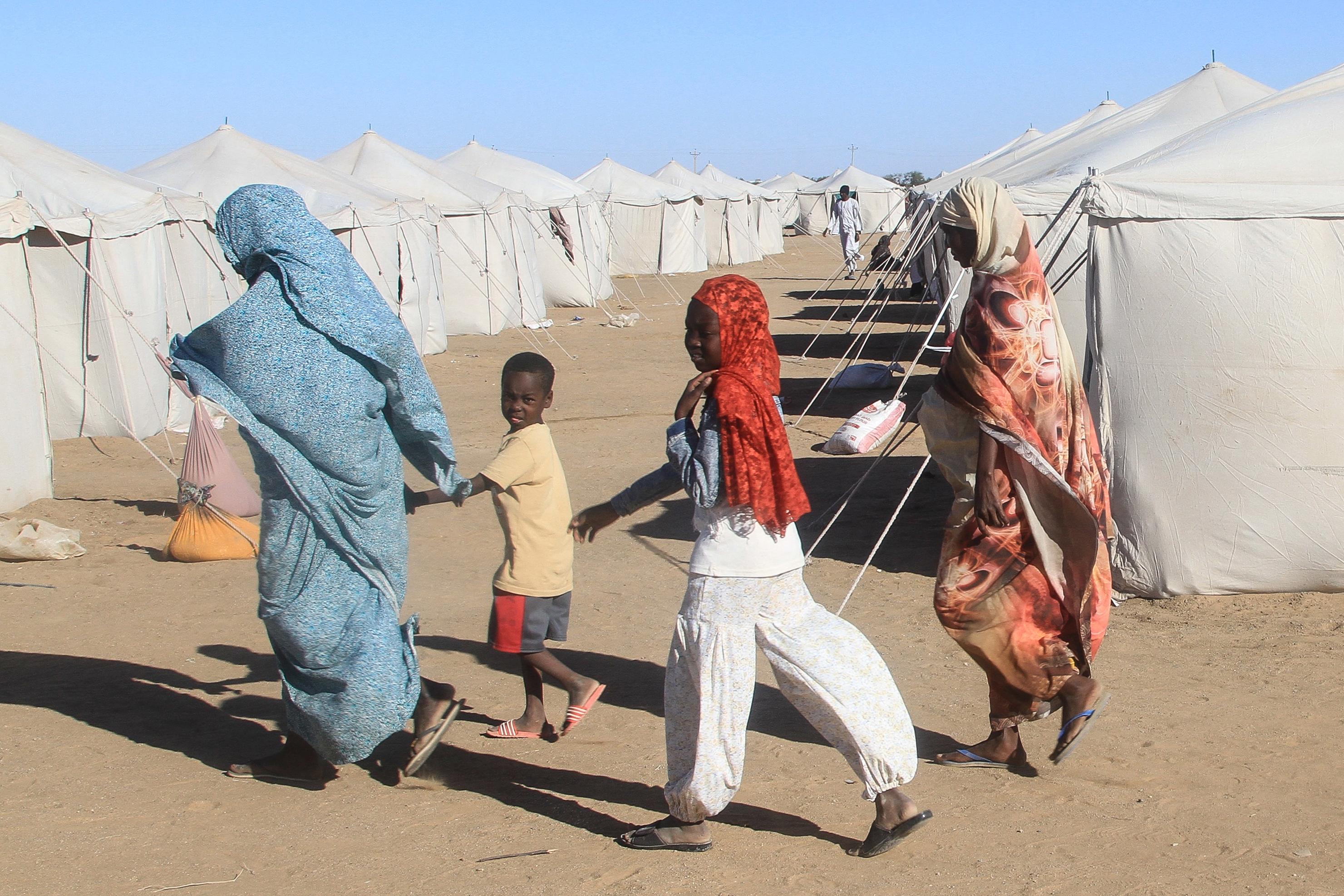
Many of the people lucky enough to have escaped al-Fashir have landed in a place known as Tawila, which is where the International Rescue Committee is set up to offer help. Now, these refugees and aid workers are worried the fighting will come to them next. Miliband sees it as a test of whether the world cares in deeds, not just in words.
On a recent episode of What Next, host Mary Harris spoke with Miliband on how Sudan’s civil war needs the world’s attention. This transcript has been edited and condensed for clarity.
Mary Harris: I want to explain the conflict to my listeners who may not be familiar with what’s going on, because the top-line numbers are really so stunning: an estimated 150,000 killed in the current civil war in Sudan, 14 million people displaced. Those are United States numbers. What are the underlying root causes of the violence we’re seeing?
David Miliband: Sudan had a history since independence, in the 1960s, of dictatorship. Omar al-Bashir, the last dictator, was overthrown in 2019 by a civilian government. Between 2019 and 2021 there was a civilian government. It was seen as a success, but it didn’t get the backing it needed. In 2021, the two parts of the armed forces who had been brought in after the Darfur crimes and tragedies of the 2000s by dictator al-Bashir, those two parts of the armed forces mounted a coup against the civilian government. They seized power. And then in 2023, parts of the armed forces, the Sudanese Armed Forces and the Rapid Support Forces, turn on each other. So this is not a civil war that came from below. It’s an elite project of two parts of the armed forces who started fighting each other.
Are they simply fighting for control of land, or are they fighting for something bigger?
They are fighting for land, but they’re fighting for resources, because this is not the poorest country in Africa. It’s a country with significant gold, it’s a country with significant agriculture, it’s a country with resources that people want to control.
And the gold mines are in the west, which is now controlled by the RSF, right?
West and north, yeah. This is a conflict over power, but it’s also a conflict over power for resources. And that’s important. It’s also important to say that this location in the Horn of Africa, the coastline with the Red Sea, it’s strategically a very significant country. It was split in 2011 when South Sudan broke off after a terrible conflict between the north and south, essentially on religious lines. And now there is a further division between the east of the country that’s controlled by the Sudanese Armed Forces, who have the backing of Egypt, Saudi Arabia, and Iran, and the west of the country, the Rapid Support Forces, who have backing from the United Arab Emirates and other countries, including Russia. You’ve got this unfinished business of civilian government, you’ve got incentives for power grabs, and you have this latent conflict between the Arab population and the non-Arab.
Is there a religious or ethnic element to what’s happening now too?
There is, what’s happening in the west, where the non-Arab population fears massacre on a terrible scale. There’s definitely that dimension to it. This is a conflict that is threatening to spill out of control for the people of Sudan, but it’s also important to recognize how it spreads. It spreads into South Sudan, it destabilizes South Sudan, it spreads into Chad, it’s got refugees in Egypt. There’s quite a lot of refugees in Europe at the moment who come from South Sudan.
Part of what I found confusing about the conflict is that it seems these midlevel international players who have become involved with the conflict, sometimes they’ve switched sides or expressed regret. Can you explain that a little bit, how the allegiances have been flexible here?
The United States, China—the superpowers are not backing one side or the other. They’re on the sidelines trying to wring their hands and say, “What can be done about this?” The Chinese interest is in oil that comes from South Sudan but is pumped out through Port Sudan, which is in Sudan.
There are also political interests, because when the Iranians are backing one side, that produces a reaction from others. And then you’ve got different coalitions coming together. It’s not just an internal war inside Sudan, it’s an avatar for modern conflict, because it’s a civil war with external backing from many sides. And all the different players have got external backers. We call that the internationalization of civil war. And that’s a feature of the modern global political and military landscape.
I feel like we have to examine the allegations of genocide here. The violence I’ve heard of is so extreme. There have been accounts of babies being raped. It’s horrible. You’ve been in the world of global politics for a long time. How do you think about this conflict and the stories you’re hearing?
It’s plumbing depths, but the trouble is it’s not the only place that’s plumbing depths. Both the Biden and Trump administrations have used the word genocide. The successive U.N. investigations have placed deeply serious allegations against both sides in this conflict. From our point of view, there are two things that I always say when people use the word genocide. One is: We mustn’t ever get into a world where it’s got to be a genocide before we care about it. I try and muster global engagement well before we hit the genocide standard. Secondly, that standard itself is highly contested. It doesn’t need to be a genocide to command international attention.
I want to bring in the United States a little more fully now. Your primary role is delivering aid. Can we talk about how that job has changed? You’ve written that the U.S. has been the anchor of the aid system internationally. U.S. foreign aid payments represent 30 percent of all funds. That’s huge. Eighty percent of programs have been terminated. That just seems like a massive sucking hole in your work.
Without mixing the metaphors, the anchor’s been pulled up. So it’s not a hole, it’s that the boat is rocking in the sea, and the passengers are getting seasick. That’s the metaphor. The pulling up of the anchor affects everything from the emergency teams that used to be the U.S. first responders right through to the basic research and innovation that was funded. The anchor has gone. The shutdown didn’t help in that sense. But there have been aid cuts for Sudan as well. Anything that’s not considered “lifesaving” is out. One of our health centers for Sudanese refugees in South Sudan has just been eliminated.
You proposed a focus on the most needy countries and a focus by much more of the international community. Is that going to get you where you need to go in a conflict like this?
When asked, 89 percent of the American public say that it would be right for about 1 percent of the federal budget to be spent on aid. That is actually the amount that was spent on aid. The trouble is, more than 50 percent of the American public thinks 20 percent of the federal budget is spent on aid. This loss is major, and the reverberations are just rippling through. They’re rippling through services, but they’re also rippling through institutions, and we don’t yet know the full extent of it, not least because the administration hasn’t yet clarified what role it wants for the reduced amount of aid in the future.
Are there things you can’t do? Or things you worry you won’t be able to do in the next year?
We’re closing health centers for refugees from Sudan. There are 300,000 kids who were being educated in Afghanistan, with a large U.S. aid contract, who have lost their educational hope. My own nonprofit has lost three-quarters of the aid it was getting from the U.S. government. And so there is a massive impact of these decisions, and they affect people’s lives in the most profound ways.
What are your representatives in Sudan asking from the international community now?
We’re begging for pressure to get our aid workers into al-Fashir, pressure to get the people out, pressure to support those who are traumatized in Tawila, pressure to halt the arms flows, pressure for accountability. And all of that depends in part on attention. This is not America’s No. 1 problem. But it’s the world’s No. 1 humanitarian problem that America could help to mitigate.