Sign up for the Slatest to get the most insightful analysis, criticism, and advice out there, delivered to your inbox daily.
The question of the moment: When will a mere handful of Republican lawmakers come to their senses? That’s all it would take for them to be described in their obituaries as saviors of democracy rather than enablers of its collapse.
The premise here is that some of these politicians are smart enough to notice that their party’s leader, President Donald Trump, has gone bonkers—that his longtime tendency to conflate his ego’s impulses with the nation’s interests has hardened into psychogenic disorders of unprecedented intensity among previous occupants of the Oval Office—and that this merging is having dreadful consequences at home and abroad.
It’s an old game, by now, to contemplate Trump’s mental state, but his text on Sunday to Norway’s prime minister, Jonas Gahr Store, obtained by PBS, takes the proverbial cake. In response to Store’s genial note (“Dear Mr. President, Dear Donald”) requesting a call to discuss Greenland, among other issues of mutual concern, Trump wrote (only the full missive can convey the depths of our president’s malady):
Dear Jonas: Considering your Country decided not to give me the Nobel Peace Prize for having stopped 8 Wars PLUS, I no longer feel an obligation to think purely of Peace, although it will always be predominant, but can now think about what is good and proper for the United States of America. Denmark cannot protect that land from Russia or China, and why do they have a ‘right of ownership’ anyway? There are no written documents, it’s only that a boat landed there hundreds of years ago, but we had boats landing there, also. I have done more for NATO than any other person since its founding, and now, NATO should do something for the United States. The World is not secure unless we have Complete and Total Control of Greenland. Thank you! President DJT
There is plenty here to unpack, after first downing a stiff drink.
First, and most familiarly, much of the note is simply wrong. As Trump has been told several times, to his persistent disbelief, the Norwegian government has no control over who wins the Nobel Prize, which is decided by a truly independent commission that happens to be based in Norway’s capital, Oslo.
Second, while Trump did compel NATO allies to spend more on defense, he did so mainly by threatening to quit the alliance if they didn’t. Vladimir Putin also had something to do with this, as his invasion of Ukraine reawakened Europe’s leaders to the dangers of Russian aggression. Finally, our NATO allies have done plenty for the United States—not least joining our invasion of Afghanistan in response to the 9/11 attacks. (In fact, Denmark, the current object of the president’s wrath, lost more soldiers per capita than any NATO nation other than the U.S.)
Third, several of the eight wars that Trump claims to have stopped are still raging to some degree, and some of those that really have ended, at least for now, were brought to a truce by actors other than Trump. When India’s prime minister, Narendra Modi, publicly disputed Trump’s claim of credit for ending the India-Pakistan war, Trump, in a fit of rage, punished him by imposing a 50 percent tariff on all goods from America’s firmest South Asian ally.
Here was a textbook instance of Trump’s nationalized narcissism—and also of its dangers to the nation’s real interests, as Modi (who has his own ego issues) responded by attending a summit in China, at which he gleefully posed for a photo while shaking hands with Xi Jinping and Putin; the other member of that troika of dictators, North Korea’s Kim Jong-un, joined the pact later.
It is this brand of narcissism that Trump’s message most unsettlingly reveals.
The president’s desperate desire for the Nobel Peace Prize, to the point of openly lobbying for its bestowal, has long been an object of, let us say, discussion. But here is something new. Here, Trump says, explicitly, that because he didn’t win the prize, he no longer feels an obligation to “think purely of Peace.” (Not that he ever did, but that’s another matter.) In other words, he is admitting that, to the extent he has pursued peace, he did so largely in order to win the Nobel Prize. Now that he has been denied the award, he’s done with peace too. (Maria Corina Machado’s gifting him her prize, as an attempt to win his support in the coming battle for Venezuela’s post-Maduro leadership, seems not to have quelled his bitterness.)
When he writes that he “can now think about what is good and proper for the United States,” he is suggesting that his earlier pursuits of peace (“having stopped 8 Wars PLUS”) were not good and proper for the U.S., but purely a gambit for his personal ambition.
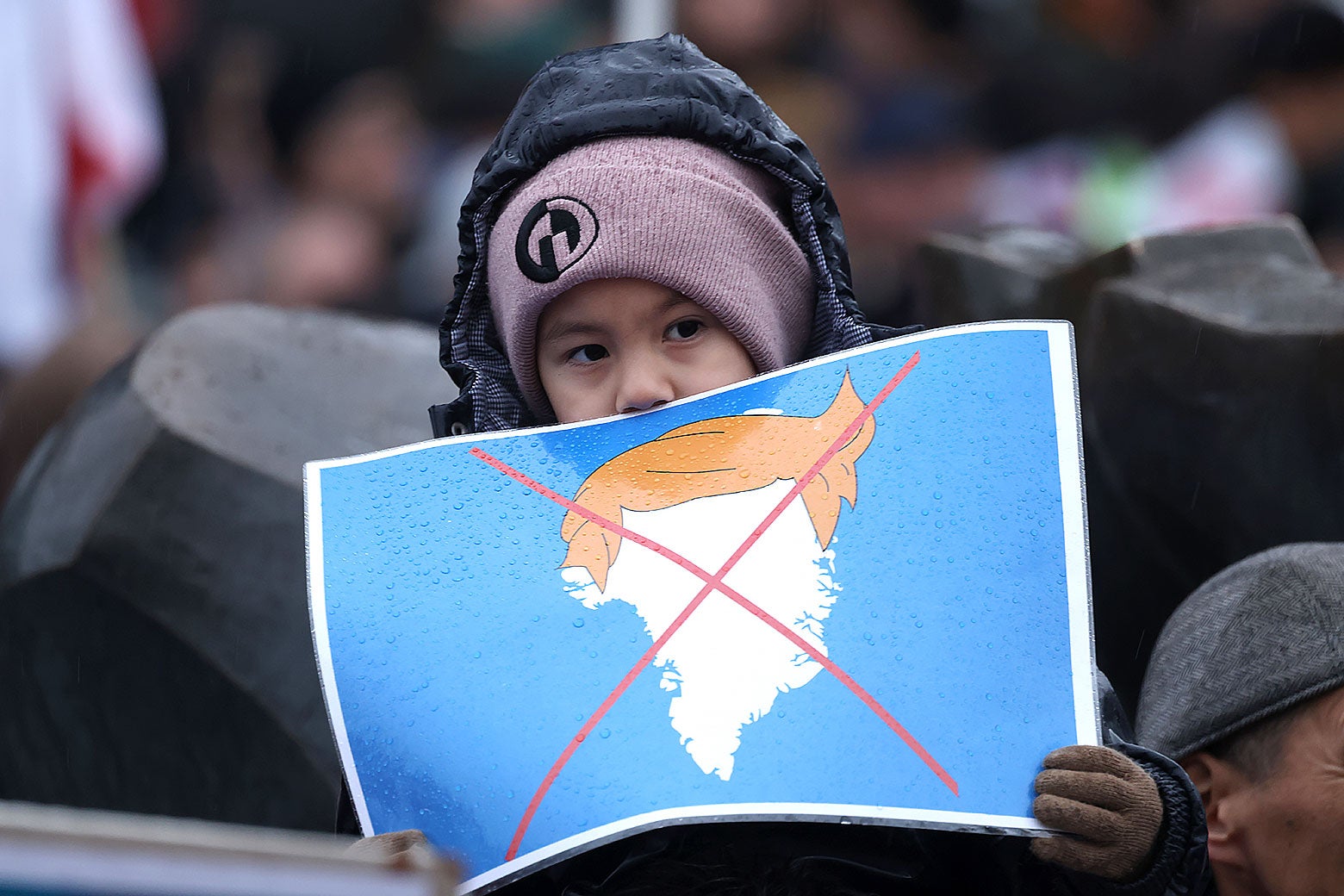
And from there, Trump pivots seamlessly to his renewed determination to take Greenland, noting that Denmark is unable to protect the icy island from Russian or Chinese aggression and asking, further, why Denmark should get control just because its boats landed there 300 years ago.
Again, Trump’s temper tantrum should astonish any reader. First, polls show that the people of Greenland (population 56,000) don’t want to become part of the United States. (Polls also show that 70 percent of Americans don’t want Greenland to become part of the U.S.) Greenland’s prime minister recently said that if given a choice, she would prefer to stay in the alliance with Denmark and the EU. That should be the end of the story.
Second, Denmark alone might be unable to defend Greenland, but both nations are members of NATO, and an additional treaty—the U.S.–Denmark Defense Cooperation Agreement of 1951—allows the United States to build and staff as many military bases on the island as it likes. Rebuilding the dozen or so bases that the U.S. once possessed on Greenland, and counting on other allies to come to the country’s defense in the event of war, would certainly be cheaper than buying the place, running a government, providing for the population’s welfare, and all the rest.
Why then does Trump insist on ownership? He was asked this question during a two-hour-long interview earlier this month with four New York Times journalists. His reply was telling: “Because that’s what I feel is psychologically needed for success.” The Times story about the interview continued:
“Asked if he meant psychologically important for himself or psychologically important for the country, he said, ‘Psychologically important for me.’ ”
And there you have it. This—everything about American statecraft, foreign policy, and the notion of U.S. security interests—is all about Trump. It’s Louis XIV’s “L’état, c’est moi” combined with a spoiled toddler’s presumption of entitlement.
This should be plain as day to anyone who cares to look and listen. So why aren’t more political leaders—those who have a stake in what happens next, who will unavoidably be seen as complicit if they remain passive—stepping up and resisting? If the ultimate challenge (impeachment) seems unlikely, they could deny funding for his most egregious programs, restore funding for his most debilitating cuts, counter the lies, investigate criminality. Even just speaking up could dent his vaunted Teflon shield. Who knows: Given Trump’s steep slide in the polls, they might even get away with it.
For now, most of the silent ones don’t want to take the chance. They believe that if they speak out, the president will sic a MAGA-loyal challenger on them in the next primary. (Trump did exactly that this weekend to Louisiana Republican Sen. Bill Cassidy, who—despite much pro-MAGA supplication over the years—could not be forgiven for having voted to impeach Trump after Jan. 6.)
Which raises a question: Why do these pols still want their jobs? Capitol Hill is no fun anymore, they spend most of their time raising money, and now, through his executive orders and threats, Trump has taken away what little power they have. Thom Tillis, a longtime GOP senator, has decided not to run again, saying, “I’m sick of stupid.” Many others are dropping out as well. Why don’t more of them at least say something? It’s a mystery.
Less puzzling is the reticence of our allies. They are clear-eyed about Trump’s dangers, but they have to appease him—they have to stay nice, kiss his ring, praise his leadership—because they are so dependent on the United States, economically (owing to the dominance of the dollar) but mainly for their security. Some European leaders, notably French President Emmanuel Macron and German Chancellor Friedrich Merz, have talked about the need to build an independent defense force. But security experts in Berlin and London have told me that if the European Union started developing one now, with full funding, it would take about 10 years to create an effective fighting force.
And so they pretend to respect him, to keep him from abandoning Ukraine altogether (which he has almost done a few times now) or quitting the NATO alliance (which he has also threatened to do). The same is true of our chief Asian allies, especially South Korea and Japan, which are even more reliant on Washington (which is why there is more serious talk than ever, in Seoul and Tokyo, of possibly building their own nuclear arsenals to deter aggressors).
Yet Trump’s steady drumbeat about “owning” Greenland (the “hard way,” if not “the easy way”) has forced a rethink. Several European nations have recently sent more troops to Greenland, in part to show that they can defend the West’s Arctic interests, in part—perhaps—to show that they can repel an attack by the United States (an event that would probably mean the end of NATO in any case).
EU leaders are meeting in Brussels to discuss the best way to deal with Trump—negotiation or confrontation. The World Economic Forum is holding its annual meeting of the globe’s wealthy and powerful in Davos, Switzerland, this Wednesday. Trump is scheduled to attend; Greenland will be the summit’s hot topic; EU members are meeting to work out a common position in advance. The dilemma is that there may be no effective stance. Negotiation seems futile (Trump seems to have no interest in a diplomatic “off-ramp”), while confrontation could be self-destructive.
The president has threatened to impose new tariffs on European nations if they continue to oppose his Greenland plans. Macron was also impudent enough to turn down Trump’s invitation to join his “Board of Peace,” an entity created by the Israel–Gaza ceasefire accord that is turning into just another ego-driven scam. (Trump, who was named the chairman, has decided to keep the job beyond the term of his presidency, and he is demanding $1 billion from those who join the board.) This rejection so enraged Trump that he has threatened to impose a 200 percent tariff on French wines unless Macron joins.
That might be theatrics, as many of his tariff threats have been. But it also may be a signal of Trump’s determination to get his way. Would he really risk the rupture of America’s strongest politico-military alliance, and even the chance of war within that alliance, to lay his hands on a vast sheet of ice that the U.S. doesn’t need to own? Even a few weeks ago, most observers would have chuckled at the notion. Now nobody knows.
That is one symptom of the nightmare we are all facing (except for the leaders of Russia, China, and North Korea, who are as gleeful as they’ve been in ages). The allies can’t do much about it for the moment—though, if and when they ever do develop an independent economy and defense force that allows them to go their own way, they are going to screw us over. And so it’s up to us. The midterms are a long way off. Those who have some power, and who have declined to use it for the past year, need to step up. Democracy might depend on it. So, to put it in more personal terms, might the ledes of their obituaries.