Sign up for the Slatest to get the most insightful analysis, criticism, and advice out there, delivered to your inbox daily.
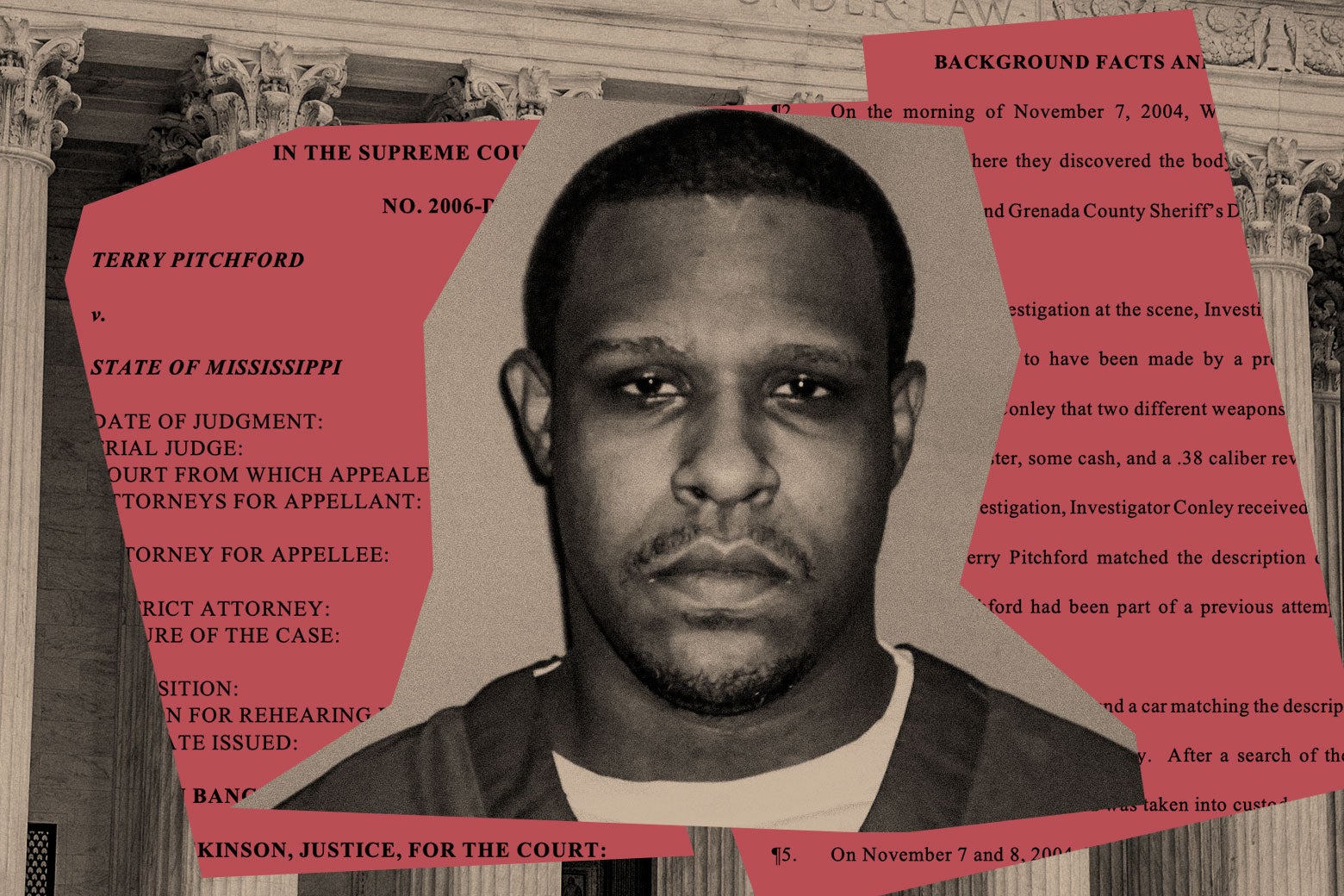
There are Supreme Court cases that arrive draped in abstraction. Their stakes are real, but the dispute comes to the court in such rarefied doctrinal form that the underlying injury almost disappears. Then there are cases like Pitchford v. Cain, in which the doctrinal maze is itself the story. By the time Terry Pitchford’s claim reached the justices last week, the central question was no longer simply whether racial discrimination had infected the selection of the jury that convicted him and sent him to death row. It was whether federal courts, hemmed in by the modern law of habeas corpus, are permitted to say anything meaningful about that possibility at all.
That is what made last week’s Pitchford arguments so revealing. On one level, the case concerns a familiar constitutional principle. Batson v. Kentucky holds that prosecutors may not use peremptory strikes to exclude prospective jurors on the basis of race. On another level, though, Pitchford is about what happens when that principle collides with the punishing procedural architecture of modern postconviction review. A court can believe that racial discrimination in jury selection is intolerable. It can say, correctly, that such discrimination degrades the defendant, the excluded jurors, and the legitimacy of the justice system itself. But if the claim reaches federal court through habeas, after state review, and under the command of the Antiterrorism and Effective Death Penalty Act of 1996 that federal judges defer unless a state court is not just wrong but unreasonable, even a serious equal protection claim can be reduced to a narrower and more desiccated inquiry: Did the defendant’s lawyer say enough, precisely enough, quickly enough, at exactly the right moment, to preserve the argument?
Pitchford was tried in Grenada County, Mississippi, in 2006 for a capital murder committed when he was 18. The county was about 40 percent Black. The jury that convicted him included one Black juror. According to Pitchford’s briefing, the prosecutor, Doug Evans, marked prospective jurors by race, using W and B, then struck each of the first four qualified Black jurors while accepting 16 of the first 18 qualified white jurors. Three of the Black jurors Evans struck were never asked any questions during voir dire. The prosecutor and the trial judge were not unfamiliar names. They were the same prosecutor and judge who later appeared in Flowers v. Mississippi, the 2019 Supreme Court decision condemning Evans’ pattern of striking Black prospective jurors in each of the six trials in which Curtis Flowers faced the death penalty.
At trial, after the state struck four Black prospective jurors, defense counsel raised a Batson objection. She argued that there appeared to be a trend of striking almost all of the available Black jurors and reminded the court that the jury had already become disproportionately white because of cause challenges, including death qualification. She also invoked Miller-El v. Dretke, another Supreme Court case involving racial discrimination in jury selection. The trial judge then asked the state for race-neutral reasons for the strikes. The judge accepted each explanation as race neutral and moved on.
That last sentence is where the law starts to split into two narratives. Pitchford’s narrative is that the trial court conducted only the first two steps of Batson and skipped the third. Under Batson, the first step asks whether the defendant has made a prima facie showing of discrimination. The second asks whether the prosecutor can articulate a race-neutral explanation. The third, and most important, requires the court to decide whether the explanation is credible or instead pretextual. That is the stage at which the court is supposed to look at the whole picture: patterns of strikes, lack of questioning, disparate treatment of similarly situated white jurors, implausible justifications, the prosecutor’s history, the texture of the voir dire, the common sense of what unfolded in the room. Pitchford says that never happened here. Mississippi’s courts, then the 5th U.S. Circuit Court of Appeals, answered that whatever more detailed pretext arguments Pitchford later developed on appeal were waived because his defense attorney did not present them to the trial judge at the crucial moment.
The court granted review on a narrow question: whether, under the Antiterrorism and Effective Death Penalty Act, the Mississippi Supreme Court had unreasonably determined that Pitchford waived his right to rebut the prosecutor’s asserted race-neutral reasons. It did not grant review to decide the Batson claim in the first instance. And that limited grant shaped the oral argument from the opening minute.
Joseph Perkovich, arguing for Pitchford, tried to do two things at once. He wanted to convince the justices that this was not merely a preservation dispute but a case in which the trial court had fundamentally failed to carry out Batson’s third step. And he wanted to show that the state Supreme Court’s ruling that Pitchford’s lawyer had waived relief was not merely debatable but unreasonable even by the AEDPA’s demanding standards. His opening was carefully built around that distinction. The trial court, he argued, “grasped and conducted just two of Batson’s three steps.” According to Perkovich, the judge never determined the credibility of the prosecutor’s explanations; had the judge done what Step 3 requires, Perkovich asserted, the court would have considered the absence of meaningful questioning, the lack of record support for several explanations, and the irrelevance of some proffered reasons to the case. He also invoked Evans’ history, including prior Mississippi capital reversals finding serious prosecutorial misconduct.
But the justices were not inclined to let him remain at that altitude for long. Justice Clarence Thomas cut immediately to the heart of the state’s position: Did trial counsel make those arguments? Did she offer argument or evidence that the prosecutor’s reasons were pretextual? Perkovich’s answer was telling. He did not say yes in the straightforward sense. He said that counsel had timely made the Batson objection and attempted to engage the three-step process but that the third step never occurred. When Thomas pressed again, noting that trial counsel later submitted an affidavit seemingly acknowledging that she had not raised those objections, Perkovich tried to cabin the affidavit as a later document that mirrored the Mississippi Supreme Court’s ruling rather than independently describing what the law required.
That exchange exposed Pitchford’s core problem. The court is not writing on a blank slate. It is reading a cold transcript under a regime of extreme deference, where a claim that feels powerful can still founder if the justices conclude that Mississippi’s reading of the record was at least reasonable. Chief Justice John Roberts pursued that point by focusing on defense counsel’s statement that “at some point the defense is going to want to reserve” both its Batson objection and a 14th Amendment racial discrimination argument. Roberts wondered whether that phrasing itself suggested confusion, either by counsel or by the trial judge, about whether the objection was then being made or merely marked for later elaboration. Roberts’ concern went to what several justices seemed to view as the case’s central interpretive challenge about how much an appellate court should infer from the supposed ambiguity of a lawyer saying “at some point” and the judge replying that the objection is already in the record.
Justices Ketanji Brown Jackson and Elena Kagan seemed the most willing to read that colloquy in Pitchford’s favor. Jackson suggested that defense counsel’s words could fairly be understood to mean she was prepared to make the showing and asking for the opportunity to do so. It sounded to Jackson as though the trial court was cutting counsel off, perhaps mistakenly saying the work had already been done. That theme drew its clearest support from Justice Sonia Sotomayor, who seemed deeply troubled that the trial judge had never actually performed Step 3 at all. Kagan approached the case by focusing on the structure of Batson itself. The rule, she suggested, does not end once a prosecutor offers a race-neutral explanation. The trial court must still determine whether that explanation is credible or merely a pretext for discrimination. In declaring that defense counsel did not waive her argument, Kagan’s questions returned repeatedly to that point.
Justice Amy Coney Barrett, however, supplied the argument’s most exacting skepticism, and likely the cleanest window into which a center-right majority might land. She kept pressing on what the trial judge should have done, and what, specifically, defense counsel was required to do. Barrett accepted that Batson has three steps. She accepted that the trial judge must make the ultimate determination. But she was not willing to elide the defendant’s burden. If the prosecutor offers race-neutral reasons, and the defendant bears the burden of proving purposeful discrimination, does counsel not have to say why those reasons are pretextual? Does the judge have an obligation to solicit rebuttal, or is it counsel’s job to insist on giving it? To Barrett, lawyers still have to make their record, and under the AEDPA, the question is not whether the Supreme Court would prefer a cleaner colloquy, but whether Mississippi acted unreasonably in deciding that defense counsel had not done enough.
Justice Samuel Alito honed that skepticism into something sharper, deeming defense counsel “the most timid and reticent” he had ever encountered, observing that any competent defense attorney he knew would have stood up and said, in substance, that the state’s explanation was pretext. He acknowledged that the judge should have handled the process differently and ideally would have invited a response. But he seemed unwilling to transform that imperfection into a constitutional defect in which counsel, in his view, still had “every opportunity” to make the point and did not. Justice Neil Gorsuch reached a similar place by a more doctrinal path, noting that the applicable AEDPA standard strips the case of some of its moral heat and forces it into the precise grammatical directives Congress imposed on habeas review.
The state’s argument, led by Mississippi Solicitor General Scott Stewart and supported by the United States, leaned hard into that narrowing move. Mississippi’s position is that the state Supreme Court accepted that Pitchford made a prima facie Batson showing, accepted that the prosecutor had to provide race-neutral reasons, and concluded that Pitchford failed to preserve later-developed pretext arguments because he did not present them to the trial judge. The state also pointed to later postconviction filings and defense counsel’s own affidavit suggesting that she had not in fact preserved the fuller pretext theories subsequently pressed on appeal.
A ruling for Mississippi would do more than reject one prisoner’s appeal. It would further expose a structural weakness in Batson itself. Batson already places extraordinary weight on the quick instincts of trial judges and the exactitude of trial lawyers in the compressed theater of jury selection. The AEDPA then adds another filter, demanding deference to a state court’s retrospective account of what occurred. The result is a system in which a constitutional prohibition on racial discrimination can become almost entirely dependent on whether the transcript captures the right verbal choreography. If the judge moved too fast, if counsel assumed she would be allowed to respond after the prosecutor finished, if the court declared the objection preserved while simultaneously foreclosing fuller argument, all of that may still amount to nothing on habeas if a later court can plausibly describe the problem as forfeiture rather than truncation.
That is why the case matters so much in both the Batson and habeas worlds. In Batson doctrine, the danger has always been that Step 2 becomes the whole game. Almost any explanation can be labeled race neutral in the abstract. The only meaningful safeguard is Step 3, when courts test those explanations against reality. In habeas doctrine, the danger has always been that federal review becomes so deferential that even substantial constitutional claims are transformed into sterile questions of state-court reasonableness. Pitchford sits exactly where those two dangers meet. If Step 3’s pretextual jury-striking analysis can be skipped in practice and insulated on review, Batson’s promise becomes thinner still. If on the other hand the court insists that a trial court cannot collapse the inquiry into a quick exchange of neutral reasons followed by an immediate return to jury striking, then the decision could modestly strengthen both Batson enforcement and the possibility of federal review in which state courts mischaracterize the record.
The justices did not make the outcome of this case obvious. It is possible the court will find a narrow way through, perhaps saying little about Batson’s substance while resolving the waiver question on technical grounds. But even if the opinion is written in the clipped vocabulary of habeas review, the stakes are larger than that language suggests. The Constitution forbids racial discrimination in jury selection not because jury service is symbolic, but because it is civic power. To exclude Black citizens from that role is to say something corrosive about who counts as part of the machinery of judgment and who is entitled to full citizenship. Batson was supposed to prevent that. Habeas was once supposed to provide a federal backstop when state courts failed. Pitchford asks whether either promise still has real force when the record is messy, the procedure rushed, and the law of review designed to look away.