Sign up for the Slatest to get the most insightful analysis, criticism, and advice out there, delivered to your inbox daily.
Someone should brief President Donald Trump on the meaning of NATO—not just its value to America’s global presence and security ever since the alliance was formed in 1949 but also, more simply, what the treaty creating it says.
He would then learn that his pique at the NATO allies for not helping him in his war against Iran—his threat to pull out of the alliance, then, a bit less extremely, to withdraw troops from those countries that refused to help him send warplanes to bomb Iran—has no justification whatever.
Most people know about the centerpiece of NATO’s treaty, Article 5, which states, “An armed attack against one or more of them in Europe or North America shall be considered an attack against them all.” But they tend to ignore the words in the middle of that sentence—an armed attack in Europe or North America.
The implication is that the obligation does not apply to attacks outside Europe or North America. In case anyone detects ambiguity in this clause, Article 6, though almost never cited, states the matter explicitly:
For the purpose of Article 5, an armed attack on one or more of the Parties is deemed to include an armed attack:
• on the territory of any of the Parties in Europe or North America … on the territory of Turkey or on the Islands under the jurisdiction of any of the Parties in the North Atlantic area north of the Tropic of Cancer;
• on the forces, vessels, or aircraft of any of the Parties, when in or over these territories or any other area in Europe … or the Mediterranean Sea or the North Atlantic area north of the Tropic of Cancer.
In other words, the NATO allies have no obligation to aid us (nor do we have any obligation to aid them) in a war that takes place outside the areas of the treaty’s jurisdiction—in other words, that occurs in or over, for example, Iran or the Strait of Hormuz. And this leaves aside the fact that in Iran, the United States was not the object but the instigator of an unprovoked attack on another nation.
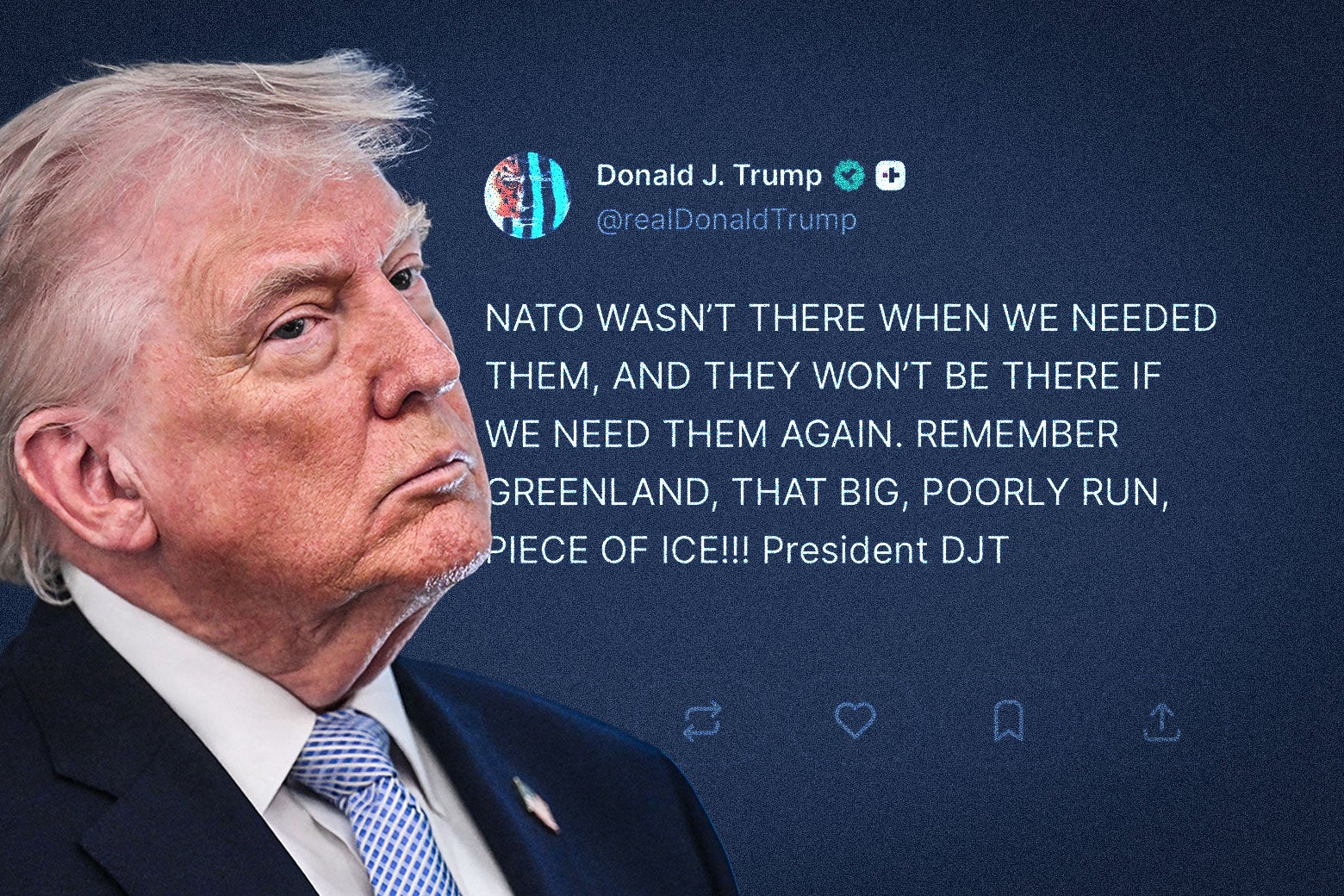
“NATO wasn’t there when we needed them,” Trump pouted on social media on Wednesday. But had he known history, he wouldn’t have expected NATO to be there in the first place.
It’s worth noting that it was the American officials at the treaty’s drafting sessions who insisted on Article 6, so that the U.S. military would not get roped in to fight Europe’s colonial wars. (Europe still had colonies in 1949.) In any case, no American president has asked—much less angrily pressured—the European allies to help fight our own foreign wars in other parts of the world. Harry Truman didn’t ask the NATO allies to help stave off the North Korean and Chinese invasions of South Korea. Dwight Eisenhower, John F. Kennedy, Lyndon B. Johnson, and Richard Nixon didn’t ask them to help fight alongside us in Vietnam. Not only did Eisenhower reject requests by Britain and France to help them occupy the Suez Canal in 1956, but he demanded that they withdraw from Suez and threatened to withhold all aid if they didn’t.
In retrospect, the Suez crisis is seen as a turning point in 20th-century history. It drove home the point that Britain and France, the main colonial powers in the decades before World War II, had lost their dominance and, from then on, would have to accede to the new Western superpower in Washington.
Some analysts see Trump’s failure to rally allied support for his venture in Iran as post–Cold War America’s “Suez moment.” The parallel is imperfect. Germany, Spain, and France—whose leaders most outspokenly refused to let their bases be used for Trump’s war—have hardly displaced the United States as the West’s top power. China, which reportedly played a role in the talks for a ceasefire, is better positioned to take on that capacity. More likely, at least for the next several years, anarchy will prevail as American power and influence decline. Still, the Iran fiasco—Trump’s refusal to cooperate with allies, his obscenity-laden threats to bomb Iran back to the Stone Age, followed by his agreement to stop the war without achieving any of his objectives despite having unleashed his military’s most lethal bombs and missiles on more than 13,000 Iranian targets—may be seen as a turning point in the American empire’s decline: the culmination of Trump’s retreat from its traditional role as a guarantor of Western security and order.
It’s a turning point that Trump seems to savor. At his news conference this week, he said, “I’ve never been convinced by NATO,” called the alliance a “paper tiger,” and added, “Putin’s not afraid of NATO,” though “he’s afraid of us.” To the extent any of this is true, Trump was only digging our allies’ grave, practically inviting Vladimir Putin to invade them (perhaps after first conquering Ukraine, a goal Trump has also all but abandoned), especially since he was signaling that he might not come to their aid, Article 5 or no.
At his press conference on Tuesday, the president capped off his tirade against the NATO allies with a particularly petulant remark.
It all began with, if you want to know the truth, Greenland. We want Greenland. They don’t want to give it to us. And I said, “Bye-bye.”
This is an unserious man. I take back my suggestion at the top of this column that someone needs to brief Trump on what the NATO treaty says. It doesn’t matter. He wouldn’t listen anyway.