Sign up for the Slatest to get the most insightful analysis, criticism, and advice out there, delivered to your inbox daily.
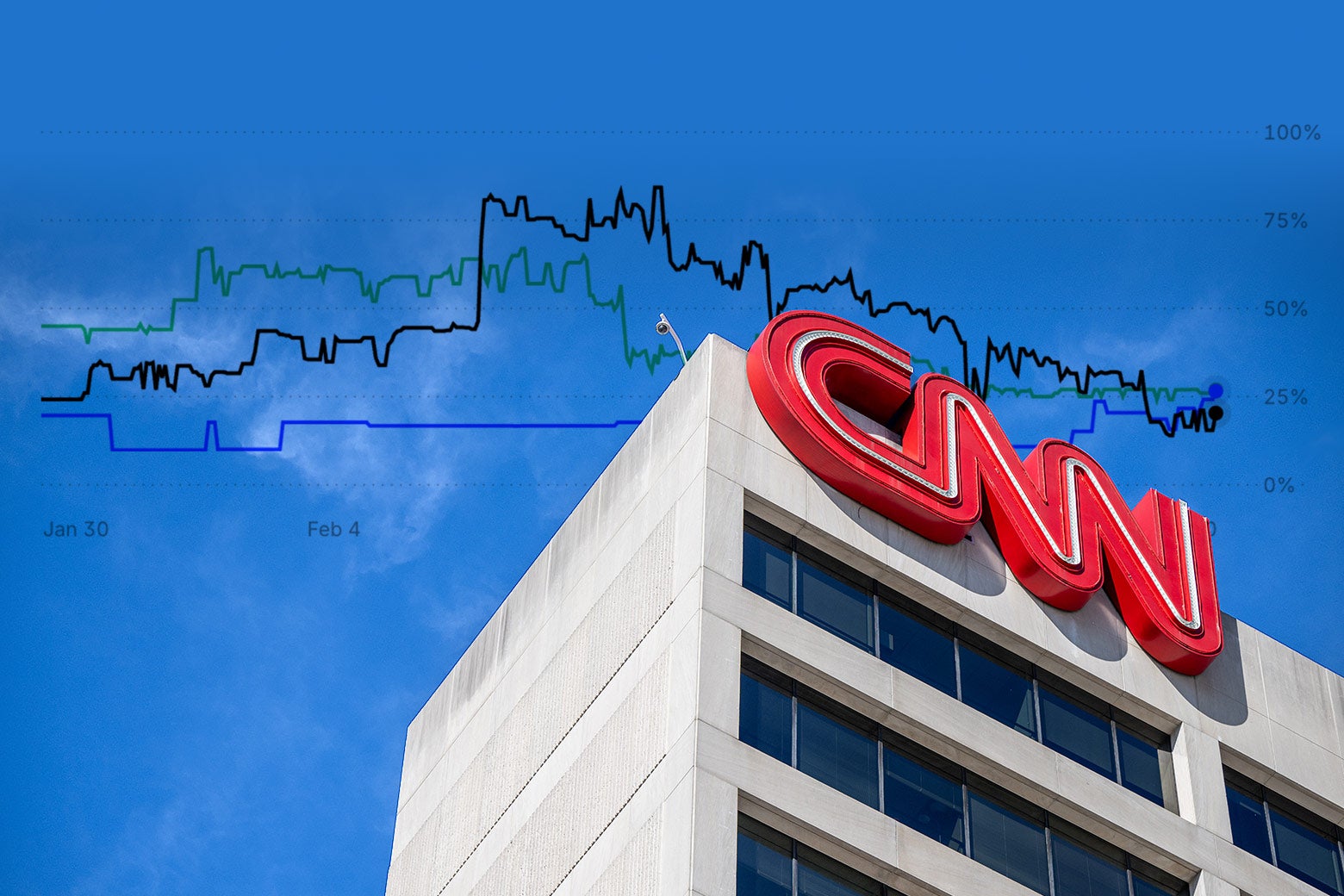
By mid-October, the Democrats’ chances of retaking the House of Representatives had taken a body blow. Or at least that’s what you would have thought if you watched the segment CNN ran that day with Harry Enten, the network’s chief data analyst. Back in April, Democrats had an 83 percent chance of retaking the House in the 2026 midterms, Enten reported. But by that day in October, those chances were down to 63 percent. “A TWIST IN THE BATTLE FOR HOUSE CONTROL,” a chyron blared. Enten tweeted the segment with the line “Democrats’ chance of taking the House in 2026 have plummeted, while GOP chances have skyrocketed over the last 6 months.”
You’d probably assume CNN was basing its probabilities on political polling, the flawed but time-tested method by which political scientists attempt to figure out which way the wind is blowing. In this case, you’d be wrong. The network based the segment on market odds on Kalshi, a predictions marketplace that takes bets on a wide variety of future event outcomes. Of course, they’re not technically bets. For regulatory reasons, Kalshi hosts not a casino per se but the trading of prediction contracts, which trade on an open market and move in price for the same reason any asset does: supply and demand. In other words, CNN’s assertion that Democrats’ chances had “plummeted” was based not on polling data but on how people gambling on the election’s outcome on Kalshi thought things were going.
This segment was a mistake. Now CNN has committed to repeat it many times over.
CNN was the “first major news network to embrace Kalshi prediction markets,” as Kalshi put it, but it won’t be alone for long. Last week, Kalshi announced partnerships with both CNN and CNBC; both will integrate its markets into their news coverage going forward.
For Kalshi, this sort of mainstream acceptance is part of its plan to grow into a behemoth that makes a financial market out of essentially everything. “ The long-term vision is to financialize everything and create a tradable asset out of any difference in opinion,” one of its co-founders says. In service of that goal, Kalshi gets to put that agenda in front of the eyeballs of CNN’s audience. CNN didn’t confirm that it was receiving payment, though it would be typical of a commercial relationship to feature a company’s logo and data and let it call itself the network’s “official prediction market partner.”
It’s the highest-profile relationship between a news company and a prediction market but not the first. Yahoo Finance and Kalshi competitor Polymarket reached a deal in November. Expect to see additional such markets in your news coverage as more outlets strike up deals.
Some of what Kalshi and Polymarket offer is only a fresh coat of paint on markets that have existed for years. Kalshi has its own version of sports betting, which uses the trading format to skirt the bans that a handful of states still have on traditional sportsbooks. Watching the NFL earlier this year, I bought a $50 “contract” on the Packers to beat the Steelers and “sold it” for $87, a tidy profit when Green Bay won. I did this from Los Angeles, legally, even though California doesn’t allow sports betting. State gaming regulators are not happy about this loophole, but according to Kalshi—whose advisers include Donald Trump Jr.—it reports to the federal government, not the states. Go figure.
The platform is breaking some new ground, though. Kalshi is slowly popularizing markets for things you’d have never thought to bet on five years ago, at least not at scale. Some of these markets are academically interesting, if not valuable, because they capture sentiment for which public polling has never tried to do the job. For example, in another segment, CNN and Enten use actual polling to discuss Donald Trump’s approval rating and share prediction market odds that we’ll all get sent stimulus checks.
Many Kalshi markets are significantly dumber. What will Mr. Beast say in his next YouTube video? There’s a market for that. What will the recorded high temperature be in New York City today? There’s a market for that. What will the CEO of Coinbase say on an earnings call? There’s not only a market for that; the CEO is aware of it and recently rigged it. He did this without getting in trouble, because prediction markets are a regulatory Wild West. The unofficial stance of the current United States government is that Kalshi and the people trading on it can do whatever they want. There is, in some very prominent people’s views, no restriction on insider trading on these markets. Securities law experts may disagree, but that doesn’t change how little interest the feds have in getting in the way of platforms like Kalshi right now. Are there members of the government or major financial institutions currently using their knowledge of coming policy actions to trade on the platform? I’ll answer that question with another one: Why wouldn’t they be?
The potential for abuse isn’t the only reason it’s foolish to present prediction market odds as some sort of real political science. Election gambling, whether it takes the tool of offshore sportsbook bets or contract trading, just isn’t a proven predictive tool. This ecosystem took off in 2020, when cooped-up people with disposable income threw mountains of cash into the offshore markets on Trump’s race against Joe Biden. As I reported in detail for my first story at Slate, all those years ago, the market was freaky. Bettors gave Trump a much better chance than the polls ever indicated he had. The demographic skew of election bettors—think white guys who are comfortable dealing in crypto—favored Trump, and the sportsbooks were happy to take their money on Trump even after the election. Election betting is not so much a weather vane as a mechanism for bettors to reflect the world as they see it, and make or lose money doing so. “People bet on their favorite team,” a spokesperson for BetOnline explained to me.
At least the past few presidential elections have been big markets, with people across the world pouring many millions of dollars into them. Sure, those markets weren’t a substitute for polling, but they at least offered a window into how global speculators felt about the races. It was academically interesting. By contrast, the U.S. House market that CNN featured so prominently has, even today, less than $2.5 million in total trading volume. If a Republican political consultant wanted to buy $100,000 worth of contracts on the GOP to hold the House, they could materially move the price and thus the implied odds. With CNN providing free media coverage of the party’s improving chances, wouldn’t that be a compelling alternative to simply buying some commercial time? Are you starting to see the problem with a major news channel using an opaque tool of financial speculation to sum up conventional wisdom about an election?
There’s less than zero reason to think that Kalshi cares about the misuse or misinterpretation of its market data. The platform is after market share in a fast-growing industry. The company has entered into at least one partnership with a fake sports reporter who farms engagement with false tweets. That would be bad behavior for any company, but it’s even further beyond the pale for a company that hosts sports prediction markets that could move based on a false report’s getting enough traction. And if that’s how Kalshi operates with something as low stakes as sports, we can all use our brains and imagine what fun a company like this might get up to around the 2026 and 2028 elections.
These are challenging times for CNN, as its parent company sells off huge parts of itself but leaves it (at least for now) to fend for itself in a spinoff. A legacy media operation like CNN will die a slow death if it doesn’t find creative new revenue streams to offset the endless bleed of cord-cutting. But if the broadcaster’s answer is to masquerade around prediction markets and treat them as a stand-in for actual political scientists analyzing actual polls, then the best case is that it’s misleading its audience. The worst case is that it’s running a news version of the betting gold rush that has conquered most major sports media companies in the past five years. The main difference is that the point spread in an NFL game actually gives you a decent idea of what will probably happen on the field.