Sign up for the Slatest to get the most insightful analysis, criticism, and advice out there, delivered to your inbox daily.
If it feels impossible to get hired in today’s job market, it’s because it is. Greenhouse, a hiring software firm, estimates that when someone applies for a job, they now have a 0.4 percent chance of being hired—meaning you have a better chance of getting into Harvard than securing employment.
It’s even harder if you’re Gen Z. A survey by higher-ed research platform Intelligent.com found that 38 percent of employers avoid hiring recent graduates for roles they’re technically qualified for. This comes on top of the use of A.I. tools in hiring, which a Brookings study found favors men’s names over women’s and chooses “white” names 85.1 percent of the time, selecting “Black” names only 8.6 percent of the time.
If we do make it to the interview stage, we now face multiple rounds and are subjected to interviews with chatbots and unpaid assignments that shift the cost and risk of hiring onto workers. At the same time, union membership, which has historically helped anchor fair compensation, is eroding across many industries. Meanwhile, layoffs continue in sectors that once promised stability. Companies focused on efficiency and lean operations are now using A.I. instead of hiring entry-level workers, freezing roles, or cutting staff altogether.
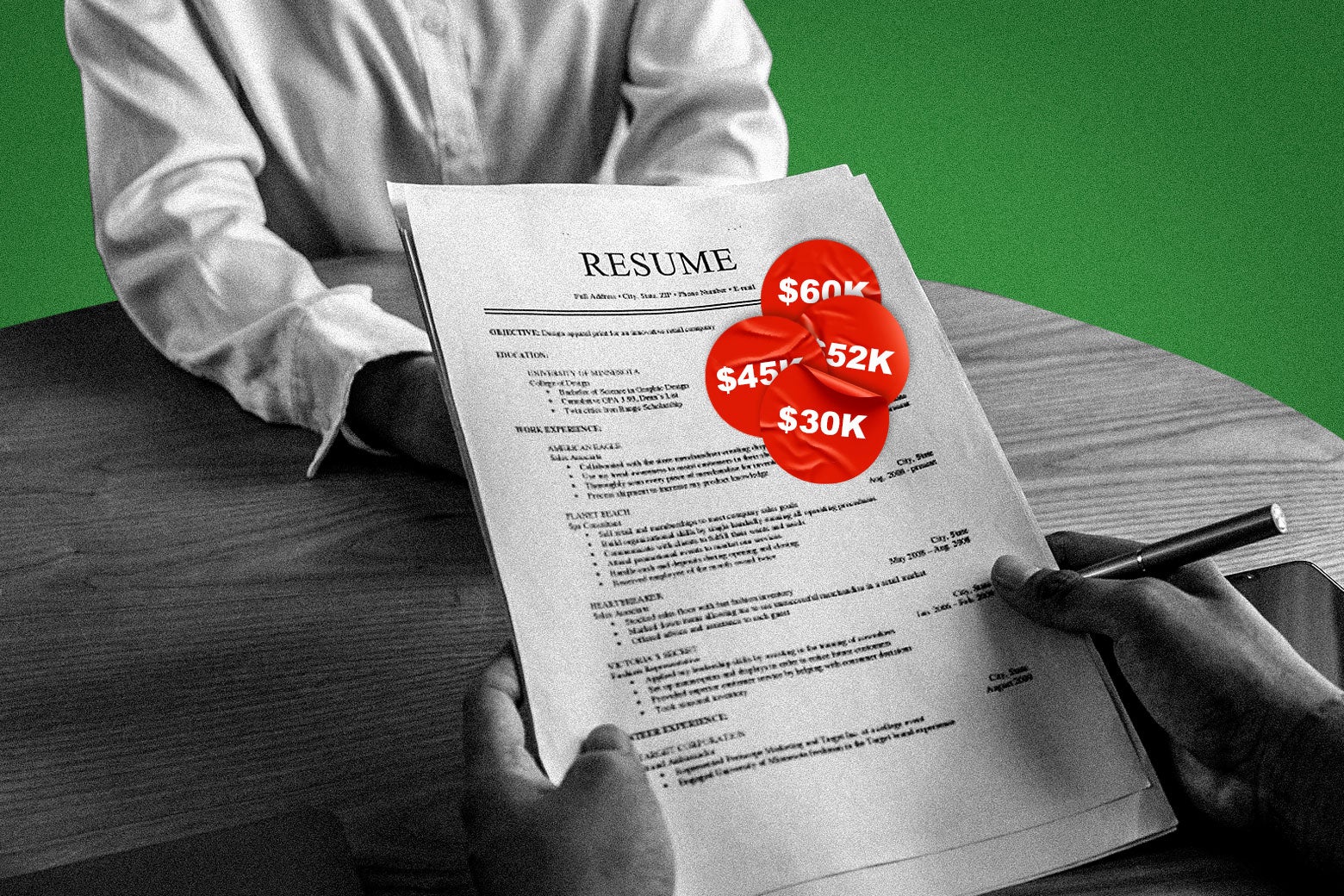
In this cost-cutting, ageist, gendered, and racist hiring market, a growing number of younger, female job seekers have begun “lowballing” their salary expectations: offering to work for less than the posted salary. I know this because I did it myself.
Despite an undergraduate degree from the London School of Economics, an Oxbridge master’s degree, and professional experience, I couldn’t find a job after sending close to 1,000 applications. I eventually made it through a competitive hiring process for a writer-editor position at a small health research publication. The hiring manager praised my initiative and said I had gone “above and beyond” in my first interview.
But almost immediately, I was cut from the shortlist. I was told I brought “too many ideas” and seemed interested more in doing “extra things” than what was in the job description. I was cast, again, back down to the anonymous purgatory of millions of other job seekers who can’t get a foothold, regardless of credentials, enthusiasm, or positive attitude.
I convinced myself that the problem was my expectations. I wrote back that I would accept $10,000 less than the posted $60,000 salary if it meant staying in consideration, just enough to get by in my rent-stabilized New York apartment. I knew that it was a small company, so the budget was likely tight. I also understood that much of the work could be outsourced to A.I., since the writing was largely technical and already trending in that direction. On top of that, I was a younger, entry-level candidate, and I wanted to show how eager I was to prove myself.
Surprisingly, the tactic worked, even if I was kept around only out of pity. I was brought back in, sat through three more rounds of interviews and writing tests, and was given a monthlong remote “trial shift.” After nearly three months of effort, I was told I wouldn’t be hired. I wasn’t meeting output expectations, my almost-boss said, and there was no budget (as expected) to train me.
When I wrote about the experience anonymously on Reddit, I received a mix of sympathy and scolding. Many argued that undercutting yourself is the worst strategy anyone could use. But some said they had started doing the same thing. A commenter who had been unemployed for eight months confessed, “Yesterday I started lowballing my pay.”
It’s tempting to frame behavior like this as a confidence problem in younger workers. And while confidence obviously takes a hit after months and years of being rejected and ignored, lowballing is a rational response to what we’re seeing around us. When we watch employers cut costs through layoffs, hiring freezes, and mass A.I. uptake in hiring, we understand that our own wages are an important consideration for companies and one of the only variables we can actually control.
Andrew Lokenauth, a former Wall Street executive and financial educator at the Finance Newsletter, told me he now sees more young women offering to accept salaries below the listed range. “They’ve internalized this scarcity mindset that any job is better than no job,” he said. We’ve learned that survival depends on appearing cheaper than the next person.
There’s little data on how often applicants offer less than what employers advertise. But Lokenauth encounters this trend most in creative and nonprofit industries. These sectors, in which “passion” has long been used to justify undervaluation, are the same ones in which applicants are now volunteering to take less pay.
For 29-year-old journalist Lucy Rowan, offering less felt like a way to stay competitive. Hoping to move from London to New York, she applied for editorial roles and offered to take $12,000 less than the listed salaries to offset visa costs for employers. She didn’t get a single interview. When she began applying locally again, she found roles offering 10,000 pounds less than she had previously earned. One junior role at a media company for which she’d interned paid less than her former salary as a senior editor elsewhere. She still didn’t get an interview for the role. This has taken a toll on her professional confidence. “Maybe that last salary was a fluke,” she told me. “I’ve started doubting if I’m really worth that much.”
Twenty-four-year-old Rupal Rao in New York sometimes offers a lower figure when she feels underqualified. “If the base is already high, I’ll offer lower and hope they give me a shot,” she told me. But hiring managers often interpret these offers differently from how applicants expect. Lokenauth explained that when candidates came in far below the range at the banks where he worked, “we assumed they either didn’t understand the role or lacked confidence. Neither interpretation helped their case.”
Despite the expansion of pay-transparency laws, many companies list ranges on the lower end of what they’re actually willing to pay, normalizing wages that are already too reduced. So when applicants lowball, they may end up pricing themselves well below what the company actually budgeted to pay.
Unfortunately, when individuals adopt this survival strategy, the effects quickly move beyond them. The job board Handshake released research on “reservation wages”—the lowest salary applicants say they are willing to accept—that shows that when expectations fall, market benchmarks tend to follow. Because Gen Z women already expect to earn $6,200 less on average than their male peers, this assumption is geared to affect women’s potential earnings over time. Lokenauth described a woman who accepted a steep pay cut to join a fintech startup, believing she could “catch up later.” Two years on, she was still behind, watching newer hires come in at higher salaries. “The math never works in your favor,” he said.
None of this means that lowballing is ethically neutral. Gem Murray, a 27-year-old creative director from New York, compared the practice to bidding wars on apartments. “Maybe people do it out of desperation,” she told me, “but it’s spineless and demoralizing.” She worries that if a company ends up hiring a worker on a lower wage, the practice will depress wages for everyone.
That fear is understandable but risks directing anger at the wrong target. A labor market structured around scarcity almost guarantees that some people will eventually bid themselves down. Blaming job seekers misses the reality that the system pushes them, particularly young women and women of color, there. Employers know they can get away with paying less when thousands of people are competing for the same few jobs. The solution cannot be to simply “lean in” and ask for more. Change lies in restoring genuine entry-level pathways, enforcing transparency standards that reflect actual pay practices, limiting unpaid trial labor, and eliminating hiring bias.
When I think back to my rejection from the health publication, after offering to work for less, I feel angry at how desperate and mentally unwell unemployment had made me. After sending more than 1,000 applications, most of which didn’t result in even an automated rejection, I’ve taken a break from applying for now.
Many of “the most rejected generation” are piecing together income through gig work or are “underemployed,” working multiple jobs that do not require the education they completed—such as nannying and dog-sitting—or retraining into vocational fields with more openings and fewer barriers to entry, even though pay is often lower than the white-collar roles their degrees would once have positioned them for. As graduates are choked off from traditional pathways, more will find themselves in this kind of patchwork employment situation. Lowballing is less a strategy than a symptom of bargaining power having shifted entirely away from workers.
The slight glimmer of hope in this new work order is that necessity may breed innovation, creating opportunities to build income streams that could revive certain industries. Small-business openings were at a record high in 2023 and remained elevated throughout 2024, for example. We’re also seeing more unemployed people starting Substacks, a trend that could perhaps spell hope for the publishing industry.
The risk is that, under conditions of precarity, people often stop negotiating for better futures at all, and the cost is in not just wages but in careers that never really get started.