Sign up for the Slatest to get the most insightful analysis, criticism, and advice out there, delivered to your inbox daily.
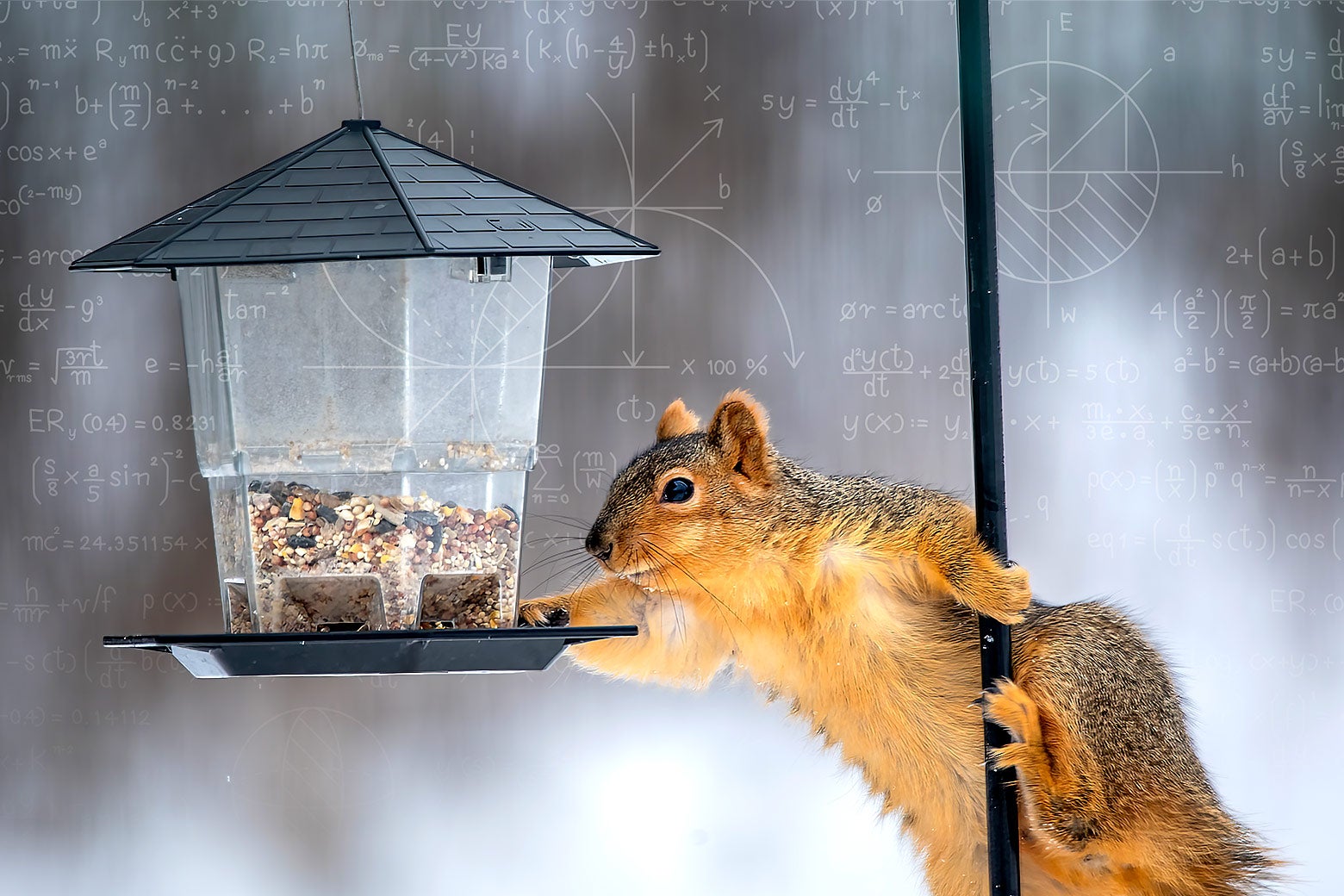
Like a true Midwesterner, my dad has been feuding with the squirrels in his backyard for years. Every few months, he comes home with a new “squirrel-proof” bird feeder, each more expensive than the previous, each one promising to finally do the trick. My mom rolls her eyes at the pile of hardware-store receipts and discarded feeders. I shake my head watching this all play out—knowing full well those feeders never stood a chance.
Walk down the birdseed aisle in any hardware store and you’ll find an entire product category promising “squirrel-proof” solutions. Weight-triggered shutters. Spinning perches. Metal cages. They range from $40 to $80, with some running as high as $140—and each defeat makes you wonder if spending just a little more on that next premium model will finally keep them out.
Here’s the thing nobody tells you when you’re standing in that aisle, planning your long-awaited victory: Squirrels aren’t dumb. You’re losing to an animal that has evolved to be remarkably like you, with hands that manipulate and a brain that learns. Every time you buy a new “squirrel-proof” feeder, you’re handing a puzzle to a creature that has spent millions of years getting really, really good at solving it.
The squirrels aren’t going to lose. They can’t. This is what they were built for.
Squirrels aren’t your average rodent. They operate with a completely different playbook. Compare them to mice, for example. Mice are nocturnal and secretive. They survive by not being seen. They’re out there in enormous numbers, but you’d hardly notice. Squirrels? They’re in the open every single day, bold and visible, dismantling your feeder in broad daylight.
The differences go beyond visibility. Most rodents play the numbers game. They reproduce constantly and bet on quantity over quality. Squirrels take the opposite approach. They don’t just breed fast and hope for the best. They have way fewer offspring, invest more time into raising them, and live up to a decade in the wild.
The reason goes back millions of years—to our primate ancestors. It’s an example of convergent evolution, when completely unrelated species independently evolve comparable traits in response to similar environmental pressures.
Our primate ancestors lived in trees and ate fruit. Fruit is scattered unpredictably across the landscape, but it’s calorie-dense and worth the effort to find. It requires hands to peel and process. And tracking the productive trees across an extensive territory requires remembering where they are. This created millions of years of evolutionary pressure for hands that manipulate and brains that learn—the tool kit for life in the canopy. Eventually, those primates came down from the trees and passed that tool kit on to us.
Meanwhile, the ancestors of your backyard squirrels faced a similar challenge—just with nuts instead of fruit. Nuts require dexterous hands to handle and access. And like fruit, they’re scattered unpredictably across the landscape, which means tracking where they are and where they’re stored. So squirrels independently evolved the same kinds of tools: fine motor control and spatial memory. Same kinds of pressures, same kinds of solutions.
Despite being much more closely related to mice than to monkeys, squirrel evolution followed the primate playbook. Convergent evolution shows us that lineages respond more to pressures than pedigrees.
And squirrels are still putting those specialized adaptations to work. When a squirrel takes on your bird feeder, it’s using the same evolutionary tool kit your primate ancestors developed. That kind of behavioral plasticity—solving new problems with old skills—is a very human thing to do.
Watch a squirrel at your feeder sometime. At first it may seem like random grabbing and yanking, but look closer. It tests the mechanism: rotates it, tries different angles, applies pressure, gets feedback, and adjusts. This is methodical manipulation.
Squirrels evolved those paws for the same reasons early primates evolved hands: Life in the trees demands it. In fact, they’ve adapted wrist bones that work like a pseudo-opposable thumb. They even evolved flat thumbnails, a feature primates also developed for handling food.
But dexterous paws are only half the story. At the University of Cambridge, researcher Pizza Ka Yee Chow runs a lab with a star-studded crew of squirrels: Simon, Arnold, Sarah, Leonard, and Suzy. In a study published in the journal Animal Cognition in 2017, Chow’s team trained the squirrels to use touch-screen tablets to get treats. The team also designed custom puzzle boxes to test the squirrels’ memory and problem-solving. The squirrels remembered the solutions nearly two years later. When researchers changed the rules, they learned the new ones.
Neuroscience backs this up. In a separate study, published in Communications Biology in 2022, researchers put squirrels into fMRI scanners—tracking blood flow in the brain to reveal which regions are active and how they communicate with one another. The scans showed connectivity patterns for spatial reasoning and problem-solving that look more like what you’d find in monkeys than in mice.
Which brings us to the fundamental problem with “squirrel-proof” feeders: Every supposedly clever mechanism is, by definition, a puzzle. And puzzles are exactly the kind of challenge squirrels were built for. You’re basically giving them enrichment activities.
So what in the heck do you do about it? A squirrel is casually cracking into your latest $67 contraption, and now you understand: You’re competing with a specialist, shaped by a deep evolutionary history in the trees.
You have two choices. First, you can surrender and admit that they’re going to win. They have millions of years of evolution on their side. Meanwhile, you have a hardware-store receipt. Keep filling the feeder, accept that some goes to the squirrels, and pocket the money you would’ve spent on upgrades.
Or you can attempt a truce. Buy a cheap feeder, fill it with corn, and put it 10 feet away from your bird feeder. Squirrels should be smart enough to take the easy pickings over the puzzle box. You can’t beat them, but you can try to coexist.
Otherwise, the real winner here is the bird feeder industry. It sells you a puzzle, the expert inevitably solves it, and you’re back again for another one. It’s your call. My dad is still buying his fancy feeders. Me? I’ve embraced a simpler approach: enjoying the experts at work.