Sign up for the Slatest to get the most insightful analysis, criticism, and advice out there, delivered to your inbox daily.
Joziah was tabling on campus for his peer mentor job at the end of last semester at Florida State University when he noticed something strange happening across the quad: A trio of men, wearing Meta AI glasses, were stopping every young woman who passed by and asking them for their social media contacts.
“I recognized them from TikTok, because they’re kind of big, especially in Miami,” the 19-year-old told me. “ I’m seeing them literally go up to every single girl that’s passed by with them.”
He posted a video of the incident on his TikTok, which quickly garnered 200,000 views. Women who had seen the same event unfold flocked to the comments to share their frustration with the situation. “Literally I was one of their victims,” one user said. Another wrote, “They were so rude to ppl asking them what they were doing too.”
Others shared their fear of the same thing happening to them. “I literally have nightmares about this,” yet another wrote.
This isn’t the first time that Joziah, who asked to have his last name withheld to protect his identity, has had an uncomfortable encounter with the new wearable recording devices. During a football game, a stranger secretly recorded a video of his friend and posted it online, to her shock. When Joziah returned to his hometown over winter break, he went out with some female friends, during which they were recorded on Meta AI glasses and posted on social media without their consent. They learned about it after the clip, a POV video of the creator approaching Joziah’s friends at a bar, went viral.
“It definitely made me feel uneasy,” Joziah recalled of the experience. “I felt uncomfortable watching them go up to all these girls to record their interactions of them hitting on them.”
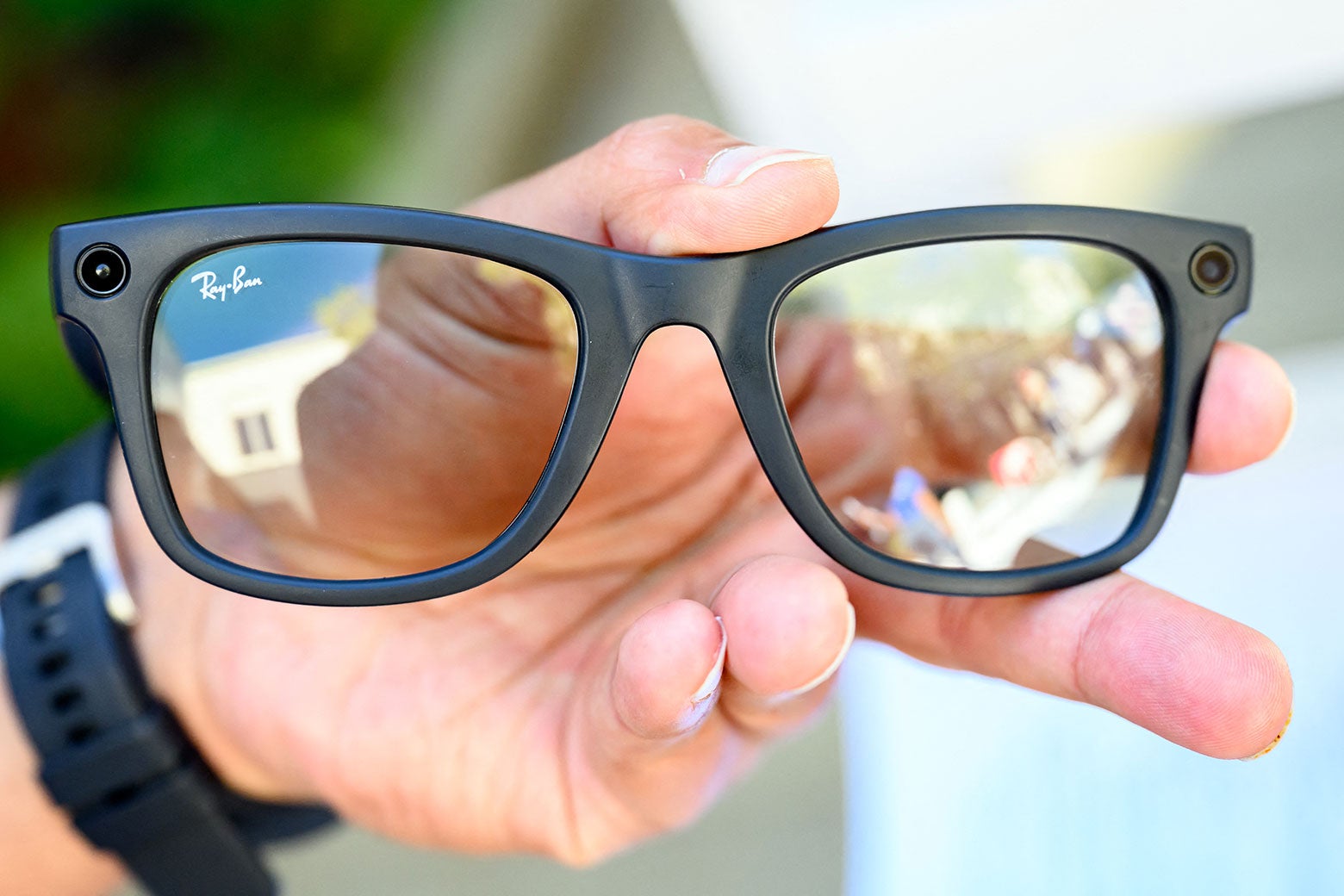
After pushing billions of dollars into the metaverse, Meta has now found overwhelming demand for its Ray-Ban display glasses, which allow users to take photos, stream content, and talk to an A.I. assistant. Waitlists for the product have surged, and the company’s pivot away from the metaverse and toward smart glasses has become aggressive: Hundreds of Meta workers in the Reality Labs division and virtual games studios were laid off, product rollout was paused to address the supply shortage, and it was reported that Meta and EssilorLuxottica, Ray-Ban’s owner, are discussing possibly doubling production capacity for the A.I.-powered glasses by the end of this year, all in a bid to capitalize on the growing demand as well as get ahead of competitors.
But its usages—specifically its ability to capture photo and video—have raised questions about how the devices will be applied in real life, especially in settings among children and young adults. Issues around academic dishonesty, classroom surveillance, and harassment have been growing in recent years but have been exacerbated as students gain access to the controversial wearable.
Chloe Peichl, who is 18, is a senior at a small private school in Texas. She told me that the introduction of generative A.I. tools and new technology has vastly shifted the environment at school.
“ A.I. and ChatGPT, oh my gosh,” she said. “It’s insane. Innocent people are getting accused of [copying their homework from ChatGPT] and having to rewrite 15-page essays that they worked all year on.”
It has resulted in a schoolwide crackdown. All wearable technology—from Apple Watches to smart glasses—is banned. Phones are not allowed on premises. Even laptops were barred, causing an uproar from students who felt very strongly about being forced to use school-issued Chromebooks for their final papers. Peichl found these guidelines to be incredibly frustrating when writing her mandatory senior thesis.
“ I mean, I can see where they’re coming from, but I don’t know,” she said. “Just eliminating tech completely from schools, I think, is not exactly helpful.”
That’s not to say that people don’t try to circumvent the rules. Peichl said that some try to sneak their Apple Watches in; others attempt to hide their phones where they think teachers can’t see them. But Meta AI glasses are new, and while those devices aren’t as common, adults are on the watch now. She recalled one student who tried to sneak their Meta AI glasses into class.
“I don’t know what he was using them for, but he has been known for trying to cheat on schoolwork and stuff,” she said. “I don’t know if that’s what he was using them for. And he got them taken away immediately.”
Jamie Cohen, assistant professor of media studies at CUNY Queens College, said that he is highly aware of the impact that new tech has on the classroom environment. Quizzes in particular have become difficult to issue, as students frequently use ChatGPT and wearables, in addition to sharing digital copies of answer keys through end-to-end encrypted apps like Signal, Telegram, and WhatsApp. “It does inspire professors to change their material consistently,” he told me. “The school, as many do, has an official policy against recording, so it falls under that, but glasses are a bit easier to get away with.”
But cheating isn’t the key issue; the problem that Cohen often sees is the ripple effects of constant surveillance on the participation of students in discussions and seminars, spaces that require a modicum of vulnerability, expression, and debate. “By comparison to the millennials I used to teach, Gen Z are far more quiet and reserved because they have a strange fear of being cringe or judged as cringe,” Cohen said. “From both observation and asking them, I know they feel paranoid when they’re answering a question, aware that someone may record them.”
Joziah feels that this has definitely affected the way he moves about his life, especially in spaces where he knows that people are constantly whipping out their phones. “ I think even just now, with everything being digital, with everything being recorded, I’m just a lot more aware of, like, my digital footprint, what I’m doing in public at school,” Joziah said. “I feel like I’m being recorded every day, all the time, especially at school.”
Of course, the fear of being recorded without consent didn’t start with Meta glasses. After all, this is the age of panopticontent, when one unconsenting clip of you could become a viral meme or the lightning rod for a global investigation of your character, all depending on how you were caught on camera. There is an overwhelming sense of Constantly Being Perceived, even if it doesn’t always show up on a day-to-day basis.
But now it’s not just phones that could be recording you. “ Obviously, there’s always the concern of being filmed somewhere while you’re out,” Joziah added. “ But it is just something I’m extra conscious of when I’m going out. Now, if someone comes up to me wearing glasses, that’s the first thing I’m looking at. ‘Are these Meta glasses?’ ”
Peichl, the Texas high school student, admitted that while the laptop ban is annoying for schoolwork, there is a sense of familiarity among her classmates that has occurred perhaps because they aren’t constantly on their devices. “ We all talk to each other a lot,” she said. “ I’m sure if we did just have our phones all the time, we wouldn’t be as close.”
Still, she believes that the teachers’ fears of Meta AI glasses being used as a cheating tool are a bit far-fetched, at least for now. The camera still emits a loud flash and shutter sound when taking photos, and there’s a light that turns on when it records video. So the device isn’t as discreet in some regards, but future models might be harder to spot. The technology certainly isn’t going anywhere, and will only add more features as long as demand continues to balloon. Upcoming models of the glasses have been confirmed to include a teleprompter, as well as the ability to respond to texts with hand gestures; Cohen added that tech-savvy young people will also learn how to make their own modifications to the hardware.
“The more the tech gets better, the less likely we’ll be able to detect Meta AI glasses wearers, especially if they jailbreak the recording light,” Cohen said.
It’s true that the product is still in its early adoption stage, which makes it something of a flex or a novelty product for many. In school, it’s something only used to impress peers, or for students who are hell-bent on constantly making content. Especially for people chasing that lucrative genre of stunt-based, man-on-the-street videos, the product is a kind of performance in and of itself, a show of wealth and access, more interesting and click-worthy than just recording on a phone. Cohen notes that he’s also noticed this trend among students—the ones who are constantly wearing their smart glasses are the ones who consider themselves content creators.
“The ones who aren’t creators or influencers see wearers as cringe,” Cohen said, sardonically summing up the general feeling of nonwearers as “Your life is not that cool, bro.” He added, “In school, at least at mine, they serve no reasonable purpose aside from recording ‘day in the life’ or ‘get ready with me’ content.”
But even for a generation that has normalized the grind of vying for social media fame, agency is still important, which is why Cohen says that most of his students are staunchly anti–Meta AI glasses. “They are keenly aware of the environment where they can find themselves online without their permission,” he said. “They hate feeling creepy.”
There is a gold rush–style frenzy for young people to capitalize on the expanding industry of content creation, and the push to constantly mine the attention economy for clicks, comments, shares, and follows has resulted in some murky ethical waters. Already, women have begun speaking out about their experiences being surreptitiously recorded on smart glasses and the feeling of violation that arose when they realized that they’d been posted online for content.
Joziah said that the click mines have significantly affected campus culture. While he already feels vigilant and wary about being recorded, he notes that it’s much worse for his friends who are women, both inside controlled settings like the classroom and outside.
“There’s already this fear that women have when going out, getting their drinks spiked or getting harassed by men. And I think that this just adds onto it because on top of the harassment, they’re worrying about the harassment being recorded, and then being used to make profit from that content,” he said. “As a guy, it’s not something that I will ever 100 percent be able to speak on, but I’ve seen how it’s affected my friends and how damaging it can be.”
Gwyneth Agbenyo, one of Cohen’s students, told me that being recorded without consent is something that she and her peers worry about. “We see it online all the time: Someone caught in the background of a picture looking less than pleased is branded a ‘hater’ or a ‘bully’ and becomes the internet’s punching bag for a day,” the 23-year-old said. “When you see things like that all the time, you have to live with the knowledge that it could be you one day, because everyone has accepted the reality that the second you step outside, you waive your right to privacy.”
She added, “We’re already living in a digital panopticon and seeing the effects of it on our culture, especially when it comes to the anxieties of young people.”
Although Agbenyo hasn’t personally experienced someone bringing Meta glasses into class, she has heard of them appearing on campus in other places. Hearing stories about it, and seeing content of people being filmed on her own social feeds, is enough to make the anxiety persist. As the technology becomes more normalized, she says, part of the issue is that there’s no more choice for people to opt out of being filmed. “While I understand the utility of a hands-free recording device for creative purposes, I can’t help but feel like there are no safeguards to prevent this technology from being used for sinister purposes,” she said. “The same way generative A.I. technology was immediately used to create deepfakes and undress women, I really wouldn’t be surprised if these glasses were used for sexual harassment purposes as well.”
Cohen adds that he has seen a similar fear among many of his students who are immigrants and first-generation citizens. These students have expressed concerns about being recorded and surveilled by law enforcement with discreet wearable tech, a fear that has only compounded at a time when both U.S. citizens and immigrants are being profiled, recorded, violently detained, and brutalized by police officers and Immigration and Customs Enforcement agents alike.
“They’ve heard stories of ICE wearing the Meta AI glasses, and that worries them immensely,” he said. “One student literally told me she doesn’t want to be a viral video on Fox.”
And of course, the anxiety of being unknowingly recorded isn’t limited to young people. “I too have a huge fear of students recording my lectures,” Cohen said. “I teach pretty off the cuff, and my lectures are critical, so I’m also very tuned in to making sure I’m not getting recorded.”
The fears around omnipresent surveillance tools not only have made students more apprehensive about saying the wrong thing in class or making a mistake, but have also turned many of Agbenyo’s peers away from social media altogether.
“A lot of my peers don’t even post on social media anymore,” she said. “I have one picture on my feed, and most of my personal friends have either deleted all of their pictures or just don’t post anymore aside from their stories, which disappear after 24 hours.”
High schooler Peichl, however, doesn’t fear the surveillance aspect of wearable tech like the Meta AI glasses. Although she grasps the issues that can arise with the product, she says, most of her life is pretty well documented anyway. It always has been. “ Personally, nothing is really super hidden in my life,” she said. “I feel like we understand tech enough nowadays to know what we can control, and what we can’t and can do.”