Sign up for the Slatest to get the most insightful analysis, criticism, and advice out there, delivered to your inbox daily.
“Houston, we have a problem” may be the most famous line in the annals of spaceflight. That’s what Tom Hanks, playing astronaut Jim Lovell, says in the movie Apollo 13. In reality, astronaut Jack Swigert said “Houston, we’ve had a problem,” words then repeated by Lovell. (Whatever. That’s close enough by Hollywood standards.) It’s become an iconic cultural line, one that I find is highly adaptable to trouble of any degree of severity—from a flat tire on a busy highway to a mustard stain on a new white shirt.
To my ear the line also captures something about NASA’s culture. In that dire moment—when an oxygen tank exploded as Apollo 13 flew toward the moon—the astronauts and their colleagues at Mission Control (“Houston”) remained calm, informative, direct. No one panicked. No one cursed, as far as I know. Most of us, faced with such a catastrophe while hurtling through space 205,000 miles from Earth, would have dropped a string of f-bombs, including f-bomb variants newly invented on the fly.
You know how the story ends: Through a triumph of aerospace improvisation, including using the moon’s gravity to slingshot the astronauts safely home, Apollo 13 became known at NASA as a “successful failure.”
NASA’s hard-won reputation for extreme competence is why Artemis, the agency’s troubled and long-delayed program to return astronauts to the moon, has been so dismaying—and why everyone is eager to see if the new NASA administrator, Jared Isaacman, can right the ship.
The stated goal of Artemis is to develop a permanent presence near the lunar south pole, which is believed to be abundant in resources such as water ice in shadowed craters. The first country to land there will be able to grab the best sites for long-term operations. And that country might be China. It has said it will land its “taikonauts” on the moon by 2030.
The race is on, and everyone knows that NASA is in danger of losing it. As I wrote in Slate in December, Artemis has an unwieldy architecture and requires some important pieces that don’t yet exist. NASA owns a big moon rocket, the Space Launch System, that’s been in development for a decade and a half, but it has yet to send anyone to space. It was on the launch pad at the Kennedy Space Center a few weeks ago, but some technical problems forced NASA to roll the rocket (at less than 1 mile per hour) back to the Vehicle Assembly Building for repairs. But the really big problem is that NASA has no lunar lander. The rocket and capsule can get astronauts to lunar orbit, but not to the surface. Astronauts can’t parachute to the surface, or climb down a rope ladder, or just beam themselves down from the Transporter Room. Until someone produces a lander, all the astronauts can do is go round and round the moon and admire its “magnificent desolation,” as Buzz Aldrin put it.
But hold on: Isaacman is in the house. NASA could certainly use a strong leader who can tap into the kind of problem-solving brilliance that brought Apollo 13 back from the brink.
NASA is poised to achieve a major milestone: the first journey of human beings beyond low Earth orbit since 1972. NASA officials said Thursday they plan to launch four astronauts on a lunar fly-by as soon as April 1. “It’s a test flight and it is not without risk, but our team and our hardware are ready,” said Lori Glaze, NASA’s acting associate administrator for the exploration directorate.
That 10-day flight, dubbed Artemis 2, was originally supposed to be the only test flight before NASA attempts a lunar landing. But at a news briefing Feb. 27, Isaacman said no: Artemis 3 will not land on the moon. Instead, it will be a flight in low Earth orbit to test the docking of NASA’s Orion capsule with one or both of the lunar landers that are under development.
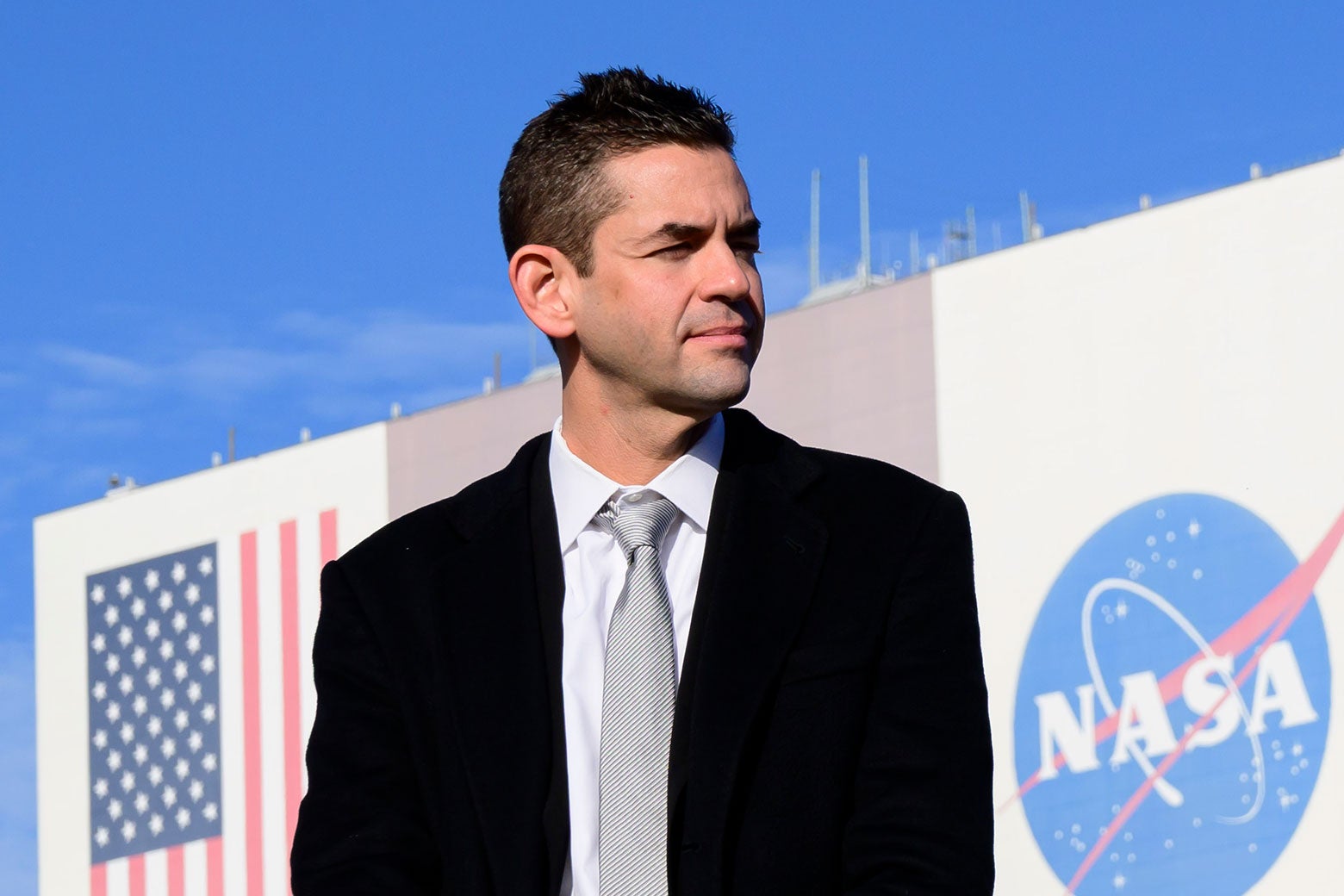
Isaacman is a billionaire entrepreneur who is close to Elon Musk. He’s been to space twice on privately funded SpaceX missions. And he has quickly taken major steps to make Artemis more plausible. At the news briefing, Isaacman said that the Artemis architecture that was on the books when he took over at NASA “just doesn’t make sense.”
NASA could certainly use someone who can—first—look at the situation and coldly assess that there is a problem here. You can’t solve a problem that you won’t admit to.
Changing the plan for Artemis 3 wasn’t quite a “Houston, we have a problem” moment, but it was a major course correction for Artemis, and possibly for the agency as a whole. And there’s a leadership lesson here. No is a powerful word for a leader to utter, especially in an agency that has to make go/no-go decisions with billions of dollars and human lives at stake.
Maybe Isaacman will say no to some other bad ideas, such as Gateway, a completely unnecessary, moon-orbiting space station that NASA has been working on and which Sen. Ted Cruz, who chairs the committee that oversees NASA, has insisted the agency build. Isaacman’s Artemis announcement didn’t quite crack the front page during wartime, but it’s a big deal in the space community. NASA doesn’t pivot often or easily. The major human spaceflight programs are supertankers, with tremendous inertia. Change in the big NASA programs requires heroic efforts by NASA leaders, because they face immense pressures from aerospace companies who’d rather stay the course and from senators who carry the water of those companies.
To be clear, Isaacman has a way to go if he wants to persuade everyone that the Artemis program will be able to achieve its long-term goals. Maybe even quite a way: He “is definitely showing spine—more than many of his predecessors—but he still did not say the hard truth that politicians need to hear. He only hinted that SLS is an albatross around the neck of NASA and the Artemis program, and it needs to be terminated,” Todd Harrison, a space policy expert at the American Enterprise Institute, told me in an email.
What Isaacman knows is that NASA, over the decades, has had some very bad days when people in charge should have said, “No, time out, this doesn’t look right.” Challenger. Columbia. Space is not forgiving. You don’t want to explore with a burn-the-boats attitude. People who read a lot of science fiction should also read NASA accident reports. Right now there are space buffs who think NASA should hurry up and send people to Mars. That should be a hard no. (Even Elon Musk has partially pivoted from Mars, saying that’s 20 years away, and first he’s going to build a self-growing city on the moon. Sorry, a city on the moon? No, no, no.)
Isaacman said the agency hopes to do Artemis 3 in 2027 and then land astronauts on the moon twice in 2028 with the Artemis 4 and Artemis 5 flights. That timeline is highly ambitious, if not delusional, and I assume he said that to ensure he wouldn’t get yelled at by the White House, which would certainly prefer a moon landing while Trump is still in office. Lori Garver, a former NASA deputy administrator, tweaked Isaacman on social media, saying adding a flight in ’27 and two in ’28 represents “more magical thinking.” But in an email, Garver told me she’s looked more closely at Isaacman’s restructure of Artemis and thinks he’s “off to an excellent start.”
The most important thing Isaacman has done is tell people what’s been glaringly obvious, that Artemis is in trouble.
“Isaacman has been quite good about saying uncomfortable truths about NASA and Artemis out loud,” space reporter Eric Berger of Ars Technica wrote on X. “In this case the uncomfortable truth was that the Artemis emperor had no clothes, and if meaningful changes were not made China will win this race going away.”
At the briefing, Isaacman announced that NASA will simplify the design of the SLS moon rocket, which was supposed to be upgraded to make it more powerful. No, he said, every rocket doesn’t have to be “a work of art.” Let’s speed up the cadence of launches. He also said, “We gotta rebuild our core competencies”—a pretty strong statement about NASA’s current state. NASA has offloaded much of its competency to SpaceX and other contractors.
Isaacman has promised to boost the number of civil servants at the agency. That’s a startling promise, because President Donald Trump, aided by Elon Musk during his Department of Government Efficiency phase and by Russell Vought’s Office of Management and Budget, has waged open warfare on the federal workforce. Thousands of workers, particularly those involved with NASA’s science portfolio, have fled NASA in the past 14 months through early retirements, layoffs, or the desire to go where their talents are truly valued.
“Jared needs to push to rebuild that damage for NASA Science to survive,” John Grunsfeld, an astronaut and former head of NASA Science, said in an email.
As we enter budget season again, Trump’s OMB may seek more draconian cuts to NASA Science in order to shift resources to Artemis. If that happens—and if Isaacman wants to be a great NASA leader—there’s one simple word he should say in response.