Sign up for the Slatest to get the most insightful analysis, criticism, and advice out there, delivered to your inbox daily.
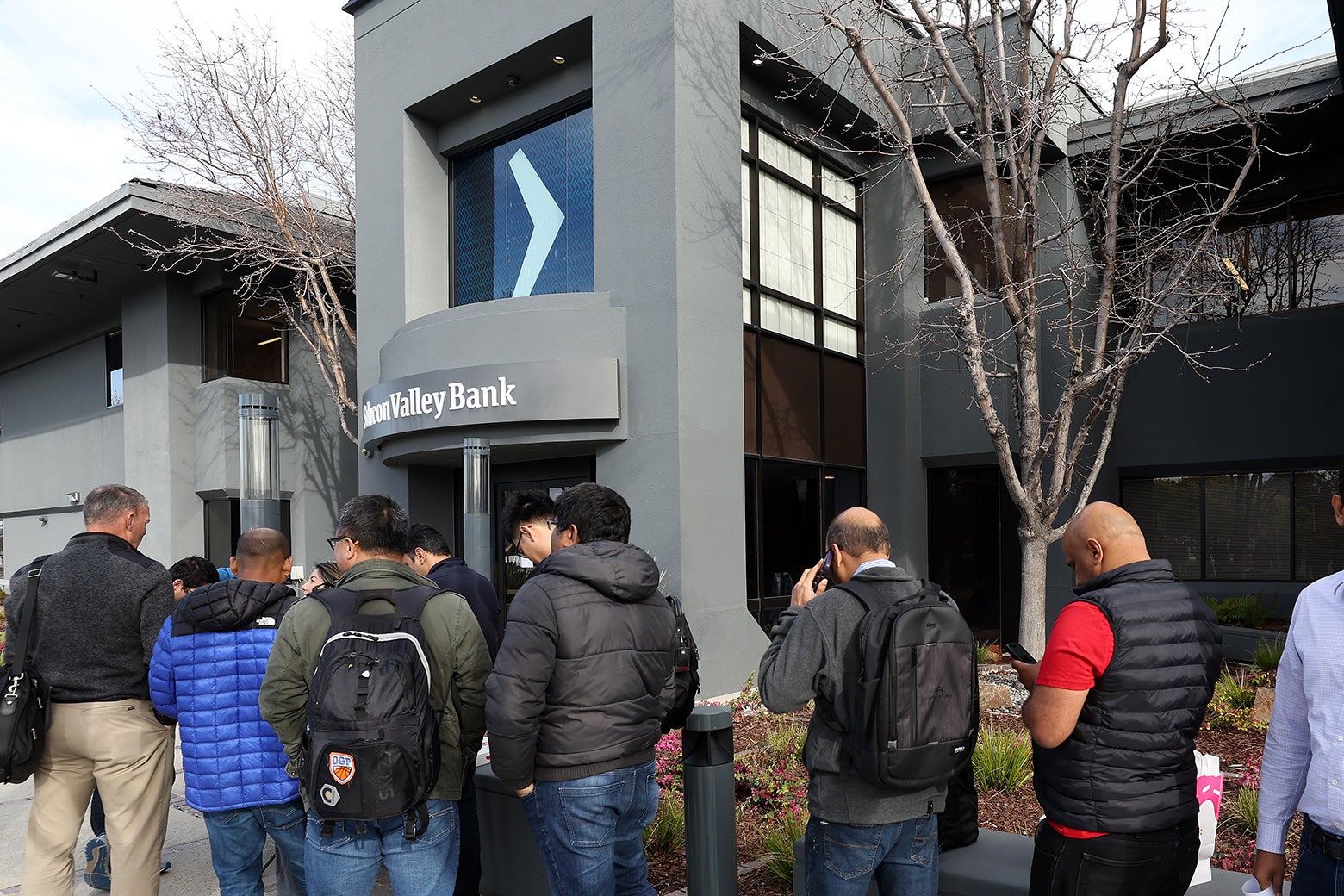
Three years ago this week, Silicon Valley Bank crashed and burned. The bank had bought a lot of bonds, which got less valuable as the Federal Reserve raised interest rates after keeping them low during the thick of COVID-19. The bank’s depositors were predominantly tech companies, who were worried that their money wouldn’t be there if they needed to withdraw. So a lot of them rushed to do just that, and there wasn’t enough money, and that was the end of Silicon Valley Bank as we once knew it.
Meanwhile, as SVB melted down, prominent tech investors like David Sacks and Bill Ackman threw public tantrums urging the Biden administration to backstop the bank if it didn’t want to see devastating consequences wreaked on the financial system. “Where is [Jerome] Powell? Where is [Janet] Yellen? Stop this crisis NOW,” Sacks tweeted on March 10, 2023. Wall Street worried about the trouble spreading too. Banks depend on most of us having the confidence that our money will be there when we all ask for it, lest we all ask for it simultaneously, while some of our money is tied up in investments. Two other banks did go down around the same time as SVB, so the theory wasn’t rooted in nothing.
The nation’s top financial cops were, indeed, on the case. Within days, the government said that it would make all of the bank’s depositors whole, even those who had far more than the standard FDIC-insured amount of $250,000 at the bank. Crisis averted. The U.S. banking system still stands to this day.
The episode should have been a humbling moment for Silicon Valley’s loudest political voices. Instead, it became a preview of the Democratic Party’s rocky relationship with the tech elite. After Democrats swooped in to stabilize and protect the billions that fuel Silicon Valley’s startups and companies, the industry’s most powerful figures repaid the favor by lurching toward the right and Donald Trump.
Everyone involved decided not to call SVB what it obviously was—a bailout—for their own reasons. Joe Biden’s team didn’t want to create echoes of the 2008 financial crisis. The loudest tech guys, who needed to cling to a myth about themselves as brave, independent business titans, did not want the ego hit of their friends or portfolio companies taking “a bailout.” The tech guys dressed up the non-bailout bailout as a populist cause. Reasonable people could disagree about the risk of financial contagion. But the clearest beneficiaries were tech companies and their investors, who got billions of dollars in timely insurance.
The cognitive dissonance wound up being a nice service to people like Sacks, who led a right-wing turn by major tech figures in the run-up to the 2024 election. It might have been awkward for Sacks or hedge-funder Ackman, two of Trump’s highest-profile tech supporters, to have had to acknowledge that they were on the government dole from Biden just a year and a half before Trump faced Kamala Harris. Instead, the soft framing of the SVB bailout as a mere technocratic step for the benefit of all of us surely made it easier for Sacks to use his influential podcast to help Trump get elected. He’s now the “AI and crypto czar” for the White House, one of a handful of major tech funders to have lent his name to the president’s project.
The SVB episode is the clearest illustration of what becomes of Democratic generosity toward the tech industry. Biden rescued these people’s money, spared them the indignity of even calling it what it was, and got a bankrolled opposition in return. Some Democrats have spent a bit of time over the past year wondering if they were a little mean to the tech industry or specific figures within it, and if they’re now paying an unnecessary price for it. (The clearest distillation: Would Sacks associate Elon Musk have become the right’s No. 1 funder if Biden had invited him to an electric-vehicle summit in 2021?) It’s time to stop asking that question. Democrats don’t need to go to war with tech as much as they need to stop pretending that they can ever win a race to the bottom, where the competition is over who can give the industry more.
Sacks is a good avatar for it, but he’s not alone among very rich, very loud tech people accepting Democratic largesse with one hand and throwing punches with the other. Venture capitalist Marc Andreessen was a longtime Democratic voter and backer but bailed on the party after Biden put forward a strategy to tax on their unrealized gains. (The plan never went anywhere.) About half of Andreessen’s startups banked at SVB, the New York Times reported, but that was no matter.
Which is why it’s a folly to argue, as Andreessen has, that Democrats drove tech into Trumpism’s arms. Saving the cash deposits of some of the tech industry’s most promising startups, despite a lack of clear risk to ordinary people, didn’t get the job done. Nor did one of Biden’s biggest legislative moves. Biden signed the CHIPS Act, a massive semiconductor and R&D bill, in 2022. The bill sent billions of dollars in public funds to support the development of the American A.I. industry, and Trump has fiercely criticized it, ostensibly because he thinks tariffs are the first and only way to move an industry stateside. (It hasn’t been fully clear what he’s been mad about, perhaps because Trump has never read the law or even a briefing document on it.) Democrats provided most of the votes for the bill, and a Democratic president signed it. Andreessen tweets all the time, but the last time he mentioned CHIPS was a few days before the 2024 election, when he took issue with the speed of the law’s financial awards going out.
You wouldn’t think politics would work this way. Conventionally, doing a series of big favors for a constituency results in some measure of support from that group. But if the question is which party will do more favors for rich tech guys, that’s a game the Democrats probably cannot win. Plus, the types of tech moguls at issue here spend a huge chunk of their time on X, where Musk’s algorithm and their own social networks push them to pick a side in politics as a team sport. They’ve picked theirs.
Trump controlling the levers of federal power also helps maintain fantasies about all sorts of things, whether that means rewriting the history of Jan. 6 or hiding the ball about why Silicon Valley Bank collapsed: deregulation. In fact, a few years before the collapse, the bank had lobbied Congress for an exemption from banking regulations around risk. It got what it wanted when Donald Trump signed a deregulation bill in 2018, sparing midsize banks like SVB from certain stress-testing and derisking requirements. Whoops! That was a real egg-on-face moment, or at least you’d have thought so. It’s easier for someone like Sacks to not think about SVB as a story of deregulation gone bad and necessitating a Democratic rescue when the government is saying that what happened did not happen.
Three years after Silicon Valley Bank went down, it has become obvious that the cycle was not a one-off. First comes some sort of Democratic intervention that straightforwardly helps the richest American tech investors (and, ideally, the rest of society), then comes not just ingratitude but obfuscation about what happened in the first place. Some Democrats seem weirdly eager to run it back; Rep. Ro Khanna talked last summer about getting Musk back into his former Democratic fold, after the world’s richest person had a (possibly brief) falling-out with Trump over tariff and spending policy. It would be nice to have that money working for you rather than against you, sure. But the great lesson of SVB, repeated a few times since, is that Democrats can’t possibly give enough to a certain sort of tech baron. They can only give more and more of all of our money, then wonder why that kind of generosity hasn’t gotten them anywhere.