Sign up for the Slatest to get the most insightful analysis, criticism, and advice out there, delivered to your inbox daily.
One puzzle of the first Trump administration was why our first developer-president since the land-speculation adventures of the Founding Fathers took so little interest in building stuff. Aside from a much-mocked attempt to get the columns and cornices back on federal buildings, Donald Trump scarcely succeeded in building anything north of the border wall. He left his mark on our psyche and our politics, but not on our cities.
That was then. Second-term Trump has already secured the funding for a national network of prison camps for immigrants. He has forced corporations like ABC, CBS, and Meta to pony up tens of millions for a “presidential library” in an apparent quid pro quo exchange for regulatory approval, and even justified the gift of a 747 airplane from Qatar by saying it would eventually be entrusted to the institution. There he is in a hard hat in the bowels of the Federal Reserve building, questioning Jerome Powell over the cost of the renovation.
And he has set about making the White House his own. He gave the Oval Office a glittering makeover that the architecture critic Kate Wagner memorably labeled a “cathedral of gilded junk” in the style of “Regional Car Dealership Rococo.” The density of the ornament is matched only by its cheapness, with chalices lined up on the mantelpiece like the decorator raided the trophy case of a middle-school gymnasium. He has torn up the lawn in the Rose Garden for a blinding-white stone terrace, complete with a ring of storm drains shaped like American flags (rain will run through the slats in the stripes), and installed two towering flagpoles.
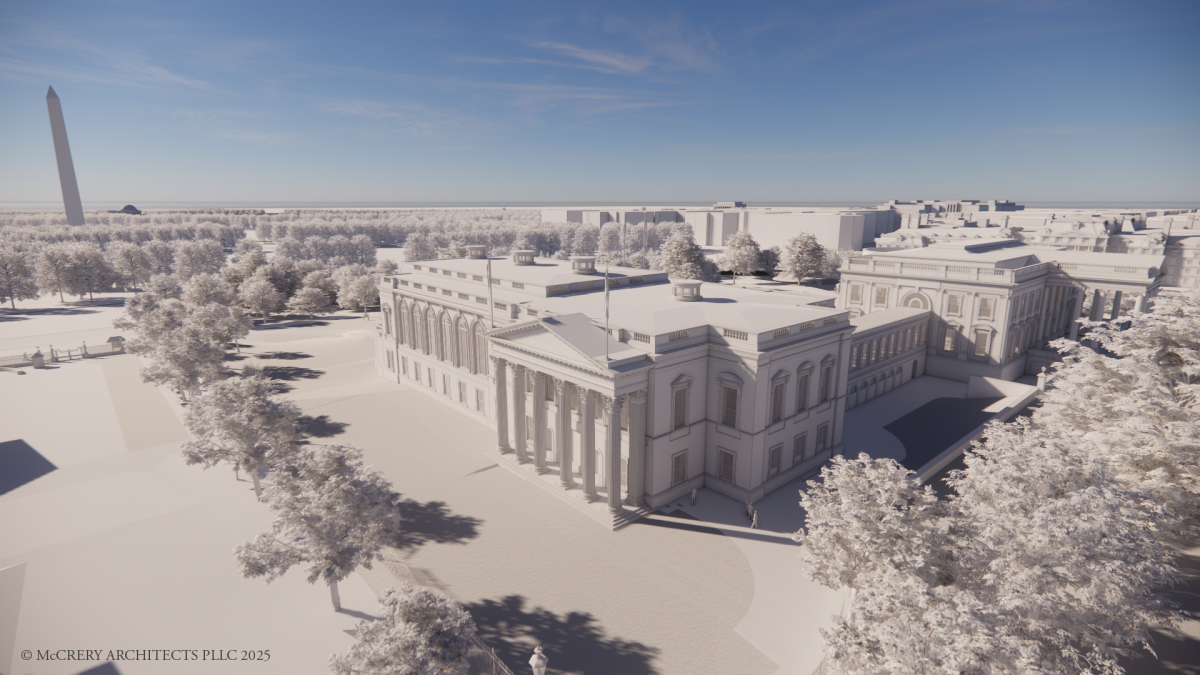
Last week, Trump unveiled a plan to add an enormous ballroom to the White House, the largest change in appearance to the residence since the greenhouses were torn down at the dawn of the 20th century. This new East Wing, more than twice the size of the White House itself, will cost hundreds of millions of dollars and break ground in September, Trump says.
Trump claims his White House designs spring from his character as a builder; on Tuesday, he was poking around on the West Wing roof. Planning the ballroom, he told a friendly interviewer this spring, “keeps my real-estate juices flowing.” Susie Wiles, the president’s chief of staff, offered a similar rationale in a statement last week: “President Trump is a builder at heart and has an extraordinary eye for detail.” And he has long talked of the need for a larger social space at 1600 Pennsylvania Ave.: Tempt yourself with the alternate history in which Barack Obama accepts Trump’s 2010 proposal to add a ballroom to the White House.
Longtime Trump-watchers (aren’t we all?) will recognize that the details in the Oval recall the interiors of his old Manhattan residence and the fixtures inside Trump Tower. But more than the compulsion to build, the common thread here is the president’s desire to re-create the ambiance of Mar-a-Lago, the “winter White House” where he spent much of his first term and most of his political exile. (Upon purchasing it, he added a ballroom.)
The paved terrace, for example, is an imitation of a similar space in Palm Beach where the president routinely entertains. Trump told reporters on Sunday: “It’s a beautiful white stone, and it’s a stone that’s the same color as the White House itself. And because it’s very white it’s going to reflect the heat and it’s not going to be very hot.” The grass was muddy when wet, the president has said, which made it inconvenient to use and particularly hazardous for women in high heels.
Turning the White House into a better hosting venue is also the rationale behind the much larger ballroom project, which was announced last week in a press release that invoked seven score and 10 years of American history: “For 150 years, Presidents, Administrations, and White House Staff have longed for a large event space on the White House complex.” Critics have been shocked by the way Trump and high-ranking guests mingle with dues-paying randos at Mar-a-Lago, but as Louis XIV showed with Versailles, a good palace can keep financial supporters close at hand—as guests and as givers. Like the “presidential library,” the White House says the ballroom’s $200 million cost is being picked up by “patriot donors” and the president himself.
This spring, when Trump hosted a “memecoin dinner” for people who stuffed the most money into his digital pockets, the 220 attendees gathered at the president’s Virginia golf club. The event was too large (and perhaps too shameless) to be held in the White House East Room. But such events will be easily accommodated in the new ballroom, which will have a capacity for 650, replacing a temporary white tent that has served crowds of that size in recent years.
To build the ballroom, the White House has engaged James McClery, a specialist in the design of neo-traditional churches who was appointed to the U.S. Commission of Fine Arts in Trump’s first term. McClery, who did not respond to a request for comment, studied under and later worked for the radical architect Peter Eisenman, whose “deconstructivist” designs looked as if someone had cut a normal building into pieces and put them back together incorrectly.
The experience apparently alienated McClery, who found the righteous path under the tutelage of the classicist Allan Greenberg, the only designer born in the 20th century that McClery counts among his influences. Before his web page was scrubbed, McClery’s recent portfolio was made up almost exclusively of Catholic churches, but he is no stranger to civic visions: In 2001, he worked with the conservative Manhattan Institute to draw up a plan for a 9/11 memorial featuring an array of spire-topped skyscrapers around a group of colossal statues.
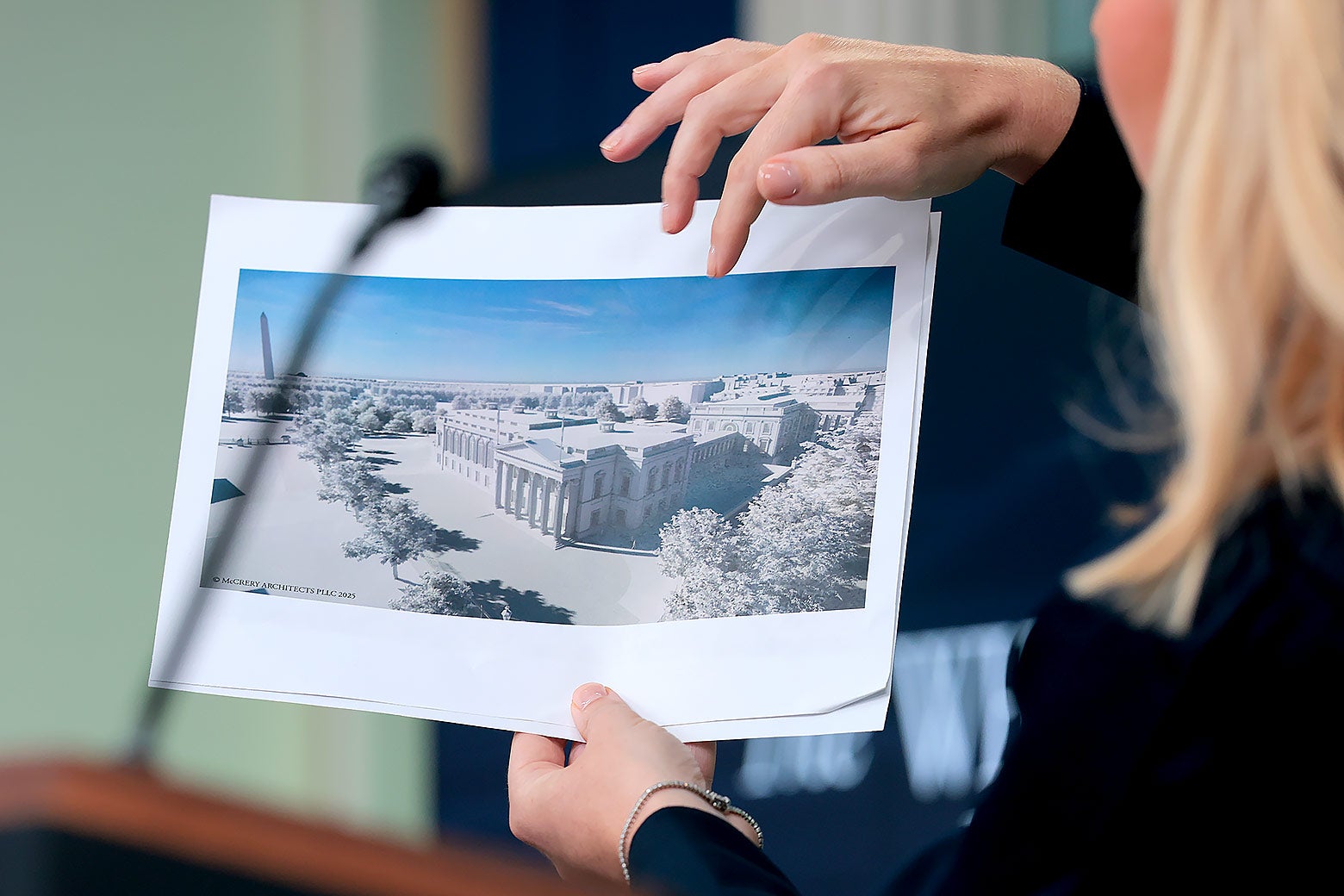
In renderings, McClery’s White House ballroom appears to lie heavy on the East Wing of the White House, an enormous box that draws the eye away from the main building to its phalanx of towering arched windows. In the most superficial way, the addition is a contextual match for the main house—it is white, and it is a similar height, with a cornice and a matching parapet. In other ways it is totally lacking in context: Such large windows might have made sense in the palaces of chilly northern Europe, but facing south and west in sweltering Washington, they will make this room a greenhouse. The building’s fluted Corinthian columns are right at home in neoclassical Washington, but they aren’t a match with the rest of the White House, with its simpler, smooth columns and Ionic capitals. If the addition really comes in at 90,000 square feet, as the press release says, it will be nearly twice the size of the 55,000-square-foot White House itself.
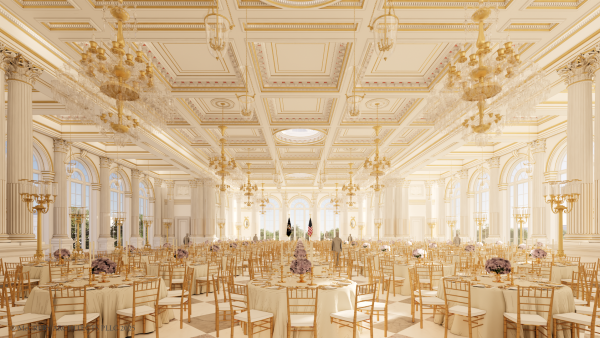
Inside, the ballroom is all white and gold like a czar’s summer palace, with coffered ceilings, gold-trimmed moldings, and crystal chandeliers. This borrowed idiom will be deployed at maximum volume, with no connection to an underlying structure of steel and concrete—the Palais de Versailles by way of Café Versailles.
The White House Historical Association, the private preservation nonprofit founded by Jackie Kennedy, has not objected to these changes. In a statement, the group’s president, Stewart McLaurin, said, “The South Portico, the North Portico, the East Wing, the West Wing, and the Truman Balcony all raised concerns at the time—but today, we can’t imagine the White House without these iconic elements.” On LinkedIn, McLaurin recently documented the controversies surrounding past White House alterations. The message? Change is the only constant. (And perhaps: Please keep us around, Mr. Trump.)
The WHHA’s former chief historian, Ed Lengel, was less circumspect in conversation with NPR: “There’s never been anything like this before—absolutely not. This dwarfs everything that has ever been done on that property before. So it’s a change that’ll practically be irreversible.” In Lengel’s view, the addition’s palatial size and ornament is a poor fit for the executive mansion’s relative modesty.
James Archer Abbott, a longtime curator and the author of Designing Camelot: The Kennedy White House Restoration and its Legacy, said it was important to distinguish the president’s objectives from his style. “I think the President and Mrs. Trump are in some ways being targeted for championing some necessary changes to the presidential stage,” he told me. “The White House is constantly evolving, and the idea of a new state dining room is necessary and has been since the 1960s.” The Rose Garden lawn, he added, has always been poorly suited to its purpose, with more “robust” guests losing their chair legs in the mud.
In design terms, however, Abbott said he would have preferred a brick surface, and felt the Corinthian columns on the ballroom were not appropriate.
Trump apologists will find no shortage of precedents here. Harry Truman gutted the building’s interiors completely, relocating his family to a nearby townhouse and reconstructing everything between the exterior stone walls. FDR got the White House swimming pool built with donations from a New York Daily News–led fundraising campaign. Accusations of bad taste also dogged Teddy Roosevelt, who mounted the heads of a moose, bison, and bear in the state dining room. Grover Cleveland tried to stretch the house across a pair of two-story, T-shaped wings—including a large ballroom. Caroline Scott Harrison wanted to create an enclosed central courtyard. And yet: If the White House’s furniture, paintings, and wallpaper inspire the fervent scrutiny of the nation’s interior decorators, it is because meatier changes have been so rare.
With the plans to forever modify the nation’s most famous building announced as a fait accompli, Trump is living out a builder’s fantasy. The White House is exempt from the cumbersome procedures that govern other federal buildings, to say nothing of such banal concerns as “municipal zoning” and “design review.” Teasing the ballroom plans in February, Trump almost seemed taken aback by his own authority:
“Who gets to approve it?” “You do sir.” I said “I do?” Normally I have to go to zoning. You know, I go through the zoning, and I’ve always I’ve always been a king of zoning.
But it’s not the building’s gaudy style or its sudden imposition that make it a monument to Trump. It’s the purpose: a higher order of luxury socializing with the most powerful man in the world. The ballroom may have been in demand since the 1890s, but it will be impossible to separate from the current president’s predilection for dinner-table dealmaking. Who needs a presidential library to explain life under a president who doles out pardons, research funding, and regulatory changes in exchange for donations when we have this donor-fueled, gilded schmooze room looming over the White House?