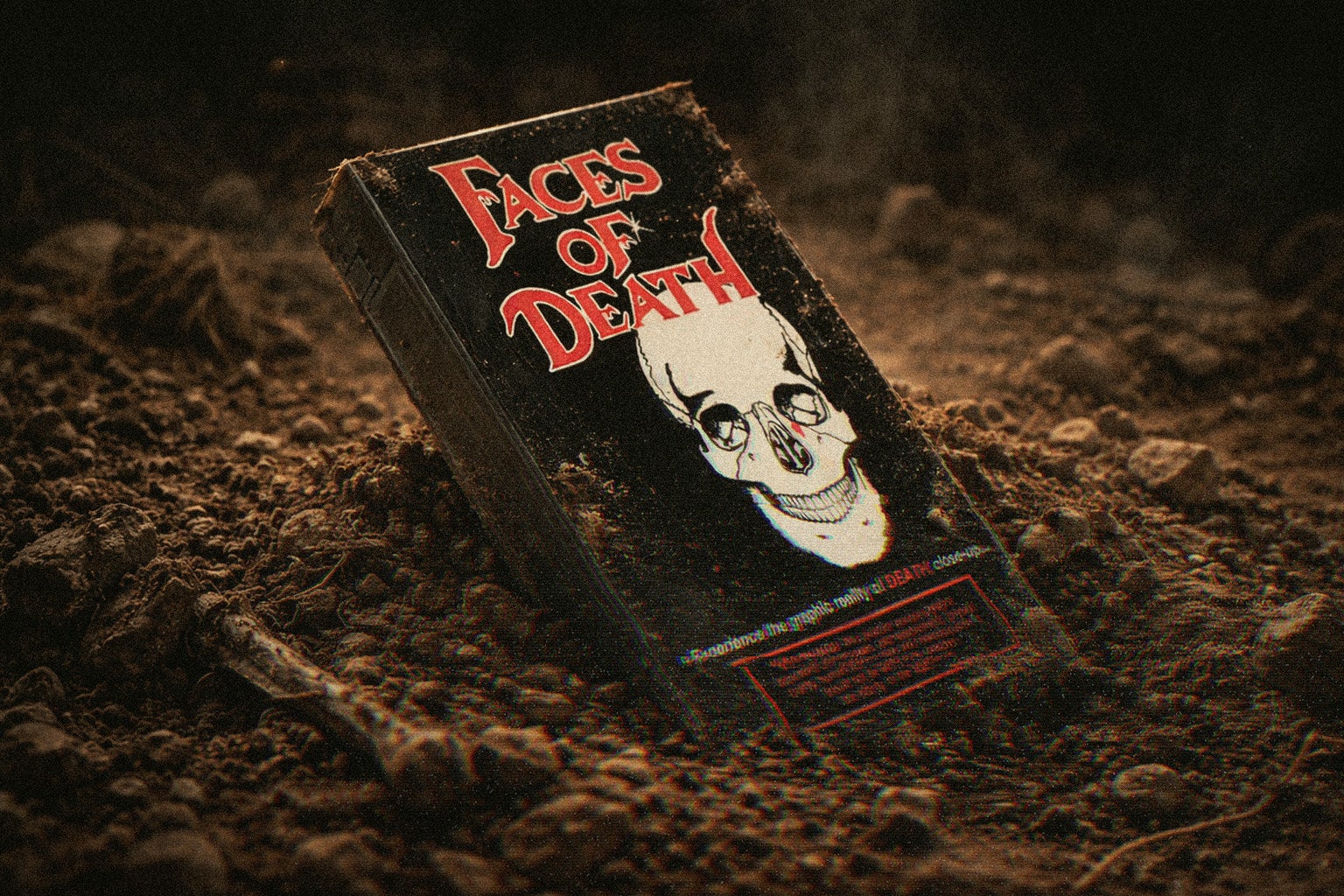
Some objects take up a place in memory so tangible it’s as if you could reach right into your mind and retrieve them from the past. For me, one of them is a black plastic case about the size and shape of a hardcover book, its edges rough and worn with frequent handling. On the front, large enough to be seen across the aisle of a video store, is a grinning skull, and above that, in large red letters, are the words Faces of Death. But what looms largest in my mind is the handwritten note Scotch-taped to the outside of the flimsy slipcover: “ADULTS ONLY—MUST BE 18 TO RENT.”
If you grew up in a town with a video store—and I mean a real video store, not a Blockbuster or a West Coast Video but the kind whose shelves overflowed with unfamiliar names and faces—you probably remember the room in the back, the windowless vault with a beaded curtain to shield X-rated box covers from curious eyes. (You might also, in the years since, have realized that it was those movies, which the big chains wouldn’t carry, that allowed local stores to stay afloat.) But Faces of Death wasn’t hidden away. It sat right there on the shelf, a few inches from Halloween and A Nightmare on Elm Street. If you got close enough, you could even read the fine print on the cover: “WARNING! This feature contains graphic depictions of autopsies, dismemberment, physical cruelty, human combustion and electrocution. It should be not be viewed by children, the elderly, or the squeamish.”
I can’t speak for the elderly or the squeamish. But that box, and the movie inside it, held an irresistible fascination to me as a child. Kids who’d seen it—or, even better, whose older siblings had—spoke in whispers about its contents, less because they were afraid of being overheard by an adult than because it felt as if even putting its terrible images into words might open the door to some unimaginable evil. There were plane crashes and beheadings, men and women getting run over by trucks and eaten by alligators, all portrayed in the goriest of detail. And to top it all off, it was all real. This wasn’t Hollywood trickery. These were people’s actual deaths, captured on film and available for rental—if you dared.
Ivylise Simones grew up in South Florida in the 1990s, in a house where neighborhood kids would gather around the TV for pay-per-view wrestling matches or the late-night Cinemax fare their parents wouldn’t allow them to watch. (They weren’t rich, but her dad knew a guy at the cable company.) Her parents figured she and her brother were “good kids,” so they didn’t keep too close an eye on what they were watching. But even so, her brother’s friend Eduardo would sometimes sneak into the bedroom window with contraband tapes, and one day, he smuggled in Faces of Death. “I remember watching it in his room with his friends,” she says. “I think I was the only girl there.” She was 12, or possibly 11.
“I don’t think we knew the term snuff film,” Simones says. “But we knew we were going to watch something with real death in it.”
What they saw was a documentary, or at least a movie that presented itself as one. It opens, without warning or preamble, with footage of doctors performing open-heart surgery, their mumbling voices drowned out by a rumbling synthesizer drone and the thump of a thudding heartbeat. After a few loving close-ups of the gaping chest cavity, that heartbeat slows and slows, the drone resolving into a high-pitched whine. And then, as the opening credits start, come the corpses, body after body dissected by a pathologist’s scalpel or a whirling saw, gloved hands rooting through intestinal coils and neatly snipping away at organs. With each new name—“Writer: Alan Black,” “Director: Conan LeCilaire”—there’s a discordant piano crash, and the screen freezes on some new piece of human meat, the better to sear the image into your brain.
As it happens, much of what appears in Faces of Death is not real, beginning with those names. Both Alan Black and Conan LeCilaire—the latter meant to sound like the word killer in a French accent—were pseudonyms for John Alan Schwartz, a young TV editor in Southern California who’d been approached by a Japanese company to make an American version of a so-called shockumentary, like 1962’s notorious Mondo Cane, focused exclusively on death. Like other movies in this new “mondo” subgenre, named for that influential Italian film, Faces of Death presented itself as educational fare, an anthropological study of different cultures’ approach to mortality, hosted by the stern-voiced Dr. Francis Gröss. But it took that framing no more seriously than it did its narrator’s last name, another pseudonym for the actor (an unknown named Michael Carr) who played the part.
Schwartz, who died in 2019, scoured local TV stations for unaired library footage, shot by ambulance chasers with movie cameras who would rush to the scene of a disaster and sell glimpses of the grisly remnants to the evening news. Because “If it bleeds, it leads” only goes so far, most of the clips would wind up going unused, so when Schwartz offered to buy the material that wasn’t suitable for broadcast, he found them quite willing to part with it. At one station, a woman went in back and emerged with a tape bearing a label that must have been as tantalizing to John Alan Schwartz as Faces of Death would be to generations of soon-to-be-scarred teens: “Body Parts.”
Fate kept providing more: In September 1978, as Schwartz was nearing completion on the film, a Boeing 727 collided with a private plane near San Diego International, showering wreckage over a residential neighborhood in what was then the deadliest air crash in American history. It went right into the film. Schwartz had plenty of body parts, even if some of them were so mutilated it was difficult to tell which parts they were. (In one unforgettable shot, a police officer uses what looks like a piece of cardboard to scrape the remains of an unfortunate cyclist off the road.) But, his investors told him, he didn’t have a movie.
So he started making things up, shooting new snippets to embellish what he already had. A single shot of a woman falling to her death from the top of a building became a tense sequence of firefighters rushing to her rescue, capped by a close-up of her lifeless body—or, rather, the body of an actress in clothes carefully chosen to match the dead woman’s—lying in the street. Some sections were entirely staged, especially those purporting to show real people in the act of dying, and not just the aftermath. There’s the one, inspired by a detailed description in Hustler, where we watch a condemned killer put to death in the electric chair, body sizzling until his eyes pop and rivulets of blood stream from his eyes. There’s a tourist being eaten by a grizzly bear, accomplished with a trained animal and some frenetic editing, and an alligator making quick work of a screaming animal-control officer, which involved a genuine alligator and a dummy stuffed with a dead pig.
And then there’s the monkey. In what might be Faces of Death’s most infamous scene, a group of four unsuspecting tourists sit down for a “most unusual dining adventure” at a restaurant somewhere in the Middle East. A mustached waiter claps his hands, and another brings a screeching capuchin out of the back, placing its body in a hole and fastening a wooden collar around its neck so its head sits level with the table. Then, as their wives gasp in disgust, the two male patrons take the mallets they’ve been offered and whack at the primate’s skull until it cracks open and they can feast on the brains inside.
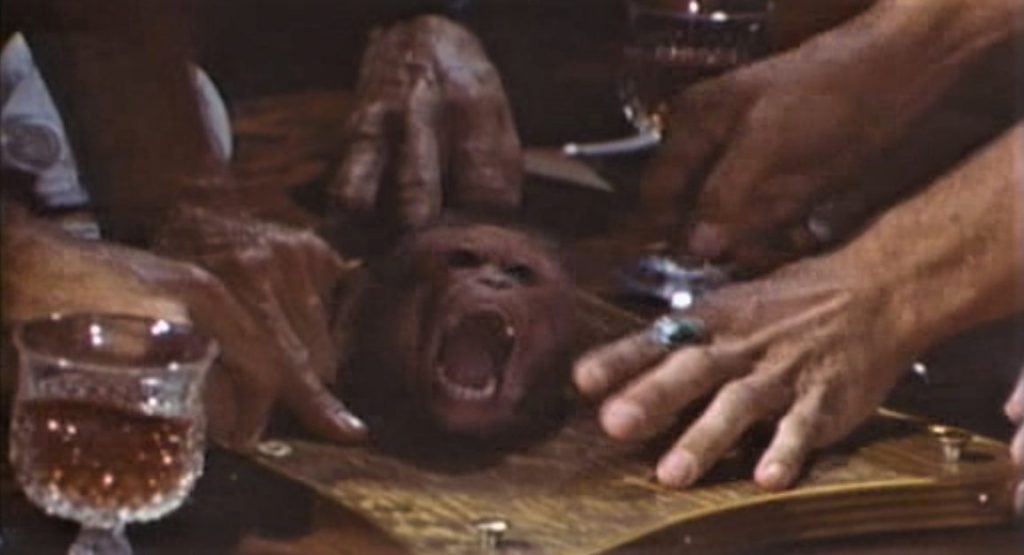
Looked at now, this segment appears almost ridiculous, from the generic costumes on the “Middle Eastern” waiters to the brains themselves, which look like exactly what they are: cauliflower doused in stage blood, with a little gelatin for extra goo. But if you saw it at the right age, especially through the muck of a VHS transfer, it looked and felt horrifyingly like the real deal. (It certainly made enough of an impression for Steven Spielberg to rip it off a few years later.) “It had that murky, shitty ’70s look,” says Joseph A. Gervasi, a longtime horror film programmer and former video-store clerk who now chronicles the history of the Philadelphia hardcore scene at Loud Fast Philly. “That just made it seem grottier, and it was effective, obscuring the sharper edges that would reveal the phoniness of a lot of it.” With more experienced eyes and the benefit of a few decades’ hindsight, the upset can seem almost laughable—imagine getting distraught over a little ersatz evisceration in a world where the Terrifier series exists. But in the years before high definition and crystal-clear freeze-frames, it all seemed horribly real, or at least as if it might be. “When you watch it now, you can pick out the stuff that’s really fake,” Gervasi says. “But a young person thinks that the scene where they eat the monkey brains is real. They think that the execution is real. And those are really disturbing scenes that you can’t unsee.”
Faces of Death wasn’t a box-office hit. But it became a phenomenon in the home-video era, which lent itself to private viewing of things respectable civilians wouldn’t be caught dead watching in public. Schwartz maintained that it had grossed more than $35 million; by the time he wrote his self-published autobiography, My Faces of Death, in 2014, he’d upped the number to $60 million. It’s not clear where that figure is meant to have come from, and the book is full of assertions that, like the film, are both alarming and dubious. (Among other claims, Schwartz states that his father would punish him and his brother by shutting them in a coffin he kept in the attic, and that he had a long-term sexual relationship with his high school ethics teacher.)
But, like the “Banned! In 46 Countries!” printed on some copies of the VHS, the legend was too good to fact-check, and the claims of censorship fed the narrative that Faces of Death was not just bad but dangerous. In 1986, a 14-year-old in Massachusetts beat a classmate to death with a baseball bat, alleging that the movie had made him curious about what it would be like to kill someone. (At the boy’s trial, his lawyer blamed a combination of preexisting mental illness and Ritalin.) The families of two California teens sued their school district after a teacher forced his class to watch Faces of Death, insisting that one girl was so traumatized by the experience that she spent the summer afraid to go outside. (They received a combined $100,000 settlement.) And in 1987, Siskel and Ebert raged against the scourge of “video nasties,” with Siskel reserving special ire for “the most popular nasty of them all … a piece of trash called Faces of Death.” Ebert lamented the existence of movies that “dwell on human despair in an almost sadistic and almost gleeful way,” but revealed that in addition to the first movie, he’d also watched Faces of Death II and Faces of Death III, just to make sure.
The movie was, in fact, banned in only a handful of countries, the United Kingdom and Australia among them. But over the decades, it took up residence in the popular imagination as the embodiment of the most vile and depraved stuff it was possible to watch—after all, what redeeming value could there be in a movie called Faces of Death?
And yet, read the reviews today on the film’s Letterboxd page, and you’ll come across a sentiment that would have been unthinkable when it was a cursed object beckoning from the video-store shelf: “More like Faces of BOREDOM, amirite?” With real-life atrocities all over the internet, the notion of having to jump through hoops or risk running the gantlet to access counterfeit versions of them feels almost quaint, its once taboo horrors now no further away than a Google search. When Daniel Goldhaber and Isa Mazzei, the filmmakers behind How to Blow Up a Pipeline, were approached about doing a contemporary version of Faces of Death, they sat down to watch the original and realized they’d already seen much of it, chopped into pieces on Rotten.com.
Goldhaber and Mazzei’s Faces of Death, which opens on Friday, isn’t a remake or a sequel, exactly. It’s a contemporary slasher whose killer, played by Stranger Things’ Dacre Montgomery, is obsessed with the original movie and starts acting out its killings in real life. The movie’s heroine, played by Barbie Ferreira, is a content moderator at a TikTok-like website called Kino, who starts to believe that the killer’s videos might be real. But no one believes her, because the images that were once considered scandalous enough to damage children for life are now commonplace, even a little corny. “It felt like a very fruitful place to start, with recognizing that what we saw in weird corners of the internet is now something that you accidentally see while scrolling Instagram every single day,” Goldhaber says.
Talking to Goldhaber and Mazzei is like strolling down a particularly seedy stretch of memory lane, one where now-defunct sites like Rotten.com and LiveLeak served as a centralized clearinghouse for as much real-life carnage as any edgelord teen could stomach. “My first experience with seeing death on a screen was 9/11,” Mazzei recalls, “and from there it just felt like death on-screen became more and more common. So there isn’t this sense of wanting to seek it out. Now it’s just forced upon us.”
That might seem like an exaggeration—at the moment, the only thing my algorithm is forcing on me are reels of American woodcocks in Bryant Park. But think back to the moment last September when timelines filled with graphic footage of Charlie Kirk’s assassination, crimson spurting from his neck in an endless autoplay loop, or photographs of mangled children in Gaza, posted without warning or context. When, years ago, Goldhaber himself worked as a content moderator at a startup platform, he says, “there wasn’t even necessarily a content policy. It was just trying to take down the snuff film and the child porn.”
The boom in generative A.I. has added a new wrinkle. Not only is there more real-life death online than ever; there’s more that looks authentic. When she sees the killer’s first video in Faces of Death, Ferreira’s moderator clicks “Approve” and posts it to the site, adding a note that reads, “Likely fake.” In Mazzei and Goldhaber’s first movie, Cam, an online sex worker (Madeline Brewer) has her identity stolen by a digital doppelganger who acts out a string of increasingly disturbing fantasies—a story inspired by Mazzei’s own history as a camgirl. When Brewer’s character asks the cops to intervene, one says curtly, “You don’t wanna see stuff like this? Stay off the internet.”
The original Faces of Death blurred the line between fiction and reality. In the new version, that line simply disintegrates—nothing is too real to be fake, or too unbelievable to be true. Even now, it’s hard to tell the difference. When they were on the promotional trail for One Battle After Another, Paul Thomas Anderson and Leonardo DiCaprio started reminiscing about being children of the video-store age, and the conversation quickly turned to Faces of Death. “That was the underground, passed-around VHS tape that everyone got in America,” DiCaprio recalled. “Like, ‘Do not tell your parents that you have this.’ ” “It was put out there as ‘This is where you can see people die,’ ” Anderson reminisced, “but I think it’s pretend.” “No,” DiCaprio responded. “It was real.”