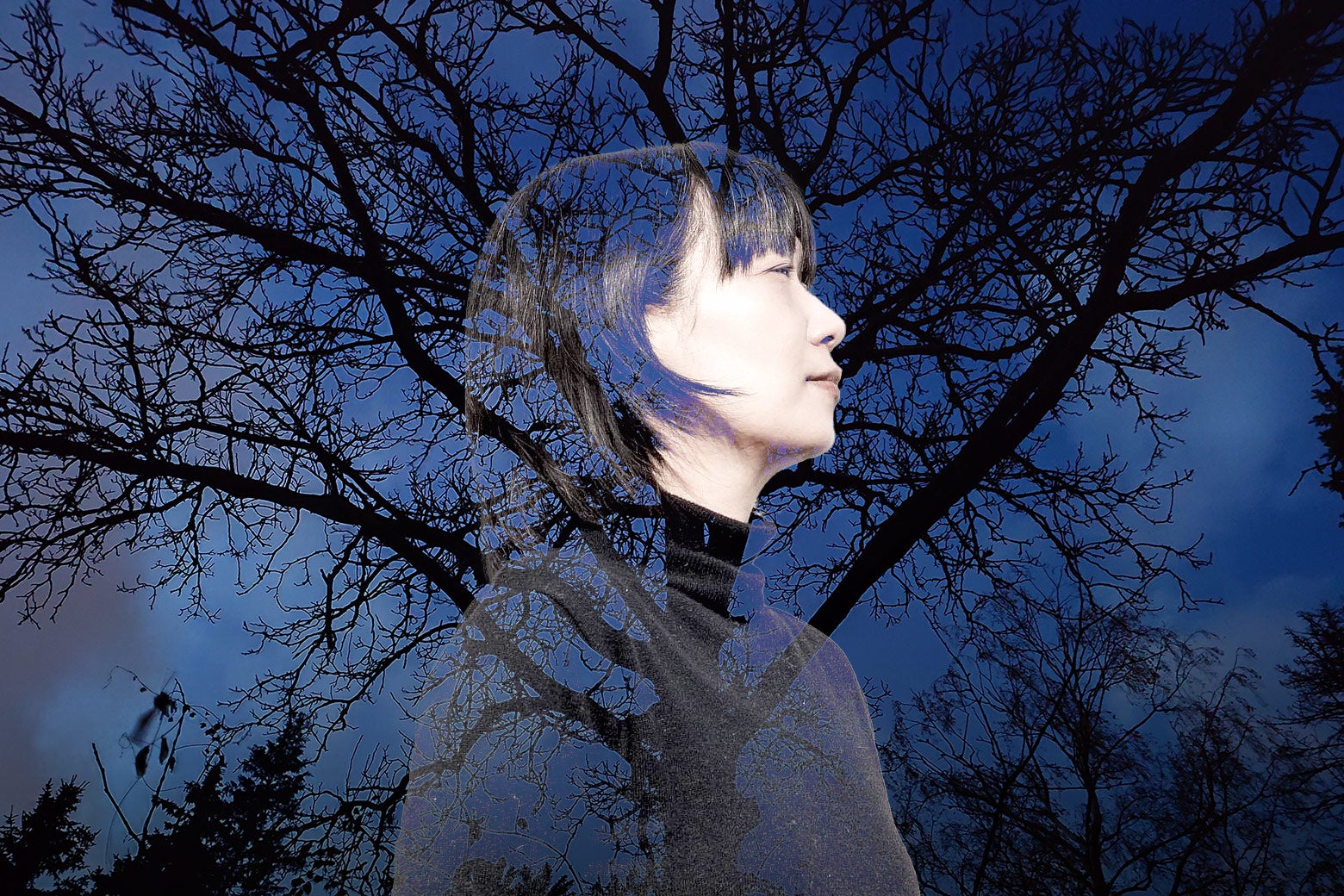
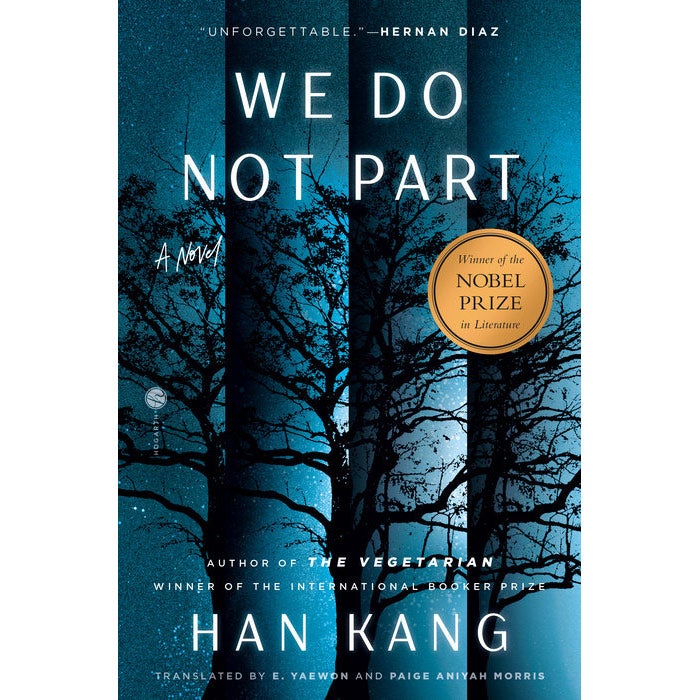
Han Kang’s pristine and enigmatic 11th novel, We Do Not Part, begins with a woman edging her way out of the world. Like the title character in the Nobel laureate’s celebrated The Vegetarian, published in 2007 (an English translation appeared in the U.S. in 2016), Kyungha, a writer, has alienated her family. While offering few details beyond the existence of a daughter who never appears in the novel, she refers obliquely to a parting made bitter by the remark “I don’t want to live face down on the ground like you.”
Now alone, Kyungha has retreated to a Seoul apartment where, racked by migraines, she barely survives on bottled water and mail-order kimchi. Every day she writes a will in the form of a letter, but she can never decide whom to address it to and by evening has become so dissatisfied with the text that she tears it up. She likens the previous four years of her life to “a snail coming out of its shell to push along a knife’s edge.”
Slate receives a commission when you purchase items using the links on this page. Thank you for your support.
Han’s heroines often stagger under an unbearable knowledge of human cruelty. The source of Kyungha’s despair appears to be a book she wrote about a massacre in a place denoted only as “G—,” a 19th-century-style elision meant to suggest that the author is discreetly relating a true story. Han has previously written about the Gwangju Uprising, a student-led pro-democracy movement that, in 1980, was brutally repressed by South Korea’s military. Han’s own family narrowly missed the violence because her father quit his teaching job in Gwangju four months before the uprising and moved to Seoul. Han herself found out about the massacre a few years later, when at age 12 she discovered a privately published memorial album of photographs by foreign journalists, hidden in her father’s bookshelf.
A dream haunts Kyungha. She finds herself standing in a field punctuated by “stooped and listing” tree trunks that give “the impression of a thousand men, women and haggard children huddling in the snow.” The blackened logs remind her of torsos and of gravestones. She notices then that an incoming tide threatens to wash away this cemetery, and frantically casts about for a way to rescue the bones that remain. This, she believes, is “a dream about G—,” one she can’t seem to exorcise. Inseon, a documentarian friend, proposes to film the two women re-creating the image from Kyungha’s dream. They put off the project for several years, and begin to drift apart, until Kyungha receives an urgent text from Inseon, who is hospitalized with a gruesome injury sustained while working on the logs for their project.
Like Kyungha, Inseon once devoted her work to commemorating the collateral damage of political conflicts, women who survived rape and unimaginable hardship yet whose lives and suffering are on the verge of being forgotten. Reading about these two women—as well as about Han’s own memories of learning about the Gwangju Uprising—I couldn’t help but find their stories eerily reminiscent of the Chinese American journalist Iris Chang, who related that, upon seeing photos of the atrocities against Chinese civilians committed by the Japanese army in the late 1930s, “in a single blinding moment I recognized the fragility of not just life but the human experience itself.” Chang went on to write 1997’s The Rape of Nanking, a bestseller that rescued this horrific event from relative obscurity. Chang took her own life in 2004, while researching another book, on the Bataan Death March.
Like Chang, struck by the “terrifying disrespect for death and dying” in Nanking, both women have an almost existential drive to unerase the lost—scrambling against the inexorable advance of the sea to dredge up whatever bones they can save and honor. These efforts can’t undo the horrors of the past, but they can restore dignity, and therefore meaning, to the dead. The urgency of Inseon’s text seems at first out of scale to the horrors they’ve set themselves to memorializing: Stuck in the hospital, she asks Kyungha to travel to Jeju, the island where she has been living, and rescue her pet parakeet from dying of thirst. But as Kyungha sets off for Inseon’s mountain cabin through a raging blizzard, the fragile life of the little bird becomes yet another fragment shored up against the ruin of history.
At this point in We Do Not Part, the novel fractures. Kyungha may have frozen to death after taking a wrong turn in the woods and falling into a snowdrift. Or she may have made it to Inseon’s cabin too late to save the parakeet, then fallen asleep, waking to find the bird alive again and an uninjured Inseon on hand to prepare bowls of jook, a rice porridge. This wouldn’t be the first time Inseon has appeared in spirit form; as a teenager, she ran away to Seoul, nearly died in a fall, and manifested back in Jeju to her worried mother. We Do Not Part is a novel of dreams and apparitions, whose significance resists simple interpretation. What Inseon has returned to impart to her old friend is her own family’s story of wartime loss.
We Do Not Part is also a novel of snow. Peculiar as it may sound, the frozen vapor commands much of Han’s attention and inspires some of her loveliest writing. She describes how snowflakes catching the sunlight reflected from the ocean at Jeju create the illusion of “white birds sweeping over the sea in a long, shimmering band.” In Seoul, the flakes “resembled countless white threads finely stitching the expanse between asphalt and ashen sky,” while the snowy winds at Jeju “swirl wildly as if inside a giant popcorn machine.” Enveloped in the drift that may or may not be her own grave, Kyungha recalls how water circulates through the atmosphere and wonders if the snow around her once fell on her friend’s face, or on Inseon’s mother’s family, who were slaughtered by a militia.
Inseon’s teenage mother and aunt were away from their village when the massacre occurred. In one of the novel’s most enduring images, the two girls return in the evening and wander among the corpses, brushing the snow off the dead faces in search of their parents. Kyungha and Inseon contemplate such tragedies from a remove, writing books and making films, but ever so close to them are the survivors, women whose ability to go on with their lives despite such losses both mystifies and humbles their children.
The snow that rests on Inseon’s grandparents testifies to their deaths. On living faces, it would melt. But snow carries many meanings in We Do Not Part, which becomes less like a novel and more like a poem as it winds to its end. Unlike the sea, snow does not wash the dead away. In Kyungha and Inseon’s vision for the film they want to make of Kyungha’s dream, snow will serve as a shroud for the unburied, “as white as cloth to drape down from the skies and blanket them all.” For the living, “there was an accompanying clarity to snow as well, especially slow, drifting snow. What was and wasn’t important were made distinct.”
During her arduous journey to Jeju to save a little bird and to receive the memories of the lost, Kyungha remembers reading that snowflakes form around a nucleus of dust or ash, acquiring frozen water crystals as they fall. “If the distance between the clouds and the ground were infinite, the snowflakes too would grow to infinity,” she thinks. So does snow in We Do Not Part accumulate meaning as it falls through the novel. It is death, honor, time, memory, clarity, peace, life itself, a fabulously intricate and beautiful miracle that takes only a second to dissolve on your skin.