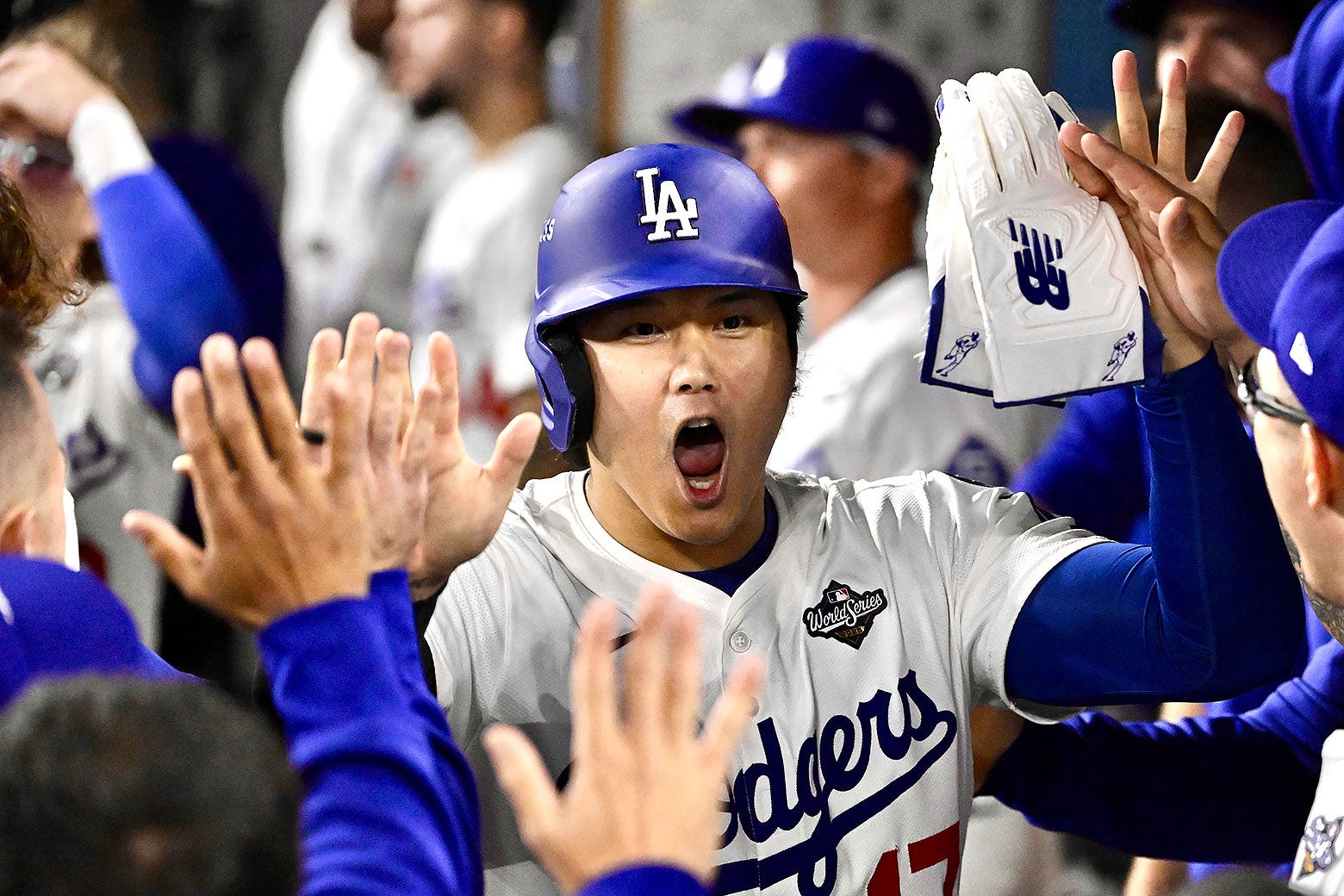
Shohei Ohtani has broken a lot of baseball conventional wisdom. He took a new step on Monday night, in Game 3 of the World Series. Ohtani has been on an unholy tear of late, even by his standards. Ohtani hit a game-tying home run to pull the Dodgers even with the Blue Jays at 5–5 in the seventh inning. At that point, the last eight plate appearances Ohtani had taken at Dodger Stadium looked like this: home run, walk, home run, home run, double, home run, double, home run.
So, when Ohtani came up again in the ninth inning, the Blue Jays decided to do something most teams would now consider a relic of the past: They refused to pitch to him. The intentional walk is no longer a significant part of Major League Baseball. Gradually, the quants who solved baseball over the past few decades realized that letting the other team have a baserunner, on purpose, was a bad idea. The main observation of Billy Beane, as revealed in Moneyball, was that getting on base was good. Ergo, letting the other team get on base was bad. As recently as the 2000s, teams handed out an intentional walk every three games. Now, they hand one out every 10.
In the bottom of the ninth inning, Ohtani came up with one out and nobody on base, the game still tied. This season, MLB pitchers issued five intentional walks with nobody on base. Every one of them was to Aaron Judge, the last of them in late July. Blue Jays manager John Schneider did not care about this and sent Ohtani down to first base. The Jays then caught him stealing to force extras. In the bottom of the 11th, with Ohtani up with two outs and no one on, Schneider did the same thing. With two outs and a man on third in the 13th, he did it again. And with one out and nobody on in the 15th, Schneider did it to Ohtani once more.
Each of these intentional walks improved the Dodgers’ win probability. The first one bumped it by more than 5 percent, according to FanGraphs. It’s valuable, usually, to get a free runner on first base with nobody aboard. Each time, though, the Dodgers failed to score.
In the bottom of the 17th, Schneider finally met his match. Or did he? Ohtani came up with two outs and a runner on first, rendering it a bit too ridiculous to intentionally walk him again and put the winning run on second base. At least this time Ohtani was facing a lefty, rendering him ever so slightly less dangerous. So Brendon Little threw four pitches to Ohtani, none of which was close to the plate. Four extra-base hits, four intentional walks, one unintentional intentional walk. Every single one of those walks had its desired effect, with the Dodgers failing to score as the best player of all time was left standing on the basepaths.
This extraordinary tightrope walk didn’t matter. The Jays stranded two runners in scoring position in the top of the 18th, and in the bottom half, Freeman hit the ball over the fence: 6–5, Los Angeles, and a 2–1 series lead. The moral of the story: You cannot run from Ohtani. You can only trade him for other problems before the cold realities of the Los Angeles Dodgers send you to baseball hell.
Once every five minutes or so, Ohtani does something that’s never been done. On Monday, he became the first player to reach base seven times in a postseason game. Then he became the first player to reach base eight times in any postseason game, and then the first to do it nine times. That’s all fun but somehow does not say anything new about Ohtani. New facts about him are somehow both jaw-dropping and uninteresting. There are only so many fresh ways to say “There’s never been anyone like this dude.” It was exactly 10 days ago that Ohtani had probably the best baseball game ever.
Barry Bonds, the best power hitter ever, never took more than three intentional walks in a postseason game. Bonds, one of roughly two people in modern times who have a good claim to being a better hitter than Ohtani, got his three intentional walks in Game 4 of the 2002 World Series against the Angels. Granted, Bonds took those walks in a nine-inning game. But he didn’t also draw an unintentional walk in addition to his freebies, and he was not getting ready to pitch the next night. Despite baseball teams losing about two-thirds of their appetite for intentional walks between then and now, a World Series manager walked Ohtani on purpose four times, basically five. The ’02 Angels’ dealings with Bonds were downright brave by comparison.
The only player to ever take five unintentional walks in any game was Andre Dawson. The Hawk took those strolls in a nondescript Cubs–Reds game in May 1990. Dawson that day was batting cleanup, one spot ahead of left fielder Lloyd McClendon, who had a .565 OPS at the time and went on to post sub-replacement-level totals over parts of eight big league seasons. Meanwhile, Ohtani was batting directly in front of Mookie Betts and Freddie Freeman, two of the best hitters of all time, in a World Series game. Basically, no major league manager has ever been less interested in dealing with a hitter than Schneider was with Ohtani on Monday night.
Ohtani, the best baseball player of all time, was in the midst of the best mini-stretch of hitting of his singular career. The Blue Jays successfully neutralized him by not allowing him to play any more baseball. Ohtani spent the equivalent of an entire extra baseball game ultimately contributing nothing to the Dodgers’ success, being walked and stranded each time. The night ended with Ohtani on base in all nine plate appearances, the Dodgers two wins from a repeat title, and Ohtani preparing to start Game 4 as a pitcher on Tuesday. The moral of the story is that there is no good way to pitch to Ohtani and no good way not to pitch to Ohtani. The Blue Jays will be broken after this ordeal. Any group of humans would be.