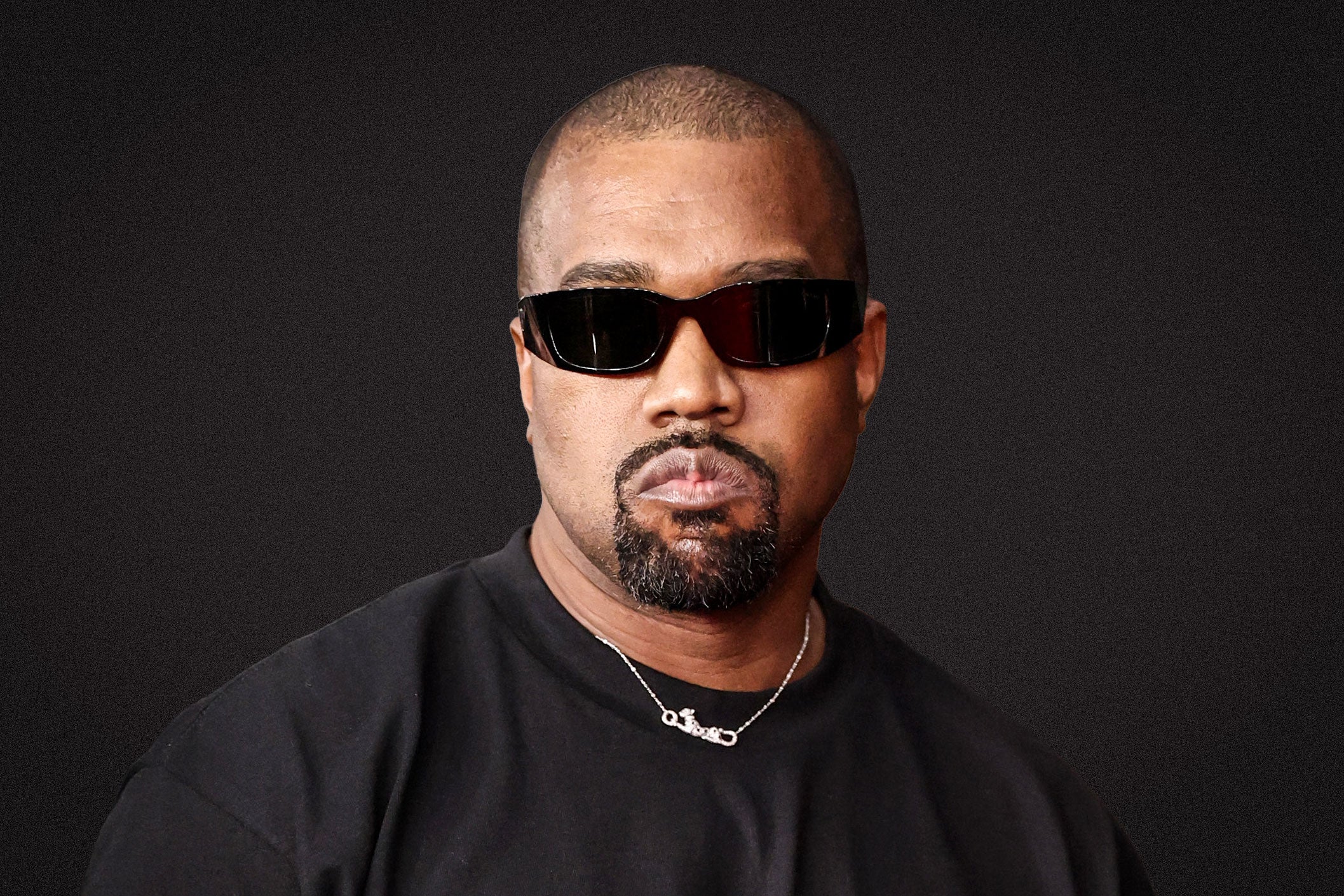
Last week, Wireless, one of London’s biggest summer music festivals, announced its headline act. That headline act was Kanye West. You know, Kanye West. The guy who released a song called “Heil Hitler” last year, sold T-shirts with swastikas on them only a few months earlier, and once announced on Twitter that he would go “death con 3 On JEWISH PEOPLE.” What could go wrong?
It does not take a genius to work out why Wireless did this—the “comeback” performances of a disgraced global superstar will surely sell tickets—but I would argue it does take an idiot not to foresee that inviting a musician who has vocally supported Nazism to the U.K., at this moment, was a bad, bad idea. In any case, he’s not coming. On Tuesday, the British government announced that it had refused to grant West authorization to enter the country. The Home Office told the BBC that the decision was made on the grounds that “his presence would not be conducive to the public good.” And the entire festival has been canceled as a result. The company issued a statement that read: “As with every Wireless Festival, multiple stakeholders were consulted in advance of booking Ye and no concerns were highlighted at the time.” Who were they consulting? Their wallets?
West has recently been making noises about atoning for years of poisonous behavior and bigoted rhetoric. In January, he took out a full-page ad in the Wall Street Journal apologizing for his antisemitism. “I am not a Nazi or an antisemite,” he wrote. “I love Jewish people.” West has attributed his behavior to suffering from bipolar Type 1. Experts in this type of bipolar dispute the link between the condition and the kind of hateful racism West has been spouting, however. In any case, he has apologized before, in 2023, after which he dove right back into making an album that included not only “Heil Hitler” but a track titled “Gas Chambers.”
The refusal to grant West entry is not exactly unprecedented—Australia blocked him from entering the country last year, citing the “Heil Hitler” track. But Americans following the story from afar are likely to be missing quite a bit of context that’s specific to the U.K.
Antisemitism is one of the hottest topics going in the U.K. at the moment. There is a very real and urgent need to protect the country’s Jewish population. Just last month, ambulances belonging to a Jewish charity group in north London were set on fire in what is being treated as a hate crime. A man stabbed worshippers at a synagogue in Manchester on Yom Kippur last year. Since the war in Gaza began, Jewish people in the U.K. have been targets of increased aggression.
And antisemitism is an accusation that has plagued the Labour Party in particular over the past decade. A dominant media narrative that Jeremy Corbyn, leader of the Labour Party from 2015 to 2020, was antisemitic for being anti-Zionist went a long way to costing him the 2019 election. Prime Minister Keir Starmer, who took over the party after Corbyn, is no doubt therefore keenly aware that it cannot be seen to be going easy on anti-Jewish sentiment of any kind. Hence Starmer’s refusal to back the findings of organizations like the International Association of Genocide Scholars by condemning Israel’s actions in Palestine as genocidal, something that has been a major factor in his unpopularity here. Last year, Starmer’s government made support of a pro-Palestine activism organization, Palestine Action, illegal, on the grounds that it was a “terrorist group,” with the result that peaceful retirees were being dragged away by police for wearing signs saying “I oppose genocide. I support Palestine Action.” (The U.K.’s High Court later declared the ban unlawful.)
All of which is to say that anything related to antisemitism is, in the U.K., even more charged than usual, and in light of that, it seems like an especially astonishing miscalculation by Wireless to think that someone who has publicly supported Hitler would be welcomed by the British government at this time.
And the British government having to step in to prevent West from coming here may now have unpleasant consequences. It does not sit easy that the Home Office has the power to dictate which artists may or may not perform in this country. Besides, is this step, canceling a popular music festival, not the kind of thing that might prompt antisemitic backlash if certain deeply misguided people decide that Jewish Brits are responsible for them not getting to enjoy themselves? Underneath Starmer’s post about West’s denied entry, there are already comments along the lines of “oh so we can’t have kanye west but we’re fine with having third world terrorists in our country?”
It’s a mess. The only solution, really, is that he should never have been invited in the first place. But there are some things you can’t take back.