This is part of Slate’s 2026 Olympics coverage. Read more here.
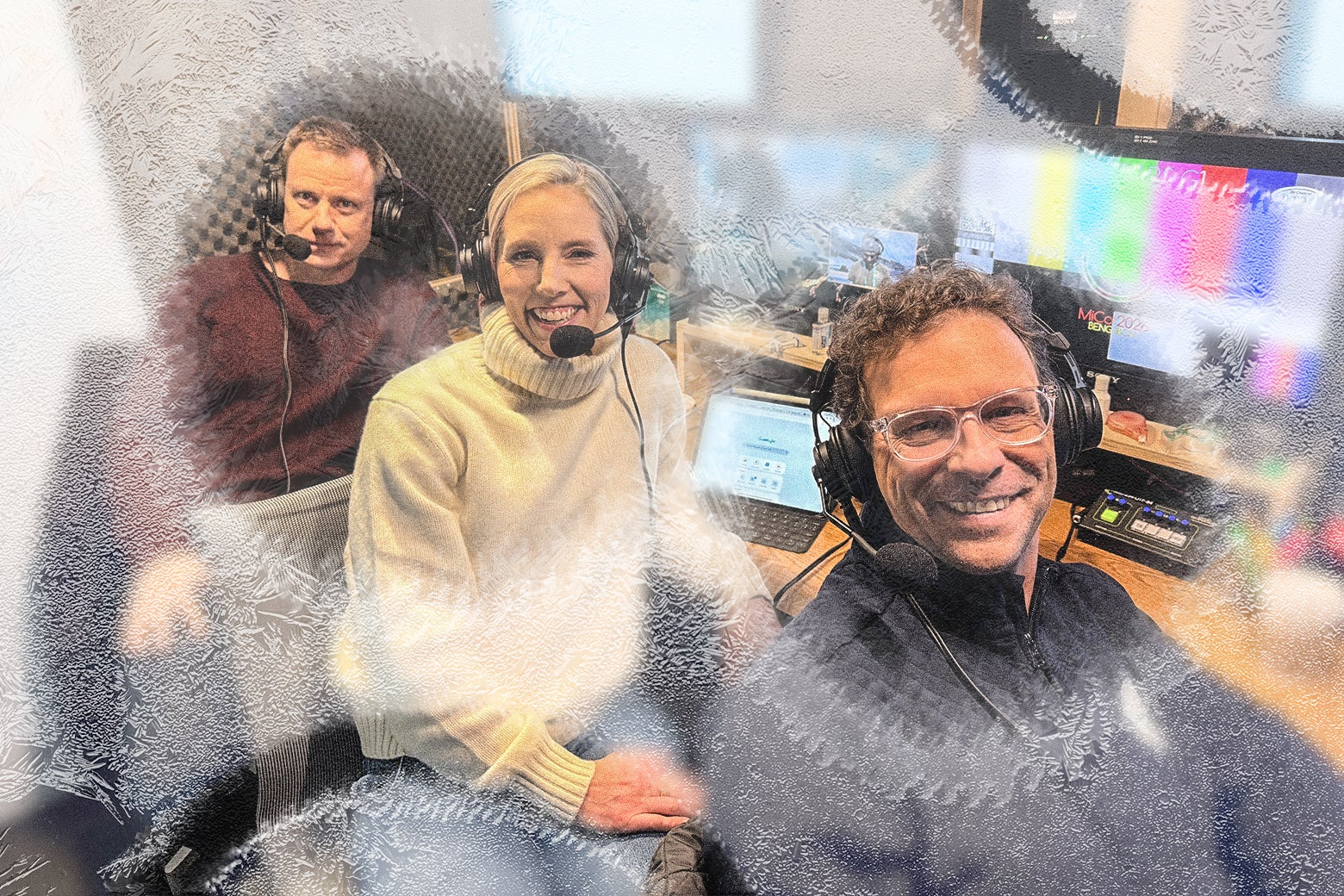
Olympics broadcaster Chad Salmela is celebrating his seventh Winter Games as NBC’s man on the ground for biathlon and cross-country skiing coverage. By “on the ground,” I mean “hunkered down inside NBC Sports’ International Broadcast Center in Stamford, Connecticut,” where he will spend the next two weeks remotely providing his trademark rousing analysis for two of the more obscure Winter Olympics sports.
Salmela is a former U.S. Biathlon Team member, and his call—“Here comes Diggins! Here comes Diggins! Yes! Yes! Yes! Yes! Gold!”—of Jessie Diggins’ thrilling come-from-behind victory in the team sprint event at the Pyeongchang Games is one of the most iconic American broadcast moments in Winter Olympics history. (Diggins’ gold medal, which she shared with team sprint teammate Kikkan Randall, was America’s first-ever cross-country skiing gold.) For the Milan Cortina Games, Salmela will be sharing the cross-country booth as a co-analyst with the now-retired Randall. They’ll be alongside play-by-play commentator Steve Schlanger, while hoping for more gold-medal magic from Diggins, who has announced that these will be her final Olympic Games.
When not analyzing winter sports races for NBC and other outlets, Salmela is the head men’s and women’s cross-country running coach at the College of St. Scholastica in Duluth, Minnesota. I called him last week for an expansive chat on Diggins and her legacy, how he developed his style as a color analyst, and whether I made things awkward for him when I wrote that he should be promoted to NBC’s lead Alpine skiing commentator. This interview has been edited and condensed for clarity.
So what’s your routine going to be over the next couple weeks?
I’m covering biathlon and cross-country, which is a big lift, obviously. I mean, I’m not flying around like Mike Tirico, but I think I’ve probably done more time and minutes on the network in the last three Olympics than anybody else they have working, as far as color analysts go.
What I do is just try to be ready for everything, and have the notes I need prepared, and rely on the people I work with to help get me through. It’s easy to try to do too much to start out. When you get into an Olympic Games like this, you just gotta sort of go with the flow and let the rhythm come to you. The goal when you put notes together for events is not to get the notes said on air. You have them there to back you up, and you use very few of them, because you can’t possibly anticipate what’s going to happen.
Do you feel like the enthusiasm you bring has played a role in increasing the visibility for those events on the telecast?
I think that’s [one reason] why they hired me—at least they get the enthusiasm. But I’m not trying to go over the top. When I get excited it’s because I think what’s happening is exciting. I think that turns some people off, people who are maybe more subdued and don’t like the commentary being part of their experience as much. They think that maybe I’m intrusive into their space. I mean, everybody’s gonna have haters, and I have mine.
Really? So there are some cross-country-heads out there who are like, “Chad’s too exciting. He’s making this seem like too much fun.”
I don’t think that what I do is something that Europeans enjoy. I think that Europeans think I’m over the top, I’m too American, they don’t like my accent. I don’t know if that’s true, but I do get worse feedback in Europe than I do in America, we’ll put it that way.
If you break down what has made my career sort of special, it’s that I break into the play-by-play’s space from time to time and get excited—and I’m not supposed to do that. That’s, like, rule No. 1, you don’t take the finishing stretch from the play-by-play. And I’ve done that. I mean, I did that with Al Trautwig without knowing it. And he didn’t bring it up for weeks.
We did the entire [2010] Olympics in Vancouver together, and I was still pretty green at broadcasting commentary. We anchored the Olympic coverage for two weeks in daylight hours. And that was really fun.
But then we went to Sochi [in 2014], and the first event we called was the men’s skiathlon, and it was amazing. Dario Cologna had this amazing finish and I just kind of went with it, and I did what I did with Jessie Diggins, sort of. And I called him down the stretch and came off air, and Al was fine. He goes, Wow, that was a different way of doing it, but I loved it. And I go, What do you mean? He goes, Well, you were kind of all over my call. And then he explained to me that, Well, yeah, I saw this in Vancouver too. You’re not supposed to come in. And so we talked about it more over dinner that night. Al was always just a good mentor. He would take me into these really fancy dinners, and he’d always pay.
That’s a good mentor.
Yeah, he was great. And so in the course of Sochi I really figured out my voice, and he helped me get there. And I think that’s probably why I ended up being comfortable doing what I do. If I’d had a different pathway and a different partner at the time, I might not have ever yelled “Here comes Diggins!”
This is going to be Jessie Diggins’ final Olympics. What should people watch out for from her over the next two weeks?
Jessie is not even close to the same skier she was when “Here comes Diggins!” happened. When [Diggins and Kikkan Randall] won that race, part of the surprise, other than the 40 years’ wait, was the fact that Jessie Diggins, of all people, was going to close the sprint. Maiken Caspersen Falla was the 2014 Olympic champion in the sprint. And in the same stretch of snow, she’s gotta outsprint the Olympic champion from several days before that, in the classic sprint, Stina Nilsson. Jessie Diggins should not have outsprinted both of those people to win that medal. And that’s what was so miraculous about it. The reason she shouldn’t have is because she wasn’t that good of a skier yet.
That particular performance, everybody catches the last 11 seconds of it. If you go back and watch the whole thing, it’s the most sophisticated manipulation of a skiing competitor on a course that I’ve ever seen in an Olympic Games. She went out there and she suddenly took the sprint out of both of them, and she knew what she was doing. She went out and she tired them out so they couldn’t beat her in that stretch.
She’s come such a long way since that race. Between 2022 and now Jessie Diggins has become the best skier in the world, and she has won in classic technique. And even more importantly, she won the first women’s skiathlon of this year, which is the first event of the Olympics. [Note: Diggins finished eighth in the 2026 Olympic skiathlon after getting caught up in an early crash.]
Do you wish you were in Italy for the games rather than Stamford, Connecticut?
Absolutely.
Do you ever try to make the case for them to send you guys out there?
Not really, because, for one, I can’t do biathlon and cross-country if I go—I can do one or the other. In Vancouver and Sochi it worked because the two venues were walking distance from each other. With this one, the biathlon and cross-country are separated by two hours’ drive, so that’s impossible. And they want to get the most out of me as they can. And that’s great. But honestly, I would love to go back to the Olympics. I haven’t been there since Sochi. And I would love to go next time, but I just don’t think it’s gonna happen. That’s my hunch.
Do you interact at all with the other remote broadcasters? Like, do you guys cross paths in the break room or anything?
You mean the ones from other sports?
Yeah, like the short track guy, or the ski jumping guy.
We hang out with them a lot. I mean, [NBC ski jumping analyst] Johnny Spillane and I hang out all the time. We’re good friends. And [NBC Alpine skiing analyst] Steve Porino and I are very good friends.
Did he get pissed when, four years ago, I wrote a piece saying that you should be promoted to do Alpine skiing?
I think he understood. And I appreciate it. I mean, we talked about it, because I think what you were doing is you’re trying to bolster the positive aspects of a smaller, upstart sport, and a commentator who maybe doesn’t get his fair share of—how should I say this?—appreciation for what he does. But I told Porino, like, Tell Dan Hicks I didn’t say that.