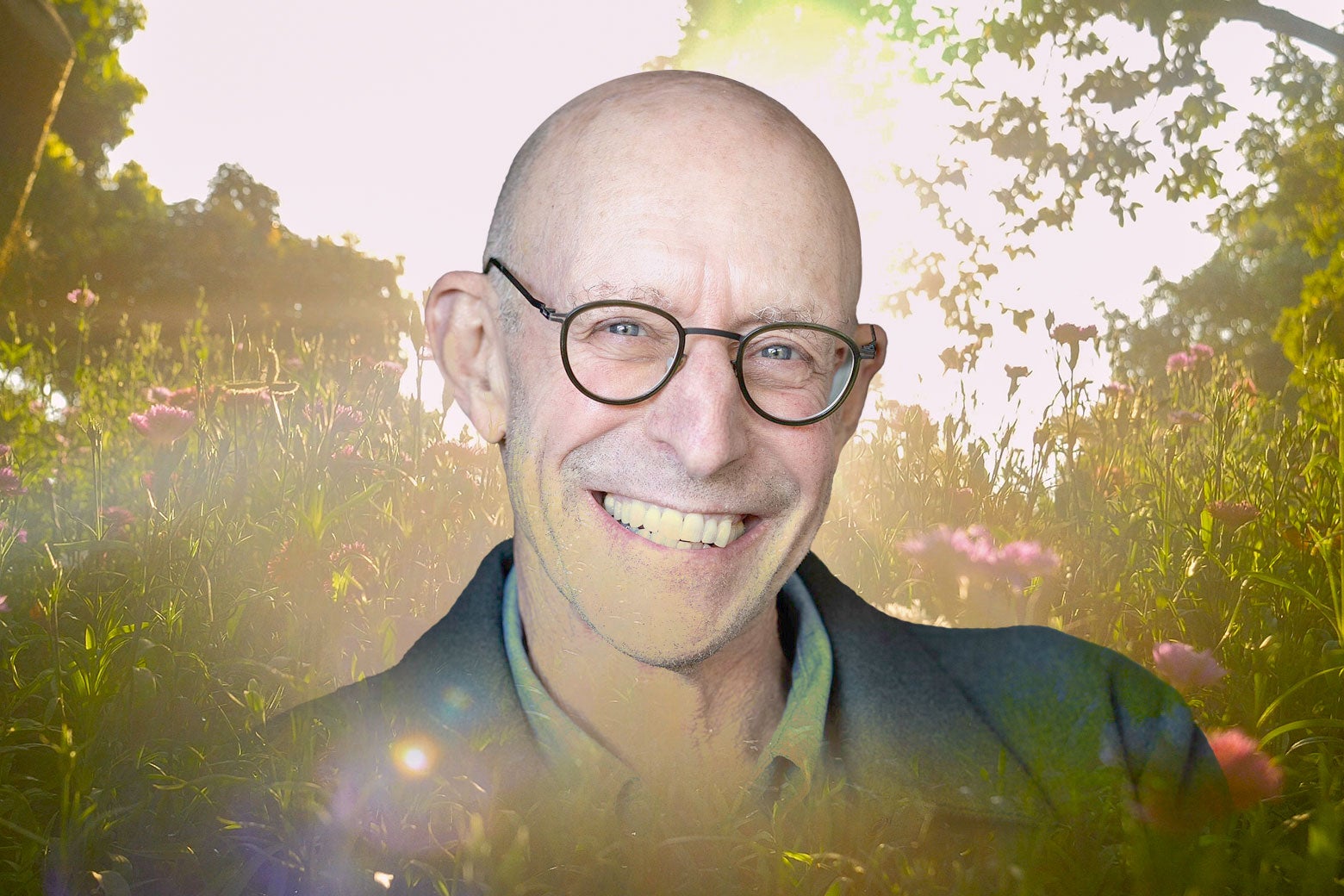
Michael Pollan’s lucid and lively writing on the science of everyday life—plant biology, nutrition, cooking—has made him one of the most popular nonfiction writers around. In bestsellers like 2001’s The Botany of Desire and 2006’s The Omnivore’s Dilemma, he illuminated the complex relationship between human beings and the plants that feed us and boiled down reams of research into a much-repeated mantra for maintaining a healthy diet: “Eat food. Not too much. Mostly plants.” With 2018’s How to Change Your Mind, he mounted a persuasive case for the judicious use of such psychedelic drugs as psilocybin, mescaline, and LSD as treatments for depression and addiction as well as a palliative for the dying. His latest book, A World Appears: A Journey Into Consciousness, however, tackles a much more challenging topic—and sometimes gets swamped by it.
How can we define consciousness? Even that starting point proves to be a sticky wicket. For the purposes of this review, let’s go with this: Consciousness is our deliberative awareness of ourselves and our surroundings. When you open your eyes in the morning, as Pollan puts it, “a world appears,” but how and why and to whom exactly? This book takes a stab at surveying the most recent thinking and—above all—debates on the topic, all falling into the cloudy area between neuroscience and philosophy, and not coincidentally provides Pollan, that self-described “psychedelic confessor,” with frequent opportunities to raise the matter of the hallucinogenic substances.
Pollan’s formula—perfected, though not invented, by him—has become ubiquitous in high-end book-length science journalism: See Ed Yong’s much-celebrated An Immense World: How Animal Senses Reveal the Hidden Realms Around Us (2022) and Zoë Schlanger’s The Light Eaters (2024). The writer presents himself as a casually informed and inquisitive layperson possessed by curiosity on a particular subject. So possessed, in fact, that he must set out on a literal and figurative journey to discover “what we know” about it. (That a book contract both necessitates and funds this journey is never mentioned.) He then travels the world interviewing the prominent thinkers in the field with an eye to sampling the various (and sometimes rivalrous) theories in play, while describing their research with an infectious wonder.
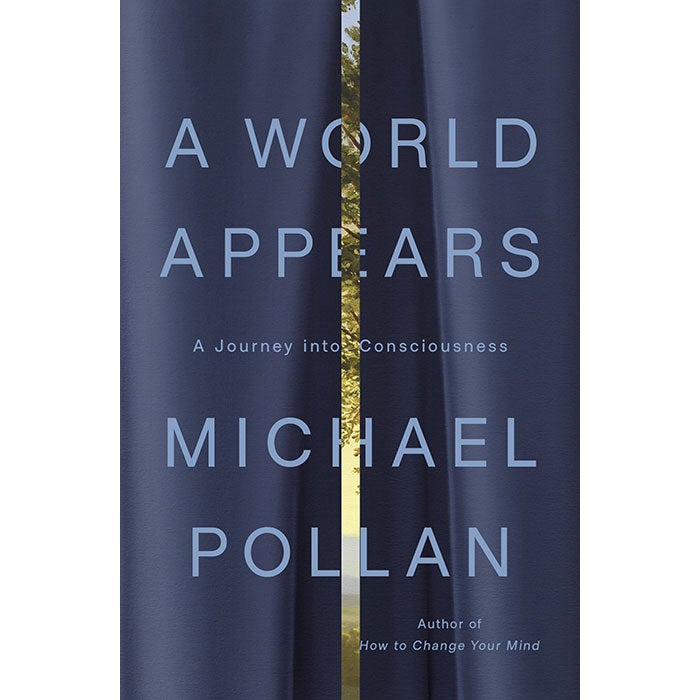
A World Appears: A Journey Into Consciousness
By Michael Pollan. Penguin Press.
Slate receives a commission when you purchase items using the links on this page. Thank you for your support.
In the hands of an expert like Pollan or Yong, this method—the Smorgasbord of Experts, if you will—can produce some terrific books that coax their readers to see such ordinary phenomena as a supermarket steak or a pet dog in radically new ways. The travelogue format gives writers a chance to set scenes and sketch characters, rather than just referring to studies published in academic journals. It’s an approach that makes esoteric material feel more concrete and palpable, opening up the often inaccessible realm of practical science to unscientific observers.
Consciousness, however, does not lend itself to this kind of journalism. Even the study of it is paradoxical because, as Pollan puts it, “the only tool we can use to crack it is consciousness itself.” Consciousness is the sum total of our experience of the world and ourselves—at least the experience we’re aware of. Everything we know we access through it. It’s a bit like trying to study the ocean while being submerged in it: How much can you really learn about a thing if you can’t get outside it?
Pollan begins with a young philosopher who, in 1994, gave a seminal lecture on what “he memorably called the ‘hard problem’ of consciousness: the puzzle of why any of these mental operations are accompanied by any conscious experience whatsoever.” Most of what our brain does is automatic and unconscious: regulating bodily functions, scanning the environment for signs of threat, executing almost every type of movement from walking to chewing, etc. Why can’t it economize on energy (the brain is a big calorie hog) by automating everything we do? Why is consciousness even necessary?
A neuroscientist Pollan consults later in the book makes the very reasonable argument that conscious deliberation allows human beings to make choices in situations when automatic responses aren’t adequate. In particular, the intricate social organization that has powered humanity’s dominance of our planet demands just such a flexible capacity to make judgments on the fly rather than reflexively. If you are of what Pollan refers to as a materialist mindset, this explanation might just do it for you. After all, evolution explains pretty much every biological phenomenon, with the notable exception of why life strives so hard to perpetuate itself.
For those who are philosophically inclined—the kinds of people who like to pummel their brains with such questions as “Why is there something instead of nothing?”—materialist answers won’t satisfy. Pollan claims that some part of himself belongs to the first camp, and is “sympathetic to the quest to explain everything in material or physical terms—that is in terms of matter, energy, and gravity.” But the very choice to write a book on consciousness suggests how much that hardheaded part of the author has receded in favor of the guy who famously once had an ego-dissolving transcendental revelation while on psilocybin.
A good chunk of A World Appears is devoted to a useful elucidation of the differences between sentience (being capable of sensing and responding to one’s environment), feelings (physical processes that yield mental experiences), thought (the content that streams through our conscious minds every waking hour), and, finally, the self (the belief, considered by many of Pollan’s sources to be an illusion, that one has a distinct and bounded essence that persists over time). This is where things get especially vaporous in a book devoted to stuff you can’t, by definition, truly perceive or understand. Pollan’s sources begin to say things like “The self is not the thing that is perceiving; it is itself a kind of perception” and “You don’t need an inferrer to make inferences or a perceiver to make perceptions.”
Psychedelics, naturally, pop up throughout A World Appears (many of Pollan’s sources have tried them as part of their research), but they really start to kick in toward the end of the book. The drugs sometimes give people the sensation of the disintegration of the boundaries of the self—or, as Pollan would likely put it, reveal the underlying truth that the self is an illusion concealing our unity with the greater universe. The book concludes with Pollan’s visit to a Buddhist retreat in the Arizona mountains, run by an exemplary woman. (For an examination of the merits of self-transcendence, A World Appears is notably preoccupied with personalities.) There, Pollan spends days doing nothing but meditating in a cave, a practice that induces an altered state of consciousness not unlike a psychedelic trip.
The concerns Pollan tackles in A World Appears are without a doubt profound and often provocative, but compared to his earlier books, they have an airless, solipsistic quality. The Botany of Desire and The Omnivore’s Dilemma cracked open the world to their readers, exposing the hidden marvels and unimagined backstories of a potato or an ear of corn. A World Appears does pick up some energy when Pollan challenges the thinking of some of his more cerebral sources, like the scientists who are attempting to create an artificial consciousness by subjecting an A.I. to a simulation of the conditions under which human consciousness emerged. “None of them,” he complains, “had anything to say about embodiment—the idea that consciousness might depend on having both a body and a brain.”
Nevertheless, by the time Pollan gets to that cave, he’s nearly as muddled as the average reader will be. None of this feels especially grounded, and the delightful quality of Pollan’s earlier books is how they link the wonders of science to what you decide to make for lunch. I believe, for example, that time is a misperception of consciousness, but as mind-blowing as that fact is, I can live only as if time exists. At the end of A World Appears, Pollan writes, “The self might well be illusory, I decided, but no more so than color or any other construct of the mind. Put another way, the self can be both illusory and real, or real enough.” A journey indeed, but one that effectively leaves us right where we started.