Seemingly everywhere millennials look, a show from our youth is getting rebooted or revisited. Scrubs is back on TV, as is King of the Hill, back on its throne not long after revivals of shows like The Fresh Prince of Bel-Air. We have specials looking back on Hannah Montana and Laguna Beach. And while Buffy the Vampire Slayer is proving harder to revive than hoped, she has a history of coming back from the dead.
The latest bet on millennial nostalgia comes from Hulu, which is bringing back Malcolm in the Middle with a revival that checks back in with Hal (Bryan Cranston), Lois (Jane Kaczmarek), and their now-adult children, led by Malcolm (Frankie Muniz). (Of the original cast, only Erik Per Sullivan, who played Dewey, opted not to return.) Over the course of four episodes that quickly and effortlessly recapture the chaos and humor of the original series, we see how Malcolm has built a happy life for himself and his teenage daughter by distancing himself from his family—an estrangement soon threatened when he’s roped into celebrations for his parents’ 40th wedding anniversary.
Reboots can be tricky. As And Just Like That … demonstrated, trying to update things too much can feel desperate and tonally confusing, but hewing too close to the original can make a project seem like an unnecessary retread. Still, as the middle child of three boys myself, I confess I was curious to check back in with Malcolm and Co., and I was delighted to see that the reboot, titled Life’s Still Unfair, struck a nice balance.
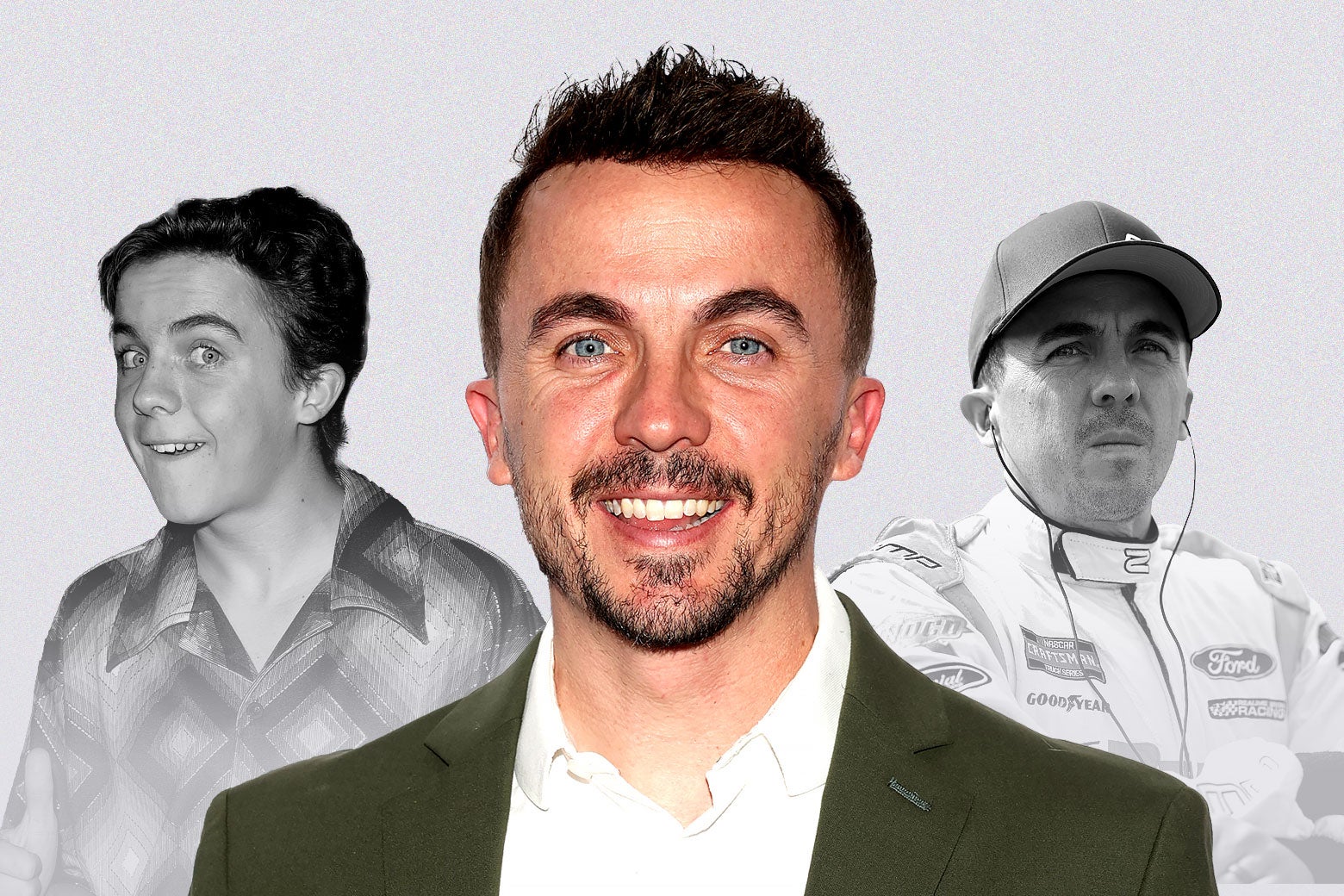
Prior to the limited series’ release, I was able to catch up with Muniz, now 40, and share with him what the show had meant to me as a kid. Although he has acted here and there since the show (notably in comedies like 2007’s Walk Hard: The Dewey Cox Story, in which he makes a cameo as Buddy Holly, and 2015’s Sharknado 3: Oh Hell No!), Muniz has rebuilt himself mostly as a NASCAR racer. As he drove himself from Charlotte, North Carolina, to Darlington, South Carolina, to compete in a NASCAR Craftsman Truck Series race (for which he ended up finishing a respectable 18th out of 36 drivers), we spoke about what it took to bring Malcolm back to the screen, how becoming a parent has changed how he sees the show, and why he believes that so many millennials are aching to go back to a simpler time. Our conversation has been condensed and edited for clarity.
Tell me what it was like to return to this part of your life.
I was thrilled to come back to Malcolm. It’s been something that we’ve talked about for the past 10 years. So the fact that we actually got it together, I was so excited. It’s not that I was nervous of how it would be to be Malcolm again or if I could do it again, but the minute we got back on set, it was as if not a single moment had passed. It felt so unbelievably natural. I had an absolute blast.
Ten years of discussions! Tell me about those. How did you know there was an appetite for this?
I think I sent out a tweet around the 10-year anniversary of the show ending, and it said something like “Man, I wonder where Malcolm and his family are now.” And I remember that tweet got a lot of traction. It was picked up by a lot of news outlets. Everybody went kind of crazy for it. I was like, Whoa. People want this. I ended up calling Linwood Boomer, the creator, and I was like, “Hey, did you see the reaction?! Have you ever thought if you’d like to do it?” And he was like, “To be honest? I’m not interested.” I thought, Oh, darn.
I was having dinner with Bryan Cranston a few months later, and we were talking about it, and he was like, “There’s no role I would love the chance to get to be again more than Hal. I want to see this happen. I’m gonna work on Linwood.” He took the lead on getting all the pieces together to make it happen. It was a 10-year process, but we made it—he made it—happen.
Well, my thanks to Bryan, then! A lot of this reboot special is about Malcolm actively resisting his family and trying to get away from that part of his life. Did any of that feel familiar to you? Were there ever times you felt, as a former child star, that this was a part of your life you were trying to get away from?
Not necessarily the show. I was always proud of having been a part of it. I remember people always being like, “Well, how are you going to transition to being a ‘respected adult actor’? You don’t want to get typecast!” I always thought, Well, being remembered as anything is a pretty cool thing. Having an impact on people, where they love a show and a character—why would I run from that?
You’re driving to a race right now. I’ve always been curious if part of the appeal of racing for you is that it is so different from acting—that it feels like a complete left turn, so to speak.
Literally, that’s what I’ll be doing 400 times tonight: a bunch of left turns! No, what I like about racing compared to acting is that it’s not subjective. The work I put into it, and the team puts into it, you can see in the results. With the reboot, I know that there’s a built-in audience for Malcolm, and I know that people are going to watch it, but I put in a lot of work. There’s so much emotion and highs and lows that Malcolm goes through in the four episodes. I was really dedicated. I was racing at the same time too, so I was flying across the country every Friday, racing, and going back and filming the show, making sure I put in a lot of work. But people might see it and go, Eh, he wasn’t that good. Whereas in racing, you see it in black and white every single week if you were good or not. I really like that about it.
The show’s obviously coming back at a time when there’s a lot of millennial nostalgia content out there. What is it about this Y2K era that you think is so appealing? Why are so many of us yearning to go back to that time?
I feel like every generation of people likes to think of “the good old days.” My grandpa would say that his time was so much easier and more fun and that life was great. Now I just turned 40, and I think that the ’90s and early 2000s were awesome!
But I think people also look back at that period and realize it’s also the last time before technology really took over. Yeah, we had cellphones when Malcolm started, but there were no apps. You were more focused on what you were doing, in your life experiences, than being tied to your phone. Back then, you didn’t really know what was going on in the world unless you wanted to. You had to read the paper. You had to specifically look for the news. Now you can’t escape it.
It’s funny you brought that up, because I had been thinking that Malcolm really was one of the last shows to capture childhood before social media, this idea that you had to entertain yourselves and get up to your own trouble.
I think of my childhood in the ’90s, riding bikes, being in the woods until 10 p.m., just doing whatever. But now, with my son—he turns 5 on Sunday, and I don’t let him go in the front yard without us being out there watching! It’s just a different time.
In this reboot, Malcolm feels sort of trapped. It’s like he’s half-adult, half-child. You can see the original Malcolm in him. He’s still afraid of his parents, he still fights with his brothers. It’s as if he’s stuck. I’m wondering if you think that’s a millennial thing, being in this eternal stage of arrested development?
Malcolm always just felt that his family—his brothers, his parents—and the world were out to get him. Everything was holding him back. And when you first meet Malcolm again, he’s actually in a really good place. He’s got his job together. He’s got an amazing daughter, and they have a great relationship. He’s got a girlfriend who is perfect and who loves him for him. Everything’s kind of good. And he believes that he has had that success because he’s stayed away from the family, because they’re the ones that make him go into that negative mindset.
Your brain is very powerful. If you think that something is the problem or someone is the thing holding you back, it’s really hard to get rid of that mindset. You can trick your brain into thinking that whatever’s in there is reality. That’s kind of the fun of these four episodes. It’s Malcolm figuring out that those things that made him crazy actually made him be the person he is now. I like that realism.
Much of the reboot is dedicated to framing Hal as the beating heart of the family. Was that something that was evident to you when the show was on? Or was it a realization that came later?
It definitely came as a realization later. If you talk to Linwood, when we filmed the pilot, Hal was going to be an afterthought. He was going to be there as this hapless dad, but he wasn’t really an integral part. But when Bryan came in and played it, he made Hal Hal. I think that when you really watch the show, Hal is the greatest, most integral member of the show. I get it. People took him for granted, but he was the family. He was the glue. He was the show.
You mentioned your son earlier. Has becoming a parent changed the way you think about the show, and Hal and Lois in particular?
One hundred percent. People are so quick to be like, “Hal and Lois were just so crazy! They were screaming!” But when you really watch the show, you can see the love, even though they bickered.
It’s definitely changed the way I look at myself and the way I parent my son. I’m constantly questioning if I’m doing it right. Is the way we approach his tantrums or anger the right way? Should we do gentle parenting or be more strict? In these episodes, Malcolm says that the way he’s raised his daughter is by thinking about what his parents would do and doing the exact opposite. But his parents also made him the person that he is today.