In the second episode of the final season of The Boys, out today on Prime, two influencers paid by the evil corporation Vought International make TikToks of themselves dragging opponents of Vought’s supreme leader, Homelander, out of their houses, destined for “Freedom Camps,” in a twisted echo of what’s been happening in our reality. Covered in advertisements for the cryptocurrency VoughtCoin, clutching the arm of the weeping mother she’s arresting, the influencer on camera stops to promote energy beverages, and gets yelled at by her partner, who’s filming, for forgetting part of the ad read. The mother’s child comes out of the house, crying for her, and the influencer acting as cameraman yells at him: “Yo! You stay back. Because if you ruin my shot, it’s on sight, bitch!” After they nail the video, offering the blandest of looksmaxxer smiles, the cameraman says to the mother: “Have fun at camp!”
Yes, nearly two years since Season 4 concluded, The Boys is back. An adaptation of a comic book series by Garth Ennis and Darick Robertson, the show premiered with a splash in 2019, aggressively satirizing politics, the internet, Hollywood, and Big Tech, via its story about a corporation that chemically creates superheroes for profit, and the vigilante Boys who try to stop them. After its well-received first and second seasons, which introduced the campy, insecure blond superhero Homelander (Anthony Starr), an unforgettable character with an incredible face that’s spawned a thousand memes, The Boys’ power, along with its novelty, has weakened over time. Given the pace of the news, and our collective reactions to the news, you’d need to be able to tape and deliver an episode of scripted television in one week—or half a week!—to really be topical, and in recent seasons it felt like The Boys just couldn’t land the plane. (Grain of salt: According to Amazon, even as critics like me have gotten a little tired of its games, Boys viewership has gone up season by season. But can Vought—oh, I mean Amazon—be trusted?)
The Boys’ latest comeback is proving to be promising, though, in a way that bodes well for the conclusion of a series that once felt profane, fresh, and exciting. The beginning of the final season finds Homelander in control of the puppet president and vice president of the United States, and three of the Boys crew in a Freedom Camp patrolled by superhero prison guards, forced to wear shitty gray sweatshirts decorated with American flags and Homelander’s face. There’s a virus that can kill superheroes that the Boys will try to locate, there’s strife between the “good guys” because their leader Billy Butcher (Karl Urban) is dangerously monomaniacal on the subject of Homelander, and there’s the matter of Starlight (Erin Moriarty), the girlfriend of Boys resident sweetie Hughie (Jack Quaid), having been officially designated a terrorist. Also, Boys member Kimiko (Karen Fukuhara) talks now, after four seasons of selective mutism, and it turns out she’s just as foul-mouthed as the rest of them.
Back in 2014, a writer tallied the number of jokes in an episode of 30 Rock: 7.44 per minute. I tried to write down every joke and visual gag about contemporary politics and online culture that The Boys drops in the first two episodes of Season 5, and ended up abandoning the exercise, confounded. How to count the numerous signs with manosphere slogans that decorate the podcast studio where the Homelander-aligned superhero The Deep (Chace Crawford), who drives a Cybertruck now, records his new show, Manhandled? When another flunky replies to Homelander’s new request to arrest dissidents by saying, “We’ve already purged the CIA, DOJ, FBI, FTC, CDC, EPA, DOJ, HHS, and USPS, we deported the nation’s nannies and gardeners, we arrested Chappell Roan and Tyler the Creator, and canceled Coachella … and now he wants to detain thousands of American citizens?”—is this supposed to elicit laughter, or stiff clapter?
These are tonal issues The Boys has suffered from for a few years now. But, happily for those fans still interested in this singularly irreverent and bloody show, something feels different this time around. And it’s not just the many new and diverse ways people will be killed by things going up their butts—a particular fixation of The Boys—or the rest of the show’s new gimmicks and tricks, like talking hammerhead sharks or a teenage superhero who’s a human granite mountain who ejaculates lava. It’s the fact that, after four seasons of Butcher and his crew mounting failed plots to kill Homelander, we know that, by the end of this go-round, something is going to stick—and that makes everything feel real. (Critics were not given the series finale, which is set to air in late May, to screen.)
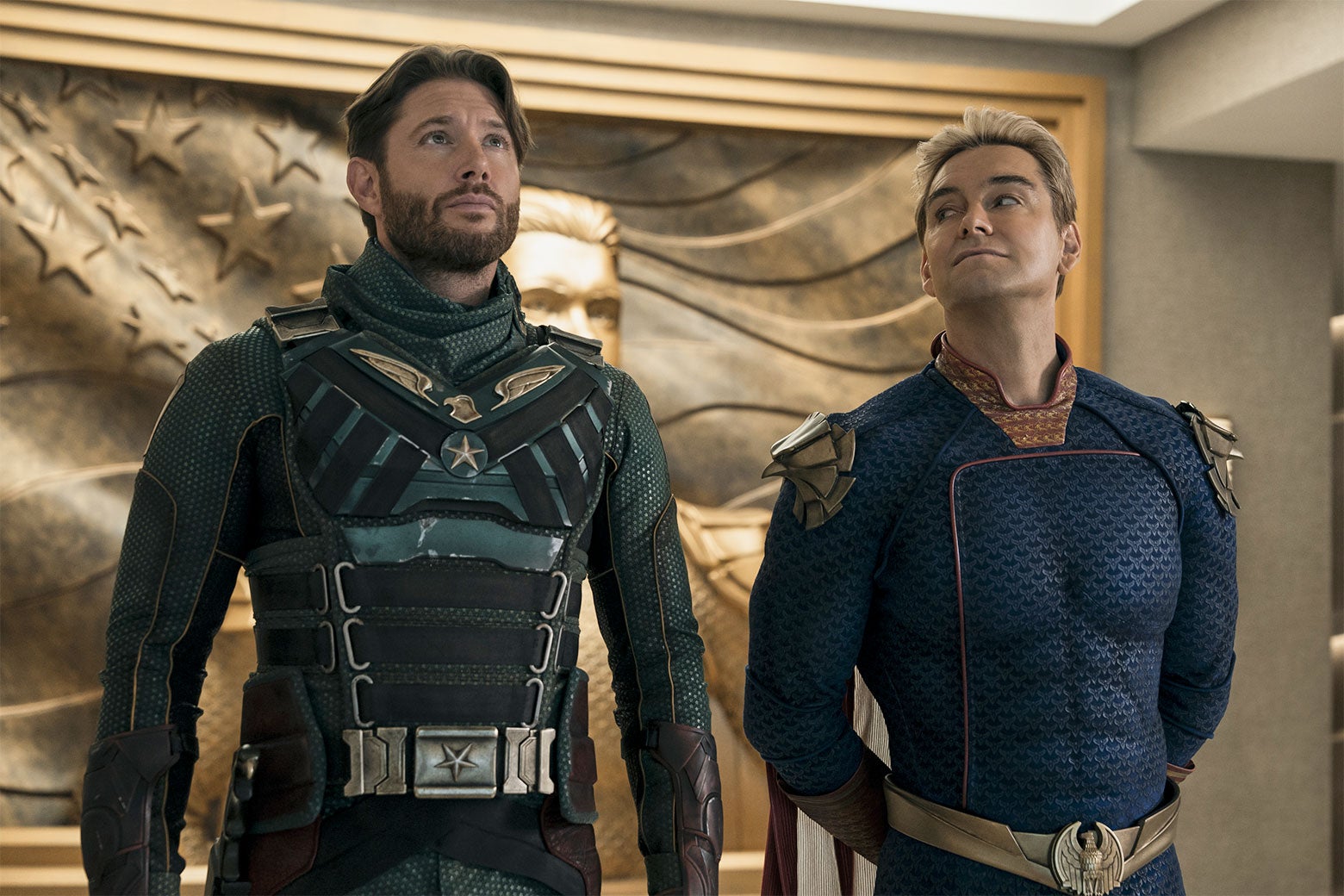
We’ve spent years watching characters bend themselves around Homelander, whether they take drugs to induce lactation so they can breastfeed him, betray friends to keep from being killed, lie to harness his power for their own purposes, or devote their lives to finding a way to kill him. All this for a person who is (as Jensen Ackles’ Soldier Boy, the only superhero who can best Homelander in a fight, can be depended on to point out) just plain annoying. But in Season 5, the gravity that Homelander’s power creates will break—is already breaking, in fact. The end of the first episode sees the death of a Homelander follower turned Boys ally, the superhero A-Train (Jessie T. Usher). “What was I so afraid of?” the speedster asks, finally cornered and pinned by Homelander, his former leader. “You are fucking nothing. … Take away these powers and you’re pathetic, weak. A sniveling fucking loser.”
Blood on his teeth, A-Train laughs, right up until Homelander snaps his neck. And for the first time in a long time, The Boys has me unable to look away.