
Sign up for the Slatest to get the most insightful analysis, criticism, and advice out there, delivered to your inbox daily.
When I arrived at the playground recently with my 18-month-old daughter, I scanned for other moms my age. I looked for strollers captained by women sporting stray gray hairs, maybe some crow’s feet, wearing skinny jeans now morbidly out of style. At some point, this had become second nature.
Seeing none, I reassured myself that I’d taken the necessary precautions to blend in: a recent trip to the hair salon for a roots refresh. An at-home chemical peel. An excessive application of that glow-y tinted sunscreen stuff. I was reasonably sure that I would not be mistaken for my daughter’s grandmother.
As a 49-year-old mom to a young toddler, I am at the longer-in-the-tooth end of the spectrum when it comes to what the medical industry now terms “advanced maternal age”—so long, “geriatric”—and what many members of my cohort more gently refer to as “motherhood later.”
We’re living in the age of what I simply call “super old new moms,” with an explosion in the ranks of women 45 and over—and some in their 50s and even 60s—giving birth thanks to huge advances in assisted reproductive technology and greater awareness and acceptance of such possibilities, as well as practical considerations like the astronomical costs of child care and housing. Did you read that recent New York Times piece about the woman who gave birth to her 13th child at 62? Well, a lot of people did.
The birth rate for women 45 and over has shot up around 450 percent in the past three decades, according to the Centers for Disease Control and Prevention, to around 11,000 babies in 2023. As a whole, the 40-and-up crowd notched around 147,000 births that year, triple their reproductive output in 1990. The actual number is higher—this data doesn’t account for the women who became older mothers through adoption or via the increasingly popular surrogacy route.
Every fertility doctor I spoke to agreed that there will soon be more of us. One predicted the number of women having babies in middle age would at least double in the next 10 years. We are coming. A mass of joyful, middle-aged new parents prancing around, supporting our aching backs with one hand and holding our beautiful babies in the other.
While there are huge upsides to parenting when you’ve (mostly) found your financial footing and maybe even (mostly) figured out who you are, reproductive doctors and psychologists, along with some older parents and their adult children, urge caution around fully embracing my path. A new ethics report from the American Society for Reproductive Medicine name-checked the primal fears that puncture our bliss, principally the whole “Will I live to get her to adulthood?” and “Can I stay healthy long enough to not be a burden?” issues.
“I don’t think anybody, when they’re a tween, thinks, I want to have a kid when I’m 50, right? It’s just sort of a whole series of factors that kind of play out,” Julia Woodward, a reproductive psychologist at the Duke Fertility Center, told me. “It’s not about blaming somebody who wants to become a parent over the age of 45. It’s about helping a woman, when she’s like 20 to 35, understand her reproductive options.”
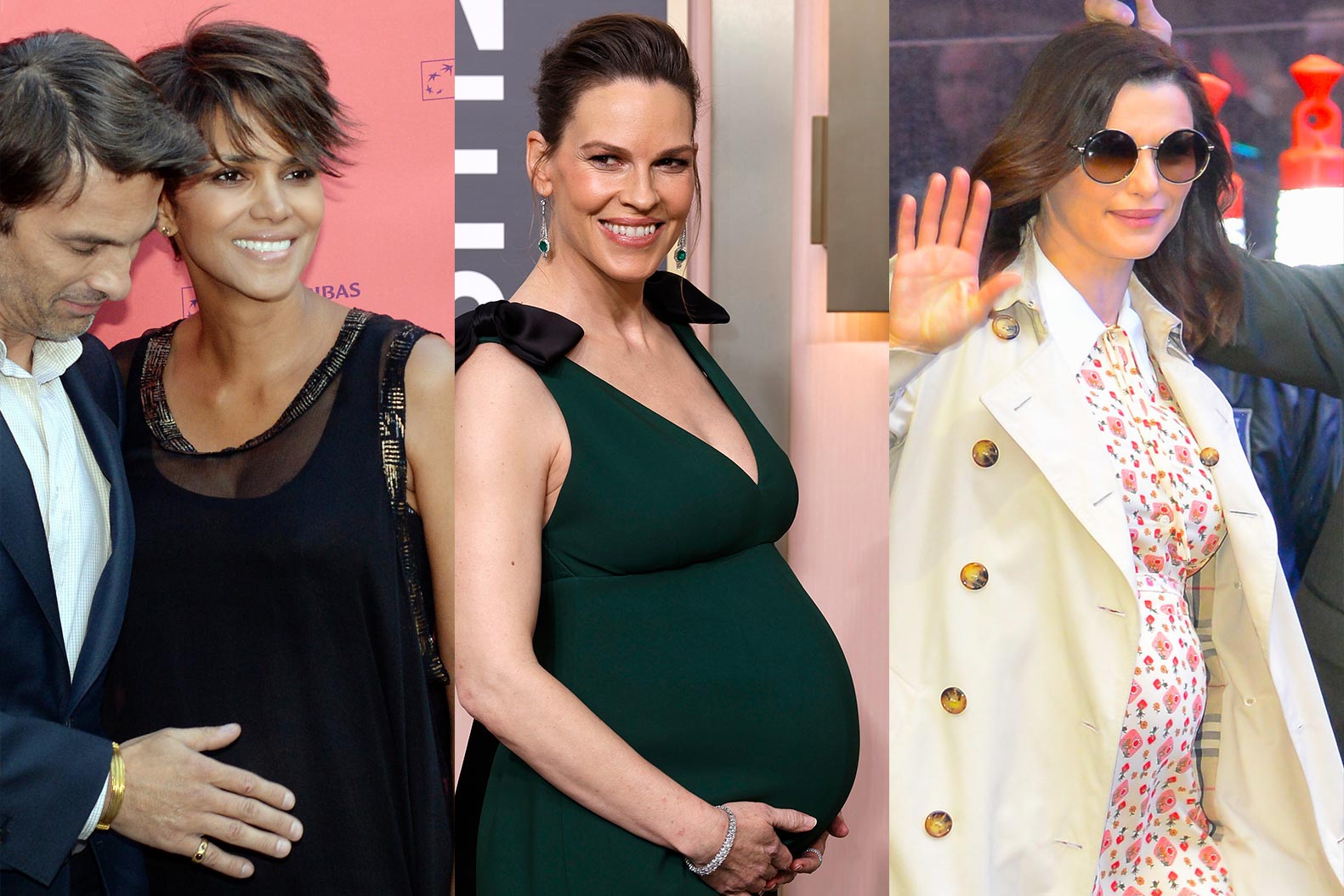
Recent years have yielded an A-list bumper crop of over-45 beauties bearing “miracle” children: Halle Berry was pregnant at 47. My generation’s It Girl, Chloë Sevigny, had at 45 what one assumes was the coolest baby ever. Then there was Rachel Weisz (48), Hilary Swank (48), Janet Jackson (50). The list goes on. Several fertility experts I spoke to were concerned that the high-profile pregnancies of older celebrities and social media portrayals of later-in-life parenthood were skewing the narrative and creating unrealistic expectations.
Most older women becoming new moms did not plan it this way. It took me around a decade to finally have my daughter, years packed with shooting up hormones in various office and restaurant bathrooms, endless disappointing calls with fertility doctors, an uncooperative uterus, and reexaminations of the lengths I was willing to go to have a child, et cetera ad nauseam (literally and figuratively).
Every one of the “mothers later” who I spoke to for this article had their own version of my story. None of us regretted what we did in the end. But as the reality for new moms in and beyond middle age comes into view, not everyone loves what they see.
At a spring event for solo mothers and aspiring solo mothers, I was just one among several Gen Xers and old millennials cheering when a woman in her late 40s proudly proclaimed she would be taking “all the drugs” at a party that evening. She had an upcoming embryo transfer that would (one hopes) curtail the use of illicit substances. I relished being among my brethren. Yes, our ranks are swelling, but we’re not exactly the norm. It takes some effort to find other older parents.
Natasha Dworkin, who lives north of Seattle on Whidbey Island, was casually dating an aerial acrobat when she got pregnant in 2018. “I was not expecting to have a child. It was a huge plot twist for me at 46 years old,” she said. “I did a lot of frantic, often late-night Googling, like: What do I know? Where are my people?”
Her search didn’t turn up much, which led her to found the Midlife Mamas Facebook group. “It feels like it’s hard to kind of plug in, because the frame is so different, the life phase is so different,” Dworkin said of other online spaces for moms.
She said nearly everyone in the Midlife Mamas group has been mistaken for their child’s grandmother, and that they share memes with potential responses to this question (“Nope, but he is a GRAND son” was one suggestion). Dworkin said this would definitely happen to me. (At an airport in Roanoke, Virginia, a few weeks after our conversation, I got my first “Are you the parent or the grandparent?”)
Dworkin said she was relieved to discover that her fears of being perceived as older, and therefore other, by parents in her orbit were largely in her head. “What I actually experienced is that a lot of moms who were even a lot younger than me, even in some cases young enough to be my children, were actually quite open and kind and didn’t seem at all to be judging me,” she said.
The physiological aspects of being older, however, are very real and hard to mitigate. Dworkin worries she doesn’t have the physical stamina she needs to run around with her son. Another mom summed up perimenopause and parenting—a common thread in many of these conversations—succinctly: “I have a 2-year-old, and I have hot flashes, and it sucks.” One mom had broken several bones because of osteoporosis.
I am very aware, as I throw myself on the floor multiple times a day to play with my toddler, that the accompanying physical twinges would not have been there 10 or 15 years earlier. Several months ago, I started doing strength training twice a week to maintain the muscle mass that so quickly depletes with age. A fervid commitment to health, for the kids, came up again and again.
I’ll be 60 when my daughter turns 13. While these days 60 is not exactly ancient, it’s perhaps a bit old to be managing that most volatile of all creatures, the human teenager. A few of the fertility experts I spoke to mentioned the difficulty of simultaneously navigating these two very different life stages: the one ostensibly serving as an entry into quieter years and the other, a raucous ramp-up to real life. I understand their concern. But will it really be more challenging than if I had raised a teen in my 40s while going full tilt on my career and riding the waves of perimenopause? It seems to me that I’ll have more bandwidth to deal with my kid’s emotional upheaval when I’m not handling my own.
Robin Gorman Newman, a Broadway producer who at 46 adopted her son, who is now 22, after years of fertility issues, said that in her experience, the most “challenging parenting time was when I would go through hormone changes at the same time as my son.” I’ll be safely through the menopause years by the time my daughter hits puberty, so I’ll take that as a win.
Newman called me out, in a nice way, for using the term “old moms,” which she felt carried judgment. Like Dworkin, Newman was driven by what she characterized as a “Where’s my peeps?” problem—verbiage befitting our age group—to found the online and in-person community Motherhood Later, a term I heard frequently and which she says she coined.
“There are so many reasons why people become later-in-life parents, and that really deserves to be honored and respected,” she said. “Nobody knows someone else’s story, right?”
Circa 2007, I was sipping Bud Light from an oversized Styrofoam cup in what could only generously be described as a park in Williamsburg, Brooklyn, when a pregnant acquaintance several years my senior plopped down next to me and declared that if I wanted to have kids, I had better freeze my eggs immediately.
I listened, but barely. At 30 years old, I was not in a place where I wanted to be thinking about my ovaries—not in life, and, more immediately, not on that patch of scraggly so-called grass next to our beer-league softball game. But later that evening, I let the idea rattle around a bit in my slightly alcohol-addled brain. Losing the shackles of my mercilessly aging ovaries, gaining true reproductive autonomy, was deeply appealing.
Then the years passed, as they tend to do. Like seven years. With 38 looming and no baby daddy in sight, I finally decided to consult a fertility doctor. She didn’t mince words: The results of my hormone tests were bad. Unpleasant visions of years of unsuccessful in vitro fertilization danced in my head.
I moved forward with egg freezing. During the process, hormones are used to stimulate the ovaries to produce multiple eggs, which are then retrieved in a minor surgery and cryogenically preserved. Each round of injections, monitoring, and retrieval is coordinated with your period and referred to as a cycle. I did one cycle—what I could afford, given the price tag, which can average up to $15,000 in the U.S. It produced one measly egg. I had waited too long.
The American Society for Reproductive Medicine removed the “experimental” label from egg freezing in 2012, and cycles had rocketed to nearly 40,000 by 2023, a 40 percent jump from just the previous year. Sara Arian, a reproductive endocrinologist at Boston IVF and the Harvard-affiliated Beth Israel Deaconess Medical Center, largely credits vitrification—flash freezing—with dramatically improved success rates. Scientists continue to optimize the cryoprotectants (think “antifreeze” that bathes the cells) to minimize the formation of ice crystals, while better storage methods also boost outcomes.
New techniques enable immature eggs that otherwise would be discarded to be matured in a lab and the cryopreservation of egg-containing ovarian tissue to be transplanted later to restore fertility, Arian said. Scientists are even developing an essentially 3D-printed ovary that may be able to produce viable eggs for women who have lost their ovarian function. But the process that’s largely responsible for creating middle-aged new moms—including me—is egg and embryo donation. Before I got there, I spent years working through other options.
I was on the verge of 40 when I started actually trying to have a baby. There was nary a daddy on the horizon. A sperm donor, at around $1,000 a vial, would have to do.
I had several unsuccessful intrauterine insemination attempts before I was ushered into the IVF side of things, which can range between $15,000 and $30,000 per cycle on average if you pay out of pocket. My bathroom was a DIY drug lab for months, with bottles of various hormones strewn all over. The cycles all failed. Then, a couple of months before my 41st birthday, we cashed in my lottery ticket, the one frozen egg. It did not take.
Adoption was Plan C for me, because I wanted to experience pregnancy. I also knew that as a single, older would-be mother, it would be very difficult to find people willing to adopt to me, a concern shared by other solo moms I spoke to. If I wanted to carry my baby myself, I was told my next stop was using donor eggs or embryos.
In 2023, more than 22,000 embryos made from donated eggs were transferred, an increase of more than 25 percent over a decade. The process is what allows the overwhelming number of women 45 and up to get pregnant. As Woodward put it, “your kid will not be the only one in that elementary school who was born through donor eggs or donor sperm or donor embryos or gestational carrier.”
Unfortunately, the aforementioned celebrities who make headlines with later-in-life pregnancies do not disclose whether donors were used, as many fertility doctors suspect is often the case. They characterize that omission as a huge disservice that often leads to unnecessary shock, fury, and grieving when women in their 40s learn their eggs aren’t viable.
The costs of egg donation can easily go above $60,000 for the whole donation-to-transfer process, and the procedure comes with its own big bundle of thorny ethical questions. Most prominent are those pertaining to IVF generally—namely, the bitter fight over whether embryos and fetuses should be accorded the legal rights of people. One mom said of a remaining embryo in storage, “I need to do something about it, especially before anything political makes it more difficult for me.” Other concerns revolve around creating a market for human genetic material, being able to cherry-pick the attributes of offspring, balancing a donor’s right to privacy with a child’s right to know their genetic history, and a lack of regulation of the fertility industry, among myriad others.
Those pursuing the donor route can go to an egg bank—and a sperm bank, too, if necessary—to get the genetic material to create embryos, or they can “adopt” donor embryos through various official and unofficial networks. IVF cycles often create multiple embryos, and some people choose to give away the ones they don’t plan to use. Unlike eggs and sperm, embryos cannot be sold, though the donors often get some compensation in the form of expense reimbursement.
A couple of my friends flinched when I explained that I would be using donor eggs. But I’d known a family back in the ’90s who had done it, when the procedure was still new, and other friends of mine were exploring the option. I kept revisiting the notion that my baby would not have my genes, sure that there was some mourning to be done, but truthfully, I never felt any great anguish around it. This is understandably not the case for everyone—Jennifer Aniston did not deserve the recent blowback she got for explaining that she did not pursue adoption because “I want my own DNA in a little person.”
Mandi LeBlanc and Lindsay Gold, two moms who each struggled with infertility for years, ultimately had successful pregnancies using donor embryos. “There’s a lot of coming to terms with it,” LeBlanc said, adding that at the end of the day, all that mattered was having a child, which she finally did at 42. “Honestly, I would never do anything different. He’s my son.”
Gold said she and her husband needed to get off the reproduction roller coaster they had been on with her own eggs. “It is such a business of hope,” she said. “You know, ‘There’s always a chance,’ right?” They eventually transferred a donated embryo that split, and in December, she delivered twins at 47. “I have two perfect, identical baby girls right now,” she told me as she was cradling one of her daughters, who was home from day care with a fever.
Kelly Kall’s arduous fertility journey began unexpectedly at 39, thanks to a gift of egg freezing from her celebrity boss, Alyssa Milano. She managed to freeze one egg before her treatment for ovarian cancer, but later developed uterine cancer, requiring a hysterectomy. Her single egg failed to create a viable embryo, but she received donated embryos from a same-sex celebrity couple who used an anonymous egg donor, and had her daughter, Emily, via surrogate when she was 47.
In December 2022, I was sicker than I’d ever been, spending nearly two weeks in the hospital with a postsurgical infection after my third operation in two years to remove fibroids so I could get pregnant. When I Googled “abdominal abscess mortality rate,” the search results estimated 10 to 40 percent. I didn’t bother verifying this with my doctor, preferring to live in oblivion. (My relative youth, lack of comorbidities, and other factors augured much better odds than I had ascertained at the time.) My main concern was when I could get back to trying to have a baby.
Weirdly, after that debacle, things began to progress both smoothly and quickly for the first time on my fertility ride. The following September, at 47, I did an embryo transfer. It worked.
I want to be completely clear about what all this cost: well over $100,000. It required withdrawing a sizable chunk of my retirement. Without insurance, I probably would have spent triple the amount.
Being financially stable and the high costs of IVF came up in my interviews again and again. Ndidiamaka Amutah-Onukagha, the director of the Center for Black Maternal Health and Reproductive Justice at Tufts University, said that the fact that most users of IVF are white women isn’t all about the inequitable distribution of wealth. Black and brown women face structural barriers in fertility care through delayed referrals, inadequate counseling, and limited access to specialty providers—patterns mirrored in other areas like breast cancer, for which Black women are more likely to receive later diagnoses.
During our interview, Amutah-Onukagha, who is in her mid-40s, mentioned that she had young children. Asked why she, too, delayed motherhood, she cited her career and meeting her husband later. A familiar story.
Beyond the relative financial security of older age are other advantages. All of the mothers I spoke to believed that they were better parents for the additional life experience they’ve had, and for the confidence and grounding they had gained in the decades before they had children.
“I’m much more emotionally stable and mature, much more patient than I think if I’d done it when I was younger,” a mom told me, recounting being able to be even-keeled and draw on her own experience as she talked her son through a difficult situation involving someone at school who seemed not to like him.
The benefits of living a “don’t sweat the small stuff” life were enormous for their kids, the moms said, as was their feeling that they were more present in the moment than their younger selves would have been. “I did all my traveling, partying, you know, boozy brunches,” Gold said. “I have had a really full, wonderful life, and career-wise, I got to a place that I wanted to get to.”
Like Gold—like me—these moms had prioritized dreams, careers, financial health, and, in many cases, finding a partner. I was a bit of a late bloomer and did not find a fulfilling professional path until my early 30s. (Jury’s still out on whether romance will bloom.) I loved work and was happy to make it most of my world. I can’t see how a kid would have fit into the picture. The trade-offs for them and for me would have been too great. The stage was set for me to be an old mom. Just how old, though, I did not realize.
Facebook—aware, of course, of my status as a super old new mom—serves up what it thinks is relevant content, including, recently, a “before” picture showing a very pregnant, very fit woman in a bathing suit, followed by an “after” image of her in the same suit holding her daughter; “49 and happy with my 2-year-old,” read the text superimposed on top.
I lazily scanned some of the comments and came across one from Karen Jorgenson Moon, who wrote that as a child of older parents, she had been an orphan for 20 years. “It’s a pain I wish I didn’t know. People need to understand the other side of this equation,” she wrote.
The ethics report from the ASRM, the industry group for the fertility field, is meant to guide practitioners on considerations when treating older prospective parents. (It’s worth mentioning that the report equally addresses male-related concerns around reproductive age, which are only now getting the broader attention they deserve, infertility experts said.)
The medical risks outlined include increased likelihood of stillbirths, as well as various serious genetic mutations. The report cites the potential for lower intelligence, behavioral issues, and schizophrenia, among so many other issues. There are seemingly endless ways things can go wrong when either old sperm or old eggs are in the picture.
But take those aged genes out of the frame, and you still have a big problem. The psychological impacts on the children of older parents can be dire and must be considered, the report says. Woodward paraphrased someone with older parents who said it was important to think of the inverse of “When do I feel ready to become a parent?,” which is, “When is my child ready to be an orphan?”
Jorgenson Moon, now 50 and living in Houston, lost her father to cancer when she was 15 and her mother when she was 33. Born almost two decades after her siblings, she felt isolated and misunderstood by her parents.
“Everybody else’s parents were so young, and were doing all the fun things with them,” she recalled, saying that the multigenerational gap was profound and her parents had strict, outdated rules. She said they were often mistaken for grandparents—as noted and experienced, not an uncommon problem—leading kids to make fun of her.
There’s a lot of mortality math involved in being an older parent. I will be 66 when my daughter goes to college, if she goes directly after high school. If she has a kid at 34, I will be 82 or maybe dead. I will almost certainly be dead when she’s my age. These calculations whir in my brain in the darkest hours of the night.
Moms perhaps more mentally fit than I point to the randomness of health and say it’s pointless to put energy toward this worry. “Nobody has a crystal ball,” Newman, the Broadway producer, told me. “No one knows how anyone’s life is going to go.”
ASRM does not provide an age cutoff for treatment in its ethics report, but many fertility clinics avoid attempting egg retrievals on women over 45 and decline to transfer embryos into women over 54.
Sigal Klipstein, a Chicago-based reproductive endocrinologist and chair of ASRM’s Ethics Committee, pointed out that the new report included an actuarial table with the likelihood of children losing a parent before 18, the somewhat “arbitrary” age at which we say adulthood starts. She said understanding the statistics around mortality rates was important when making choices about becoming a parent at an older age.
“That’s really powerful, because as I’m counseling people, I can say, ‘Look, the risk is not super high, but you need to be aware it,’ ” Klipstein said, before offering the counterargument that plenty of young people are not super healthy themselves, and, when it comes to longevity, you just never really know.
“What’s important is to have a loving parent, right?” she said.
I sent my sister an email the evening before my planned C-section in May 2024 with the subject line, “Just in case (do not read unless things go wrong).” I was extremely freaked out. I had, unfortunately, stumbled upon an article in this publication about a 45-year-old emergency room doctor who almost died during her C-section. The article mentioned that the maternal mortality rate for women 40 and over is nearly eight times that of women under 25.
The C-section went fine. I lived. The baby, in my eyes, was perfection personified.
I cried my way—silently, because, you know, professionalism—through most of the interviews I did with the other mothers who had babies later. There was so, so much loss. But it was the joy that brought the tears, that resonated so deeply it was almost painful.
The words were almost trite, iterations of phrases like “I’ve never been so happy,” “This all feels right,” “I’m in the life I was meant to be in.” It was the freight of the years behind them, the genuine flabbergastedness of finding this love, the pure glee, that made them magic.
Yes, my daughter will be filling out college applications while I labor over Medicare forms, but she can use my wisdom, and I can use her 20/20 vision. What a team we are, what a team we will be.