Sign up for the Slatest to get the most insightful analysis, criticism, and advice out there, delivered to your inbox daily.
When the negotiations succeeded and the fighting ended, everyone here thanked Donald Trump for stopping the war. They thought he was a man of good intentions who cared about the Palestinians and respected our right to remain in our land, free from war. However, Trump’s escalating statements that he plans to displace the people of the Gaza Strip yet again are not only threatening the fragile peace we have finally achieved but demeaning the people for whom this land means so much. In a press conference on Tuesday with Israeli Prime Minister Benjamin Netanyahu, Trump called Gaza a “hellhole,” said that all 2 million Palestinians here should leave our home, and stated that the United States should take it over to turn it into “the Riviera of the Middle East.”
The anger and desperation Palestinians are feeling now is impossible to convey. Trump’s proposed solution—if one could even call it that—is that Jordan and Egypt take in the people of Gaza while it is rebuilt into an “international city” with people from “all over the world” coming to live there. The leaders of Egypt, Jordan, and Saudi Arabia are strongly rejecting the idea. Thousands of Egyptians took to the streets in demonstrations to reject these plans. Seemingly everyone agrees that this is not a sane or just solution to Palestinian displacement and that it only threatens what it will take to bring about lasting peace. Everyone, it seems, except for Trump.
For 15 months we waited for the end of the war and the return of the displaced to the north of Gaza. With the region in ruins from Israel’s bombing campaign, the world may be surprised that the people of Gaza insist on returning. Why would we want to go back to what Trump has called “a massive demolition site” and “a pile of rubble”?
I am a refugee, even in the south of Gaza, where I live. My ancestors were born in a town inside the occupied territories, in the lands of 1948 that are now Israel.
In 1948 the Israeli army forced the Palestinians to leave their lands; some of them went outside Palestine, and others went to the Gaza Strip. My ancestors were among the Palestinians who were displaced to the Gaza Strip. As a journalist, I cover the Nakba anniversary every year. My first source for that difficult experience was my grandfather, my mother’s father. I used to go to him in mid-May every year so that he could tell me his story. It is my story too.
I lived in a refugee camp west of Khan Yunis. Throughout my life, people have asked me if I am a refugee or if I am from the Gaza Strip. I tell them that I am a refugee and that my town is Beit Daras, which was occupied by Israel. But the younger generations like mine did not experience the forced migration of 1948—and did not feel it for ourselves until after Oct. 7. Now we know with painful clarity what it is to be wrenched from our homes.
One of the most difficult things in war is displacement—to leave your home, your land, and your safety and go to the unknown. The number of displaced people from the northern Gaza Strip is massive; according to the U.N., 1.9 million people were displaced, 90 percent of the population, beginning in October 2023. What our ancestors had lived, we were now living. The pain only increased after seeing the placement of tents for the displaced. My grandfather had told me about this scene. Our ancestors lived it, and now we were living it too—in the 21st century, in the era of democracy, humanity, human rights institutions, and technological development. The tents collapsed all those concepts.
During the war, I used to call my colleagues and friends who were displaced from the north, crying bitterly over this painful experience and wondering if there was any hope of return. We all listened with dread to the Israeli army’s statements and politicians’ plans that were announced on the news from time to time to divide the Gaza Strip in two, and prevent the people of the north from ever returning, in preparation for Israel’s occupying the northern Gaza Strip. These fears controlled us all. We wanted Gaza to be free, we wanted to return to our homes, but the recurring question, month after month, was when? We were terrified, but we were determined and patient in the face of this torture. We believed that the war would have an end, and it would end with the return of the people of the north.
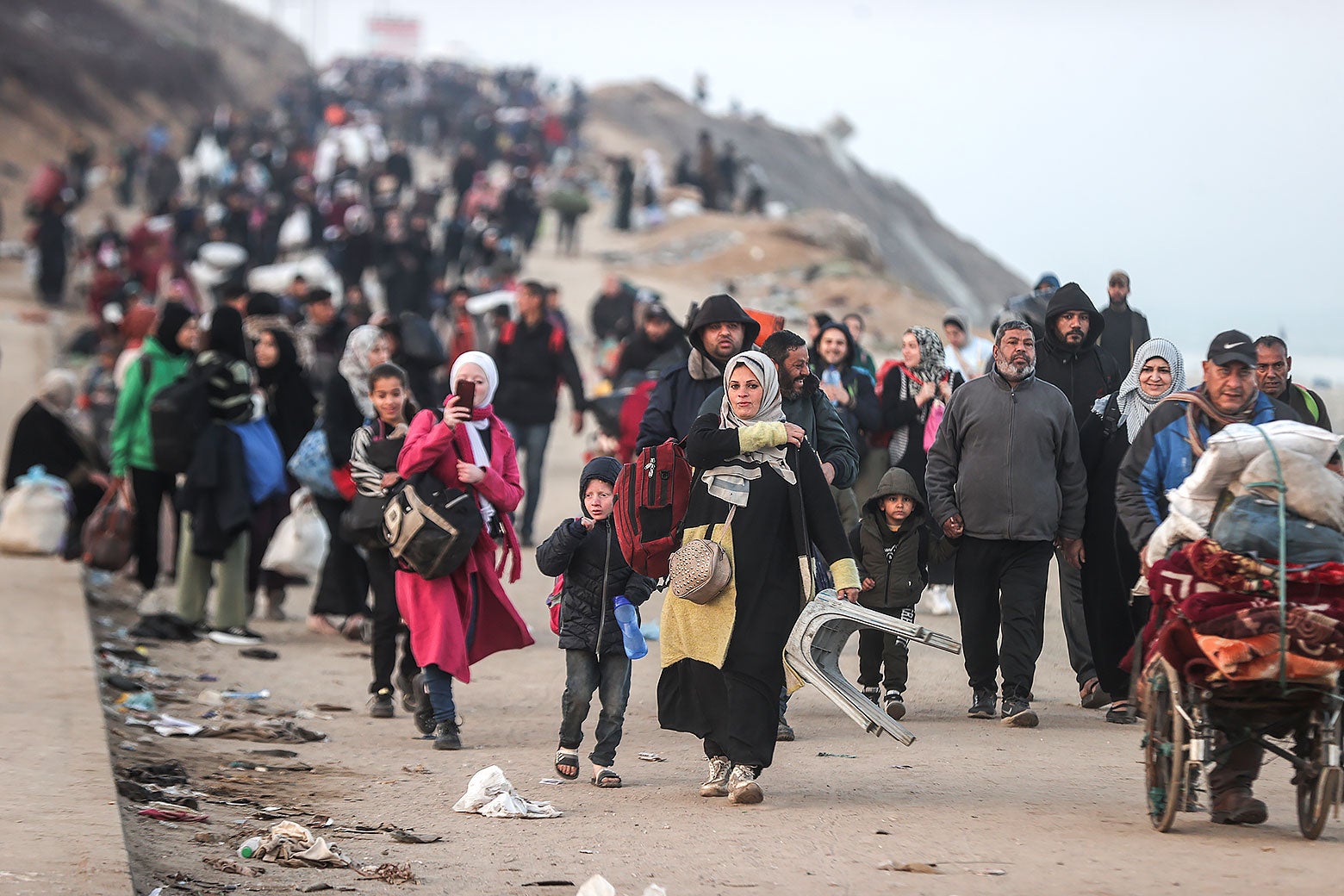
So the success of the negotiations to stop the war, the agreement on Jan. 19, brought us back to life again. On Sunday, Jan. 26, the people of the north were supposed to start returning to their homes and land. But the Israeli army refused to leave. Hundreds of thousands waited in the cold and in the streets, clinging to the wish and the rights that were denied their ancestors. The next day, finally, a joyous crowd of people streamed back to their homes. They had traveled on foot for many hours. The scenes of rubble were painful, but the hearts of the people of the north were reassured when they passed the Netzarim axis, where the army had established a military base and was planning to occupy it. The pictures that came out and are still coming out of the return are so remarkable; they have amazed the world.
So how can these people return to the rubble? How can they celebrate, sing, and cheer for a return to such demolition? Because it is their home. Yes, there is great destruction there. But the people of the north reclaimed what was left of it and sat in what was theirs, instead of inside tents amid the difficult conditions of refugee camps.
Trump is suggesting, ridiculously, that displacement is necessary to rebuild Gaza. The people of Gaza are already rebuilding their homes, and though we would welcome international assistance, we do not need to be displaced to complete the work. If Trump is trying to show his sympathy for the Palestinians in Gaza—he said Tuesday that if we are displaced, “the people will be able to live in comfort and peace and … we’ll make sure something really spectacular is done. They’re going to have peace. They’re not going to be shot at and killed and destroyed like this civilization of wonderful people has had to endure”—he would do better to prevent those wars by finding a solution to this Palestinian–Israeli conflict that has been going on for decades. He campaigned on a slogan of “no new wars,” and if he sees himself as a man of peace, let him work to spread it in a fair way—not in a forced way that he imposes on the Palestinians. The scenes of the people of the north returning to their destroyed homes and the lives that were destroyed by Israeli planes and tanks should make him certain of the Palestinians’ loyalty to their land and country, even if he doesn’t know how to respect that.
