Sign up for the Slatest to get the most insightful analysis, criticism, and advice out there, delivered to your inbox daily.
The Trump administration claims the conflict in Iran has degraded the Islamic republic’s capacity to wage war. It has also damaged the political brands of several top administration officials.
Vice President J.D. Vance, who used to laud Donald Trump for not starting new wars, supports this one in public despite reportedly doubting it in private. Defense Secretary Pete Hegseth appears to have lied about a dead U.S. soldier’s father, gleefully cheers on Trump pronouncements that could amount to war crimes, and seems to be getting set up as the fall guy if the war ends badly. Director of National Intelligence Tulsi Gabbard, another longtime dove who may also be at risk of losing her job, got raked over the coals by members of Congress and onetime allies for backing the president’s dubious claim that Iran presented an imminent threat. Energy Secretary Chris Wright sent oil markets reeling after he falsely claimed on X that U.S. Navy ships had escorted a tanker through the bottlenecked Strait of Hormuz. (A department spokesperson blamed staff for the erroneous post, which was quickly deleted.) And of course the president himself has caught flak from some prominent MAGA influencers as his approval ratings tumble.
But there is one prominent member of the Trump administration whose stock has been rising: Secretary of State Marco Rubio. Rubio, Trump’s only second-term cabinet nominee to earn unanimous Senate approval and America’s first Latino secretary of state, has been deeply involved with some of the administration’s biggest initiatives, from freezing foreign aid to negotiations over the wars in Gaza and Ukraine. Besides helming the State Department, the secretary has temporarily served as interim national security adviser, acting USAID administrator, and acting head of the National Archives. (All that hat-wearing has yielded a meme: A photo of a glum-looking Rubio photoshopped to match open roles he might hypothetically occupy, from president of Venezuela to former Homeland Security Secretary Kristi Noem’s husband.)
Trump, who kneecapped the then–Florida senator as “little Marco” when they were rivals for the 2016 Republican presidential nomination, has also warmed to him. After bragging during his State of the Union address about the U.S. raid that captured Venezuela’s leader and his efforts to negotiate peace deals around the world, Trump shared some of the credit with Rubio. “People like you!” the president exclaimed, sounding almost surprised as lawmakers cheered and applauded. “Great secretary of state. I think he’ll go down as the best ever.” And since the war began, even some of Trump’s staunchest supporters appear palpably relieved to have Rubio in the administration. “Just put this on TV tonight,” the conservative podcaster Stephen L. Miller tweeted about a video of Rubio explaining the rationale behind the U.S. attack ahead of Trump’s prime-time speech last week. (Indeed, instead, the speech ended up being a lethargic, lie-filled affair that caused stock futures to fall and oil prices to spike.) Sohrab Ahmari, a right-wing pundit who has harshly criticized the war, recently called Rubio “a competent adult in the room in an administration starved for them.”
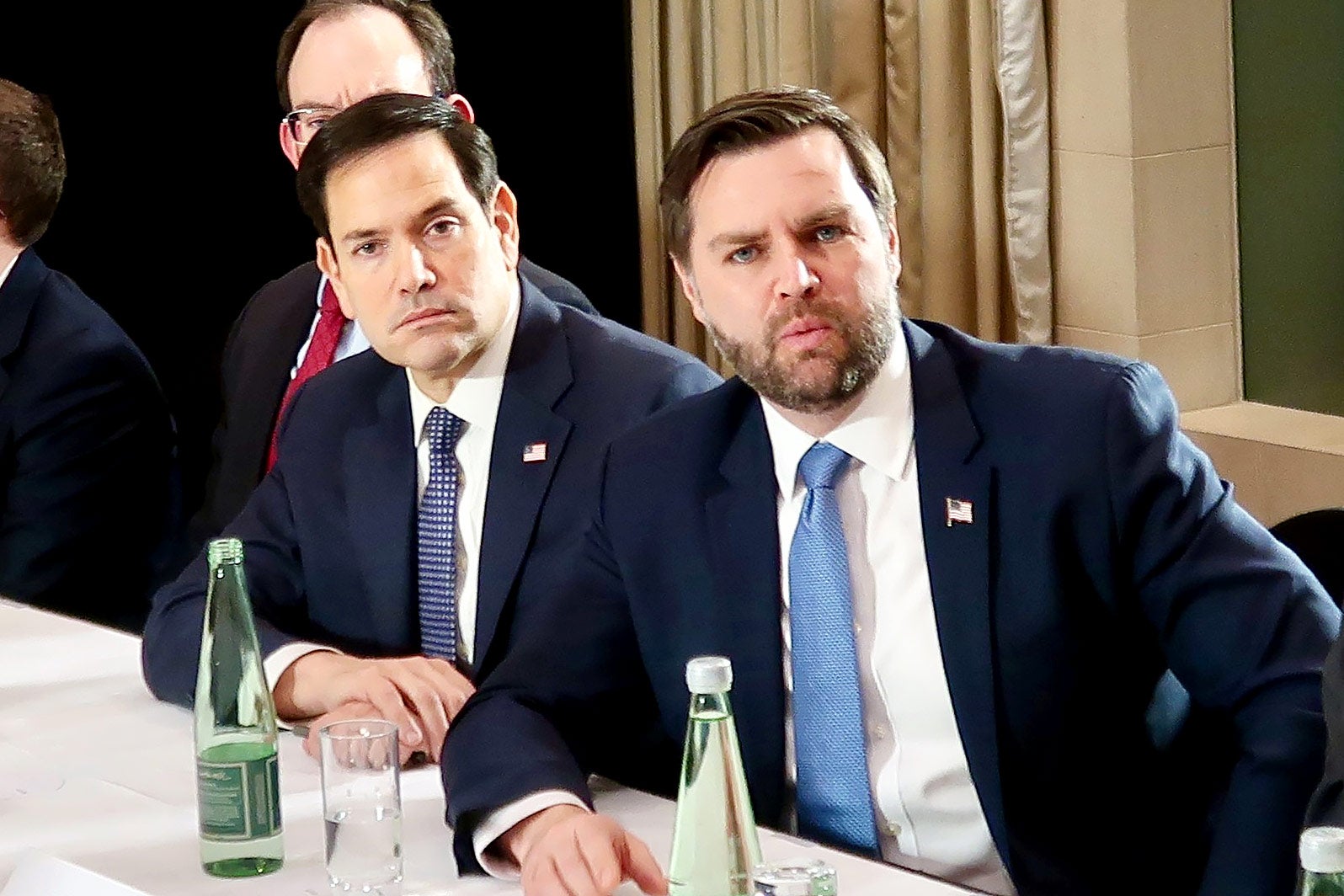
The good feelings have set off a boomlet of speculation that Rubio might mount another bid for president in 2028. Polls of a hypothetical GOP primary find him trailing Vance, but the gulf may be shrinking: Rubio earned 35 percent of the vote in a straw poll of people who attended last month’s Conservative Political Action Conference, up from just 3 percent last year; Vance’s share, meanwhile, fell from 61 percent then to 53 percent this time. On prediction markets like Polymarket and Kalshi, Rubio’s chances of becoming the Republican nominee have shot up, a sign that at least some political observers are willing to stake some skin on his prospects. Rubio’s odds rose in January after the Venezuela raid and again after Iran, while Vance’s have steadily eroded (though they remain higher). Even Trump seems to be newly Rubio-curious, reportedly asking advisers and donors whom they like better.
Rubio has said publicly that Vance will be the party’s next nominee if he chooses to run, “and I’ll be one of the first people to support him.” But plans can change. And if Rubio did run, he’d join a tradition of secretaries of state who have sought the top job. The country’s first, Thomas Jefferson, used the office as a launchpad to get elected vice president and then president. Five other secretaries of state later followed Jefferson into the White House. But what started as a robust pipeline to the presidency has gotten pretty anemic since then. Despite several additional attempts, it’s been 170 years since a secretary of state won a presidential election. In fact, since the advent of the modern primary system in the 1970s, more politicians have parlayed a failed presidential campaign into the job of secretary of state than have mounted a successful White House bid after serving as America’s top diplomat. Rubio should know—he’s one of them.
Some of the reasons secretaries of state have made poor presidential candidates of late are structural. The office used to be one of the few perches prominent enough to attract national attention. These days, being a limelight-seeking senator, swing-state governor, or New York City real estate developer who used to host a reality TV show can do the trick. As U.S. foreign policy became more professionalized, some historians have argued, the role of overseeing and executing it became a better fit for capable administrators than aspiring presidents. Today, Americans generally favor presidential candidates with track records of winning votes, not just flattering foreign diplomats.
But other reasons for the shift highlight real vulnerabilities should Rubio run. U.S. foreign policy has had a mixed record in recent decades, to say the least, and several politically ambitious secretaries have ended up tainted by association. The 1988 presidential campaign of Alexander Haig, a former four-star general who served as Ronald Reagan’s first secretary of state, flamed out amid GOP infighting over the Iran–Contra affair. Colin Powell, another military man who filled the role under George W. Bush and whose name was often bandied about as a possible presidential candidate, never fully lived down having sold the world false claims about weapons of mass destruction in Iraq. Hillary Clinton, Barack Obama’s first secretary of state, spent chunks of her 2016 campaign fending off GOP criticism over the deadly terror attack in Benghazi or caught between Bernie Sanders–supporting progressives and the Obama administration over a Pacific trade deal. If secretaries of state often shoulder the baggage of the presidents they serve, Rubio may yet become the face of an increasingly unpopular war, the thus-far-unsuccessful attempts to broker peace between Russia and Ukraine, or the uncertain efforts at regime change in Venezuela and Cuba.
Still, as the top Cabinet official in the presidential line of succession after the VP, secretaries of state are often ambitious pols who bring baggage all their own. Clinton may be the ur-example: Her popularity surged during her tenure as secretary of state but fell once she stepped back into the political arena. Unlike Henry Kissinger, Madeleine Albright, and other past secretaries who were popular in office, recent polls suggest Rubio is underwater with the public (even if he appears better situated than Trump, Vance, or Hegseth). Rubio has also made missteps. His much-lampooned lunge for a water bottle in 2013 set the standard for what not to do in a State of the Union response speech (even Trump once mocked him for it). More recently, Rubio made a mess for the administration when he told reporters that Trump had decided to attack Iran because of Israel, comments he quickly tried to walk back.
Since his first run for president, Rubio has started to sound more like his boss. He helped dismantle USAID last year despite previously calling foreign aid “a very cost-effective way not only to export our values and our example, but to advance our security and our economic interests.” He parrots Trump’s criticisms of NATO even though as a senator he sponsored a law that prevents presidents from unilaterally leaving the alliance. But trying to succeed Trump—who remains a kingmaker despite being an unpopular, term-limited lame duck—is fraught with risk, something one of his previous secretaries of state learned the hard way. Mike Pompeo, who took the role partway through Trump’s first term, also followed in his boss’s footsteps, praising dictators, clashing with journalists, and echoing false stolen-election claims. In 2020, the Los Angeles Times dubbed Pompeo “Trump’s most Trumpy Cabinet secretary.” But after gently distancing himself from the ex-president (“I think Americans are thirsting for people making arguments, not just tweets”), Pompeo opted not to run in 2024. He reportedly angled to join Trump’s second administration only to be rebuffed after getting crosswise with Donald Trump Jr. and Tucker Carlson.
All that said, don’t count Rubio out. Despite his recent affect, the secretary may be banking on a reversion to a more normal style of politics once Trump passes from the scene. Where Vance has lunged rightward, indulging in far-right memery and lib-owning, Rubio seems to have tried to maintain the more statesmanlike bearing that Americans used to expect of presidential candidates. When Trump praised Rubio during his State of the Union, the secretary mouthed “thank you,” placed a hand on his heart, and briefly stood to acknowledge the applause before ducking back into his seat. If a faltering economy or Middle East quagmire has taken the shine off MAGA come 2028, Rubio’s links to the pre-Trump GOP—Time magazine called him “The Republican Savior” more than a decade ago—could turn out to be an asset. Navigating that kind of rupture would take poise, flexibility, and tact. And Rubio is, after all, a diplomat.