Sign up for the Slatest to get the most insightful analysis, criticism, and advice out there, delivered to your inbox daily.
When I was 18, I fell asleep in bumper-to-bumper traffic and ran into the car in front of me. You might think that would have stopped me from driving while tired again, but in the decade since, I’ve found myself fighting sleepiness on the road more often than I’d like to admit. I’ve become well practiced at the crank-up-the-AC-and-music routine. More than once, I’ve pulled over in sketchy lots alongside the highway to take an emergency nap.
For a long time, being tired while driving felt inevitable: I was always tired, so I did everything tired, so of course I would be tired while driving. It wasn’t until last winter, when I went to a sleep specialist, that I realized my error. As the doctor was leaving the appointment, he turned and said something that, in hindsight, should have been obvious: As long as I was so sleepy, I should not be on the road. Period.
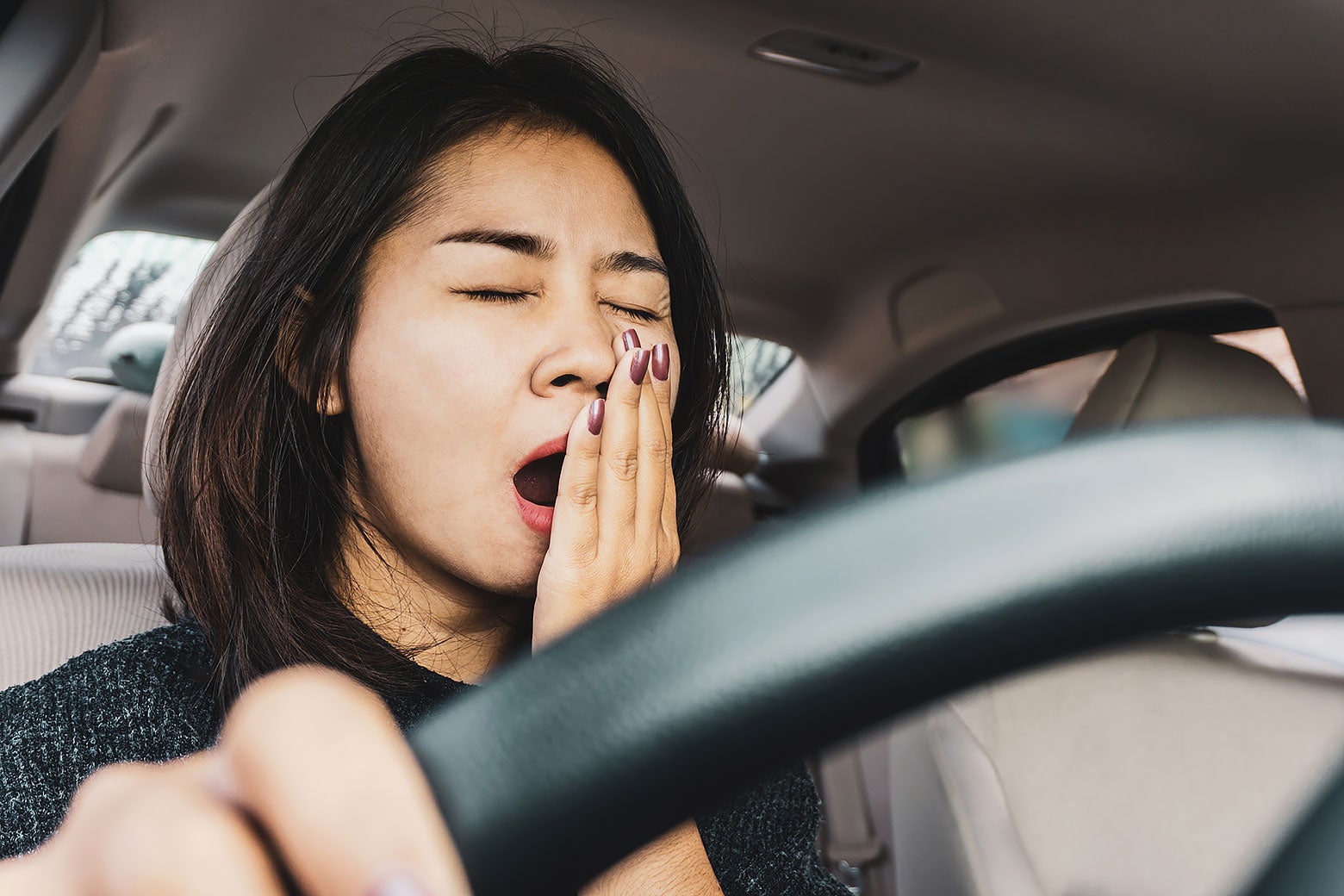
Drowsy driving isn’t just the act of nodding off at the wheel. Even if you think you’re alert enough to drive, sleep deprivation can impair your abilities without you even realizing it. Reports say that nearly 1 in 5 fatal crashes in the U.S. involves a drowsy driver, resulting in roughly 6,000 preventable deaths a year. That’s about half the number of fatalities caused by drunk-driving crashes. Driving after 17 to 19 hours without sleep—a pretty standard period of wakefulness, mind you!—increases a driver’s crash risk as much as a blood-alcohol content of 0.05. (The legal limit in most states is 0.08, though impairment is already significant before that.) But there’s no similarly straightforward metric for drowsiness, which makes it difficult for traffic safety enforcers and drivers alike to determine a fatigue cutoff.
Despite the substantial harm caused by drowsy driving, “it’s still culturally accepted, which is a problem,” says Joseph Dzierzewski, senior vice president of research at the National Sleep Foundation. A recent survey suggests that nearly three-quarters of Americans experience regular daytime sleepiness, while in polls, some 40 to 60 percent of Americans admit to driving while tired. Teens, who require more sleep and whose biological clocks tend to be a mismatch with school start times, are at higher risk of driving tired, as are parents, especially those with several kids. Perhaps it’s our fierce familiarity with fatigue that makes us more susceptible to ignoring the risk it poses on the road. As humans, “the more we do something and get away with it, the more we think it’s not a big deal,” Dzierzewski says. “But that’s not the way the odds work. They reset every time.”
Sleep loss affects a huge range of cognitive domains, explains Rachael Muck, a sleep researcher at Washington State University. But it’s the simple ones, known as vigilant attention and attentional control, that affect our driving abilities. We need the former to respond quickly to an event, like a deer running out into the road. The latter is responsible for, say, successfully navigating a complex intersection as the honker to your left and the merger on your right vie for your attention. When we’re sleep-deprived, our brains react more slowly, explains Muck. We also become worse at task switching, an important ability in that intersection. And we become less able to anticipate outcomes—information needed when making quick yet major decisions on the road.
But alarmingly, sleep researchers have found that people are extremely bad at knowing whether they’re tired. In one simulation study run by the AAA Foundation for Traffic Safety, 75 percent of drivers reported a low drowsiness level when videos of their eyes revealed that they were actually moderately or severely drowsy—and thus still at risk of impaired driving. Chronic sleep deprivation in particular can make tiredness less noticeable over time. Many people who function day to day with fatigue might not even realize that they’re a risk on the road. “Our bodies are amazing at compensating,” says sleep physician Andrea Matsumura, “until they’re not.”
If you can’t trust your own judgment about your fatigue, how can you know if you’re safe to drive? Well, it’s difficult. But there are three factors that inform how likely you are to become impaired over time: how long you’ve been awake, how long you’ve been driving, and the time of day. Experts have concluded that if you’ve had less than two hours of sleep in the past 24 hours, you are “unequivocally unfit” to drive, says Dzierzewski. The majority of people are impaired with less than five hours of sleep and thus also should not drive. When you are behind the wheel, it’s important to take breaks every two or three hours to avoid monotony-induced fatigue. Time of day factors in because of our biological clocks; we’re sleepiest late at night and early in the morning. It might be tempting to drive at those times to beat traffic, but it will increase your crash risk.
With these three factors, it’s possible to predict the likelihood of an accident, says sleep researcher Hans P.A. Van Dongen, also at Washington State University. Apps are currently in development, he says, that could someday project your risk and allow you to plan accordingly. Until then, the tech in your car might be able to help. Increasingly, new cars are built to detect deviations from the lane or physiological markers of drowsiness—such as eyelid drooping—then alert drivers that it’s time for them to get off the road. The trick in this ongoing area of research is getting the sensors to be accurate, reliable, and trusted by the driver.
Truly fixing the drowsy-driving problem will require a cultural shift around sleep, many of the experts tell me. “We pride ourselves on getting less sleep,” says Matsumura. “We have phrases in our society like ‘I’ll sleep when I’m dead.’ ” In recent years, there’s been growing awareness about the importance of sleep for individual health—that not getting enough sleep could very well hasten us toward death, thanks to any number of chronic medical conditions. Still lagging, Matsumura says, is the realization that chronic sleep deprivation is a public health issue too.
That will require change at the systemic level. Legislation could help to penalize drowsy driving—the only form of legal impaired driving—though enforcement would be difficult. (If a police officer pulls you over for suspected sleepiness, that will quickly wake you up, points out road safety engineer Federico Orsini. “Just imagine the adrenaline!”) That route also risks punishing some of our essential workers and most vulnerable groups, who are more likely to drive sleepy: doctors and nurses, parents and teens, shift workers, people with multiple jobs. Ideally, these groups would receive avenues to prioritize healthy sleep, says Jacob Nelson, the director of traffic safety advocacy and research for AAA.
But it’s also up to individuals to recognize the dangers and opt to prioritize sleep, says sleep physician James Rowley. When I ask about people who simply don’t have time to get the minimum seven hours of sleep recommended by experts, he pushes back. “I really think people can,” he says. “They just have to change a few priorities.”
That might require changing some assumptions too. Like, just because you weren’t able to get seven hours of sleep at night doesn’t mean you can’t catch up during the day, says Nelson. Naps are powerful things: During a long road trip, build in time to visit rest stops, not just to relieve yourself but to take a 20-minute nap. (Then make sure to shake off the grogginess, or “sleep inertia,” before you drive again.) While caffeine is considered helpful for alertness, evidence suggests you shouldn’t rely on your tunes to keep you awake. A recent study found that music—especially if it’s higher tempo and “more danceable”—does have an immediate effect on monotony-induced fatigue but that the effect wanes after 15 to 25 minutes. The concerning finding here: Drivers didn’t realize that they were becoming drowsy again, even though physiological changes demonstrated that they were.
That’s why these sorts of alertness tricks should be used with caution. If you’re needing these interventions, says Van Dongen, you probably shouldn’t be on the road. You really just need to sleep.
In my case, I was getting enough sleep, which is why I went to a sleep doctor. Turns out I have obstructive sleep apnea—which more than doubles crash risk if not treated. While I’m now treating that disorder, I won’t be making the same mistakes I’ve made in the past if life gets in the way of a good night’s rest. In particular, I want to get more comfortable with making other plans: securing a designated driver, staying at a friend’s house, calling an Uber. We do this all the time if we know we’ll be drinking. It feels a bit like overkill if you’re just a little sleepy.
But that’s exactly where the shift needs to happen, because just a little sleepiness can kill. At the end of the day, “dying in a car crash is the same level of death,” says Dzierzewski, “no matter if it’s because you weren’t alert enough to drive or you had too much to drink to drive. The end result is the same.”