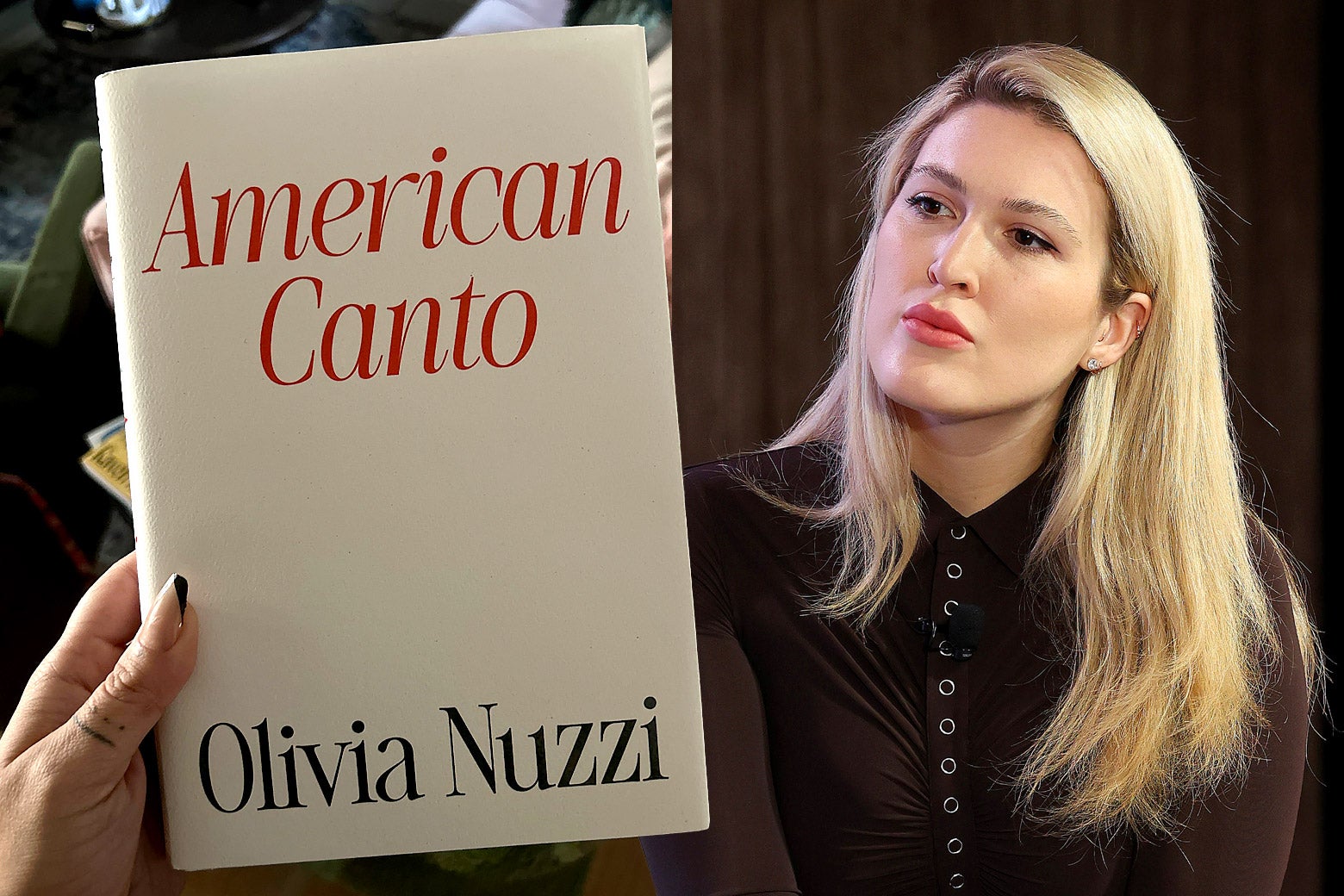
Are blond white women OK? I am, notoriously, brunette, but even I have started to notice that blond white women are in such varied states of disarray. This summer, Sydney Sweeney seemed to tank her career (and then doubled down) with a poorly placed denim ad that was, incredibly, about white supremacy. Meanwhile, Karoline Leavitt, the White House press secretary, can’t get her boss to stop talking about her hot, thin mouth while she ignores her nephew’s mother’s deportation. And today, Olivia Nuzzi’s greatly anticipated (at least, if you ask any other journalists about it; most of us are unemployed anyway) memoir, American Canto, finally arrived. Intended to reveal the truth behind headlines from last year, the book is purportedly about her affair with then–presidential candidate and now head of the U.S. Department of Health and Human Services Robert F. Kennedy Jr. In reality, it’s mostly about how compelling Nuzzi thinks it is to be a blond white woman in journalism.
Nuzzi is fixated on blondness, her own and others’, throughout American Canto. She writes about Marilyn Monroe and Britney Spears and Pamela Anderson, and wonders where her self-incrimination fits in as another blond woman misunderstood by our culture. She talks about her own looks at length, remarking on which public figures admired her features, while also saying she defied the odds to make it in journalism. Those odds remain unclear throughout the book, especially considering she’s a conventionally attractive white woman (she keeps reminding us!) who went to a good school and became a nationally successful political journalist with name recognition in and out of Washington by her mid-20s.
Her deep reflections into blondness extend even to the president. “If you do not count strawberry blondes or dirty blonde (a stretch, but I could make an argument), and if you do not count Gerald Ford (easier), Donald Trump is the first blonde president,” she writes, 24 pages into her first—and if God is hearing me, perhaps last—book. “Is it any wonder then that he can so easily fetishize his own victimization?”
The section ends with an Alfred Hitchcock quote: “Blondes make the best victims. They’re like virgin snow that shows up the bloody footprints.”
All this after one of the most overhyped rollouts in the recent history of media. After a year spent in self-imposed exile in Malibu, Nuzzi reentered public life as any shrewd media personality might: with a splashy and totally mortifying puff profile in the New York Times written by Nora Ephron and Carl Bernstein’s son (apt), complete with video of her driving her Mustang down the Pacific Coast Highway, and then in an excerpt of the memoir in Vanity Fair, where she’s an editor (for now), complete with a painted nude that she commissioned herself. Ah yes: another quintessential tragic blonde, this time rising from the ashes.
American Canto was the last real opportunity for Nuzzi to talk about what happened: tangibly, what she did to torpedo her career and personal life. It could have been a pulpy tell-all that explains how she fell in love with the worst Kennedy or a political book opening up her reporter’s notebook to share from a vantage point few people ever reach. After these brief weeks around Christmas, already a chaotic time to publish a book, the interest around her will ebb. American Canto could have helped redeem her if only it were interesting.
Instead, it is illegible in ways you can’t imagine. Historians will study how bad this book is. English teachers will hold this book aloft at their students to remind them that literally anyone can write a book: Look at this, it’s just not that hard to do. Three hundred pages with no chapter breaks, it swerves back and forth through time, from Nuzzi’s interviews with Donald Trump over the years to her combustible relationship with fellow annoying journalist Ryan Lizza to her alleged affair with Robert F. Kennedy Jr. as he was running for president himself. Reading it is like spending time with a delusional fortune cookie: platitudes that feel like they were run through a translation service three times.
Written in a stream-of-consciousness flow, the book offers almost no insight into Kennedy as a person, as a politician, as a figure helping guide our collective political moment, or even into Nuzzi herself as a journalist once widely lauded and now largely seen as embarrassing. If you have not studied the intricate details of the pre- and post-exile life of a broadly connected 32-year-old reporter, the book’s contents are nearly incomprehensible, like hieroglyphics written in dust. For those who have been locked in on the Nuzzi gossip of late, it’s merely ham-fisted and tedious. Throughout the book, Nuzzi conflates what she’s responsible for with the L.A. wildfires, with political violence, and, of course, with the downfall of America.
But hey, at least she devotes countless pages to the American flag. She writes about it being sewn, about it being raised, about its pigmentation: “The blur of colors, the flash of red, of blue, of white, stretched and folded, pulled apart, undefined yet unmistakable, the flag.” It’s like a children’s book about good old red, white, and blue—except it was written by Joan Didion in a black turtleneck, and it fucking sucks.
I don’t begrudge Nuzzi for being shameless enough to churn a book out this fast. This is America, baby! Why wouldn’t a well-known journalist capitalize on her opportunities? Besides, if she pulled this off, her scam would be complete, and she’d deserve her success. Torpedoing your career with the brain-worm guy and then getting a job at Vanity Fair and writing a juicy tell-all about it? Put her on every television in the nation—she’s earned that much.
But with little distance and zero self-reflection, Nuzzi has given us the least interesting version of her own story. It’s disappointing only because the reader knows there’s more, and Nuzzi is deciding too late to be cute about her derelictions. “I could tell you the truth,” she writes, with irritating coyness. “I could tell you, probably, nothing that you would like. I could tell you, almost certainly, nothing that would redeem me. I could tell you that the year flew in birds. And I could tell you that the year flew in bullets.” Really, just dogshit writing all around.
Nuzzi might try to sidestep the details, but American Canto does confess to a clearly inappropriate romantic relationship with Kennedy as he ran for president. She says her work never overlapped with Kennedy, but there remain allegations that she helped torpedo stories that would impact him negatively. She did eventually help nudge Joe Biden out of the race by writing a scathing and widely read feature about his age-related ineptitude and shocking decline while in office. Whether she wants to be direct about it or not, it seems obvious that her love for Kennedy impacted her work as a journalist, which has inarguably changed the course of American history.
But rarely does she ever say any of this directly, instead wrapping much of her narrative in self-mythologizing around her role as a reporter, her desire to never be too close to the story. After the affair was revealed to her then-employer, New York magazine, she was eventually fired. She hid out in Malibu, where she still lives now. She’s currently working for Vanity Fair, though her continued employment is under question as her ex-fiancé, Ryan Lizza, is on Part 4 of an explosive Substack series about his version of events. He, too, has offered an equally annoying rollout that proves mostly that he was willing to stick it out with Nuzzi—and seemingly look the other way—so long as it personally benefited him.
Throughout this story, there’s been a lack of accountability from all parties involved. Nuzzi has tried to soften the blow of her betrayal to her readers and colleagues by writing American Canto as a love story. The Author’s Note gets at it directly when she writes, “It is also a book about love, because everything is about love, and about love of country.” It would be a naive sentiment for a high schooler, never mind an experienced political journalist. After all this, who’s going to finally tell her about power?
Throughout the book, Nuzzi doesn’t directly name most of the people she writes about, like some tool ripped from literary fiction that instead creates more distance between her and the reality of her actions. Kennedy is “The Politician,” Elon Musk is just a “South African tech billionaire,” Marjorie Taylor Greene is “an inarticulate and overprocessed blonde congresswoman from Georgia.” (Blonde-on-blonde crime—people just do not talk about this enough.) Meanwhile, do you know who does get name-checked? Maureen Dowd and Dick Wolf.
The book is unemotional despite Nuzzi’s defense being among the most emotional kind: She had simply fallen in love with The Politician. There’s little mention of Lizza, and so it should be. Her real betrayal was always of her audience, and of the work she was trusted to do. It’s a cowardly failure made worse by her refusal to name it, or name almost anyone.
If you’re reading American Canto for grimy details about Nuzzi’s affair with Kennedy, you’ll be disappointed. The book is slim on those, except for some icky bits about being in love with him and them wanting to fuck each other’s brains out. Besides, Lizza has already scooped her with his own poorly drafted newsletter. Writing like a pearl-clutching virgin, Lizza focuses on the lurid specifics meant to humiliate both perpetrators in the affair, as if we’re dealing with normal people in the normal world. Oh, did RFK drink his own cum, Ryan? HE KILLED A BEAR AND LEFT IT IN CENTRAL PARK.
Meanwhile, the most you’ll get from Nuzzi is her fawning over Kennedy’s chin, his eyes, his—and let me just make sure I’m reading this right—his voice?? But Kennedy is just a small portion of the book, and when he’s present, he’s framed as some kind of tender but unreachable lover and not, say, the guy intent on bringing polio back. “Good times ghost. Bad time crash,” she writes. “Alone at the after-party, a kind of honeymoon in hell. I am on the list, a bit of grave misfortune. I am in the New York Post, even worse.” What the hell does this even mean?
Most of American Canto is actually about Trump, and about his own efforts to spin and deceive the media and the public. There are some whiffs of revelations in there (though Nuzzi says she doesn’t really care to break news), but they’re all about the same things that don’t actually matter that much anymore: crowd size, hating his former press secretary. She sketches a believable portrait of him, but not a particularly interesting one. The world has already moved on beyond the kind of sourcing Nuzzi was known for, and her kind of access is no longer revolutionary. After all, Laura Loomer now occupies a desk inside the Pentagon’s press room. There’s little to learn from getting close to the president, and yet for pages and pages, she lets Trump ramble in endless monologue via interview transcriptions. What insight is there to be taken from the reality that Trump talks a lot, and that he appreciates an audience of a pretty, young, and—yes—blond woman?
But mostly, Nuzzi is obsessed with her role as a fuckable victim. Nuzzi writes about a famous movie star who took her by her face and told her that “the secret to life is to be rapeable. You are rapeable.” Who knows what this possibly means to Nuzzi; she lets the statement hang like a prize only briefly before pivoting to a story about being in the Oval Office. (Who will tell Nuzzi the truth—that everyone, actually, is rapeable?) Later, she writes that it felt like the country “had snaked its hand up my skirt.”
Public attention is, to her, a kind of sexual violence. Of Trump’s relationship with the country, she says it’s like a man who hits a woman and then kisses her to comfort her after. (“You could not use this metaphor now,” Nuzzi offers in an aside immediately after she employs this apparently verboten metaphor. “Not in this climate. You would get a lot of angry feedback. How dare you compare anything to domestic violence, and so on.”) Nuzzi lacks enough perception to be poetic and is too defensive to be incisive. The analogy she’s offering isn’t stupid because it’s crass to compare Trump’s media spin to domestic abuse; it’s stupid because he’s already been found liable for abuse against a woman. You can just say it with your chest, Olivia. It’s allowed.
When Nuzzi gets close to insight, it seems to shock her away, like an electric fence. She writes about going into journalism because she needed an antidote to her upbringing with her alcoholic mother. “My childhood was an exercise in the daily management of fiction, in the upkeep of lies for survival,” she writes. “I found there was a kind of paradise within the privacy of a lie. I found the paradise was at turns a prison.” She liked journalism because the rules were obvious: Do not lie, and do not let anyone lie to you. It’s only near the end of the book that she briefly touches on the misery of her childhood, namely her addict mother, who “was an uneven and explosive personality with an emotional range in primary colors.” Nuzzi writes about keeping an untouched vial of cocaine in her apartment in New York, just to prove to herself that she wouldn’t grow up to become like her mother. This is as close as you get to any kind of profound disclosure in her memoir.
She retreats from anything truly revealing as quickly as possible. Even in her attempts at capturing her affections for Kennedy, Nuzzi paints herself as the most credulous reporter in the world making the most brain-dead assessments you could imagine. When Kennedy confesses to her that he’s been using DMT (a type of hallucinogen), she doesn’t consider that his sobriety has been compromised. “I had heard he used another drug and there were rumors it sometimes interfered with his ability to perform the work of campaigning for office,” she writes. “If he was willing to tell me about the drugs he did consume, like DMT, it did not make sense that he would lie to me about the others.” It could be a compelling moment braided with her story about her mother’s addiction; instead, it’s a horrifying peek into the mind of a fully compromised journalist, and a foolish woman with a silly crush.
American Canto offers no explanation for how Nuzzi got here. She doesn’t explain how she went from reporting on politicians to allegedly sleeping with at least one of the men she profiled, or offering to kill stories for another, if Lizza’s Substack is to be believed. Mostly, she’s insulted that all of this has gotten so public. “What occurred in private was supposed to be private, and it had not been my choice that it ceased to remain so, nor that a corporate media outfit with a political reputation to uphold had been spooked into participating in what I considered a siege of hyper-domestic terror, and through their actions would help to transform that terror into a public harassment campaign.” A sentence both delusional and poorly constructed? Good thing she’s a high-profile editor now.
The Nuzzi/Lizza/Kennedy affair has no winners. There are no safe ports here, no one to really root for. Kennedy was married and left Nuzzi to the wolves—an act of brazen cruelty considering their emotional intimacy—never mind the ghastly public policies he’s enacting while in the Trump administration. Lizza is yet another white male writer with a grudge against his much younger ex (warranted, certainly) who is trying to rebrand as a truth-teller while seemingly hoping no one brings up that he was fired from the New Yorker in 2017 for “improper sexual conduct.” Nuzzi doesn’t suggest she’s aware that her work and affair have helped implement a government that’s devalued public health and safety. Instead, we’re once again confronted with a story about middle-aged men falling over themselves for a woman in her 20s, an embarrassing but familiar display. Nuzzi’s mistakes remain severe, but without any real insights from her, there’s no room to consider all the men around her who knew better and performed abominably.
God, everyone sucks so much in this—you really have to pick the brain worm.
Memoir is a tough class of writing, usually among the hardest. It requires not only a mastery of basic writing—and here, Nuzzi does not suggest even a limp command over the English language—but the ability to turn a magnifying glass onto oneself. You can tell she doesn’t really want to do that, and instead turns to self-mythologizing politicians like Trump and Kennedy and making ludicrous assessments about herself. She calls herself “an improbable success in the straight world,” which is especially insulting after reading several pages about her male sources hitting on her.
Nuzzi has had nothing but chances, and nothing but powerful media figures, now including those at Vanity Fair, helping prop her back up. All she had to offer me as her reader was a good story. All she had to do to complete her inevitable cycle of retribution is prove that she can still write.
But Nuzzi—and Lizza, too, don’t let that 50-year-old toddler get away with anything either—isn’t even offering a compelling account of what is actually a pretty interesting life. “I had thought it a blessing and still do that when I entered the profession, at the height of what was determined the personal essay boom for young women writers, I could not participate because I did not care to write of my own life and experiences because I did not find any of it terribly interesting and certainly not more interesting than whatever I might learn about the world from other people and their experiences,” she writes in, again, one single fucking sentence. Her sentiment is clear: She has at least a little derision for her reader, who has only picked up this book because of the major moral failing that brought her to this point. She’d rather you pay attention to her for other reasons, but it’s her fault that you don’t. She doesn’t want to play ball. She dismisses the very kind of writing that’s now her only remaining non-fictive avenue.
“A politician’s greatest trick is to convince you that he is not one,” Nuzzi writes in American Canto. “And what is a politician? Any man who wants to be loved more than other men and through his pursuit reveals why he cannot love himself.”
So what is a journalist? She’s someone who convinces her sources that she’s not interesting, that there’s nothing compelling about her. Only you are the story. Only you matter.
But that’s never been Nuzzi’s playbook. She actively sought the spotlight and fed into the beast she now recoils from. She attended the White House Correspondents’ Association dinner and political conventions. We got to know her on the news and in documentaries and through her work, which always placed her in the scene as a foil and an active witness. She had a cameo in Billions. Nuzzi has pretended, for most of her career, that she was above all that female-centric personal-essay bullshit the rest of us were pumping out while she was doing Serious Business with Serious Politicians in Washington.
Nuzzi generated her own hype through mystique, but remaining unknowable is hardly any kind of protection in this world. What’s left? A lousy book, a renewed mean streak in group chats across New York and L.A., and a cadre of men who get to feel like they got away with it.
Update, Dec. 8, 2025: This article has been updated to clarify for whom Nuzzi had allegedly offered to kill stories.