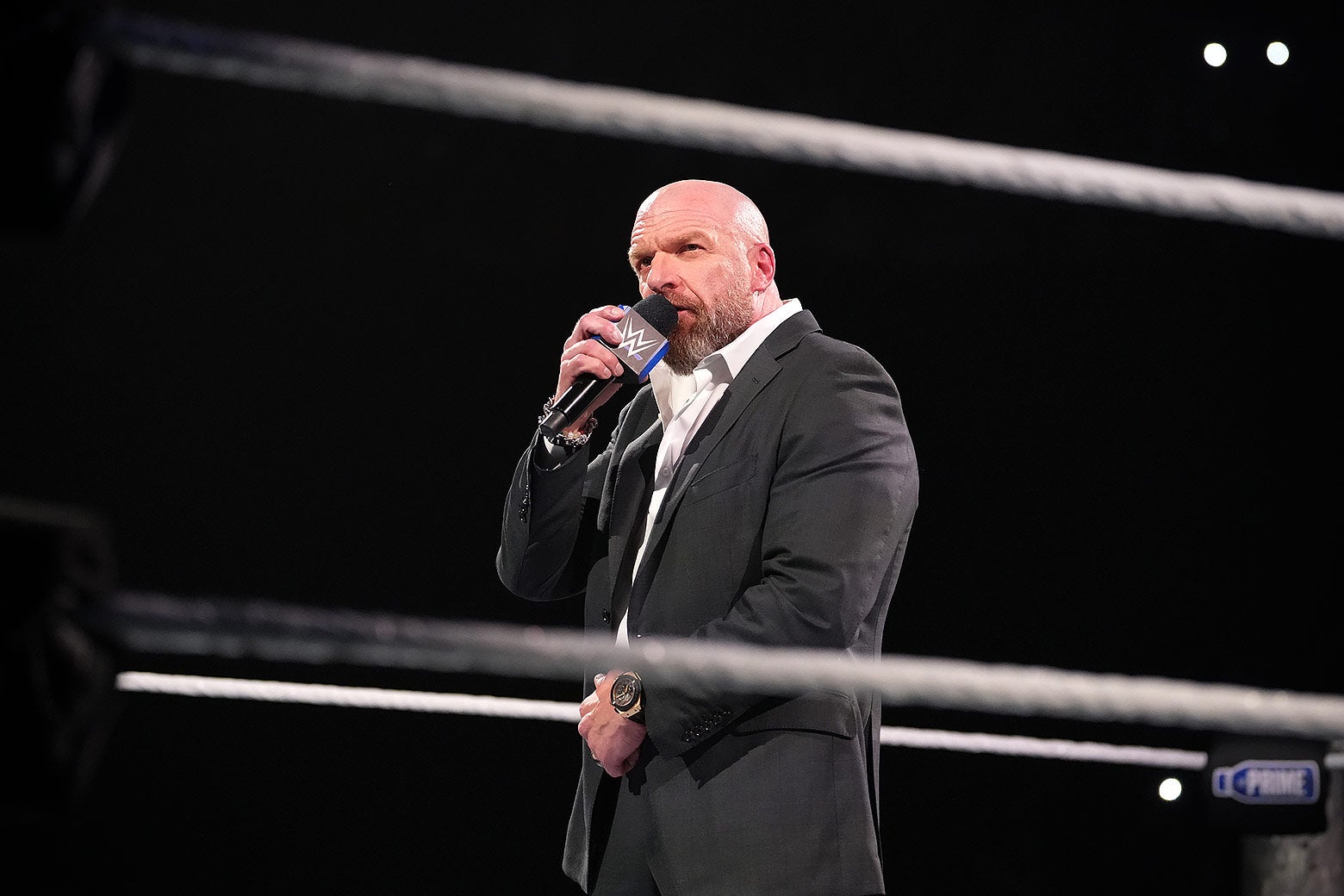
Last September, WWE’s chief content officer Paul “Triple H” Levesque appeared on a YouTube livestream to make an announcement. For the first time in its history, WrestleMania—the most prestigious franchise in the sport, equivalent to the industry’s Super Bowl—would not be emanating from the United States. Instead, WWE would be dispatching its roster to Riyadh, the capital of Saudi Arabia, as part of the country’s ongoing attempts to revamp its public image. “We could not be more excited for this opportunity,” said Levesque, flanked by a lieutenant of the Saudi royal court. Meanwhile, in the chatbox next to the video feed, apoplectic fans repeated one message ad nauseum: “YOU SOLD OUT.”
Where was the outrage coming from? Well, for one, Saudi Arabia is famous for its manifold human rights abuses and punitive modesty laws. WWE has run events in the country before, and they have a knack for leaving audiences feeling complicit in something dirty. Tomorrow, the company will be debasing itself again when the Royal Rumble—another one of promotion’s marquee shows—is broadcast live from Riyadh. A small handful of fans called to boycott the event entirely. It’s an understandable cause when you consider that when WWE’s women wrestlers perform in the country, they’re forced to don oversize T-shirts or latex catsuits to ensure no flesh is exposed to the public. But all of that is just a symptom of a larger disease. In 2023, WWE merged with Endeavor, the owners of UFC. The two companies formed a conglomerate called TKO Group Holdings, and longtime chairman Vince McMahon retired under significant controversy shortly afterward. Some wrestling fans hoped the changeover would be the start of a golden age, a return to WWE’s late-’90s renaissance. But TKO quickly made its intentions clear. Going forward, the WWE would be treated like an asset. And as it tends to go with these things, assets are subject to extraction—no matter how many wrestling enthusiasts are alienated in the process.
What is the most iconic trope in wrestling? I would argue that it’s a performer retrieving a flimsy table from under the ring so they may suplex another performer through it. Wrestlers have been effecting some version of this stunt for close to a century. There is even such a thing as a “tables match,” in which victory in the ring can only be achieved by shattering the furniture with a human body. So, naturally, one of the first mandates TKO instituted on WWE was to sell advertising space on those tables. Tune into an episode of Smackdown today, and you’ll see Slim Jim logos stickered to the wood. On air, announcers refer to them not as tables, but as “Slim Jim tables.” It makes you wonder if, as part of the deal, Slim Jim was guaranteed that at least one of its tables would be weaponized per broadcast. The WWE has committed far more grievous sins in its history, but this particular venture is symbolic of the company’s shift in priorities. TKO has made its directive clear. Every element of the WWE product can, and will, be financialized. There are no more sacred cows.
“If there’s blank space on-screen, TKO wants to monetize it. TKO’s business is to sell sponsorships,” said Dave Meltzer, longtime wrestling journalist, in a Wrestling Observer Radio podcast episode last year. “They’re trying to turn every frame of WWE content into an ad vehicle. If they could sell a sponsorship for the pyro, they would.”
Meltzer isn’t exaggerating. Those Slim Jim tables are just the tip of the iceberg. WWE’s wrestling mats are now crammed with logos for Snickers, Cricket Wireless, and Real American Beer. A “hydration station,” stocked with Prime energy drink, is propped up ringside. Meanwhile the center of the ring—where champions are wreathed with glory—is emblazoned with a Fortnite insignia. Even more audaciously, WWE has managed to fasten brand names onto the wrestling bouts themselves. In 2023, a few months before the TKO acquisition, two of the company’s brightest young stars, LA Knight and Bray Wyatt, performed in what was billed as a “Mountain Dew Pitch Black Match.” In practice, that meant the arena was shaded in purple light reminiscent of the umbral tint possessed by the limited-edition grape-flavored soda.
Ultimately, none of that matters much. Some extra advertising saturation—even if it’s especially pervasive—doesn’t impact the WWE fiction. Great wrestling can still occur between the commercials. But the most pernicious aspects of TKO’s monetization efforts aren’t as visible on-screen. Since the merger, ticket prices for WWE’s live events have skyrocketed. Wrestlenomics, an independent firm that analyzes the commercial trends in pro wrestling, discovered that, when adjusting for inflation, access to WWE’s shows cost almost double what it did in 2019. This is less an economic glitch than a deliberate campaign executed by TKO leadership. Speaking at a Goldman Sachs conference last September, TKO president Mark Shapiro said that WWE’s previous administration was preoccupied with “pricing tickets for families,” and “wasn’t totally concerned with maxing opportunity.” Shapiro later intimated that the prices for the company’s live events would likely continue to increase going forward. “We have our work to do there,” he said.
Fans have been understandably furious with the price hikes. (“Does WWE think we’re rich?” joked someone on X, after the company unveiled a preposterous $40,000 package for SummerSlam.) More surprisingly, some of WWE’s wrestlers themselves have expressed discomfort with the surging costs. Last year, a TikTok went viral where a gaggle of fans told Randy Orton—a legend of the industry—about the $30,000 they spent collectively to attend WrestleMania. Orton seemed to wince at the news.
“It’s embarrassing, to be honest,” he appeared to say. “So much fucking money for a seat.”
As for the events themselves, TKO hasn’t altered the formula too much. The company still employs some of the very best wrestlers in the world, and when they’re left to do their job, they can conjure magic between the ropes. However, at the same time, the company has begun to rely more heavily on miscellaneous YouTubers, all plucked from the manospheric ecosystem—in what appears to be an attempt to coalesce with the rightward drift in pop culture. (Relatedly, Triple H is now a member of Donald Trump’s Presidential Council on Sports, Fitness, and Nutrition.) Tony Hinchcliffe, of Kill Tony fame, has guested on the commentary desk, Logan Paul is an active competitor, and Andrew Schulz—the comedian who was central to Trump’s digital campaign strategy—is emerging as a prominent WWE character. Most recently he appeared on an episode of Raw to mix it up with Domink Mysterio, the reigning Intercontinental Champion.
Schulz, of course, is not a trained grappler, but I don’t think anyone would be especially surprised to see him brandishing a title belt in the near future. As world-renowned wrestler Kenny Omega put it last year in an interview with Adi Shankar, “I think we’re headed on a path where it’s like, a couple of WrestleManias down the road, the main event’s gonna be Logan Paul vs. Mr. Beast.”
WWE wasn’t always like this. In earlier eras, professional wrestling maintained a certain artifice, an in-universe consistency, where the feuds on-screen were treated with the faintest sense of competitive legitimacy. But in the 2020s, I’ve gotten the sense that the WWE is meant to be a static pop-cultural product—a blank canvas ready to be leveraged by the highest bidder. The wrestling itself is secondary, because frankly, the suspension of disbelief necessary to make the sport compelling takes a beating when the performers are grappling in service of a Mountain Dew activation. It makes you wonder how, exactly, this new ownership group understands the WWE. Is this still a legacy brand? Responsible for blissful childhood memories? A company infused with American mythology? The birthplace of Hulk Hogan, the Rock, and Stone Cold Steve Austin? Or has the WWE become just another revenue platform ensconced within a vast portfolio of other business interests? I think I already know the answer.
Of course, it needs to be reiterated that the WWE never possessed a reputation for equity. The company’s longtime chairman, Vince McMahon, was notoriously avaricious. His résumé speaks for itself. McMahon busted unionization efforts and presided over callous layoffs. It was he who initially orchestrated the partnership with Saudi Arabia back in 2018, and he who navigated the TKO merger. McMahon’s creative vision was also entwined with his own bad taste. He booked a lot of potty humor, a lot of tawdry sexuality, and a ton of racist caricatures. (One example: After the London bombings in 2005, WWE debuted an Islamic terrorist character played by an Italian American from Syracuse, New York.) And McMahon was also a monster in his personal life. His retirement was presaged by the Wall Street Journal reporting that McMahon had made $12 million in hush money payments to four women, one of whom accused the chairman of sex trafficking her. The wrestling industry desperately needed to be released from his grasp, and it was downright liberating when he finally disappeared.
But what I don’t think I realized is that McMahon also represented a fragment of American culture that is rapidly going extinct. The man lived and breathed professional wrestling, and that made him the last of a generation of promoters who can remember the industry’s wild early days. This was a sport conceived in carnivals and state fairs—the only goal was to put butts in seats, by any means necessary. McMahon followed that code dogmatically. The results could be genuinely absurd, in a way that TKO’s sterilized influence never seems to be. McMahon once wrestled a match against God himself, and he won. When the WWE faltered under his stewardship, as it often did, it was reflective of McMahon’s maniacal desire to entertain, with reckless abandon. But the industry has evolved beyond those singular figures who—for better or worse—became synonymous with the companies they built. We exist in the consolidation era, the boardroom era. WWE’s quirks and eccentricities have been paved over; the color has drained out of the building. And frankly, when I think about the way TKO’s brand of wrestling disappoints me, it always seems to be the result of bloodless corporate plundering. I know the flavor of mismanagement I prefer.
The real tragedy about all of this? The WWE can still put on a great show. Tomorrow’s Royal Rumble, despite the unsavoriness of the Saudi Arabia affiliation, is likely to be a barn burner. I am especially excited to watch Gunther, a behemoth Austrian with nimble feet and incredible strength, who is one of my very favorite wrestlers of all time. There’s a decent chance his match with A.J. Styles culminates with him tossing the man through a table, which will probably be inscribed with a Slim Jim logo. I guess the joke is on me.